
Among the several mentors to whom I owe my formation, Kobus Smit figures prominently, not only because he supervised my graduate research and writing, but perhaps more significantly because he introduced me during my undergraduate years to the scholarly disciplines of ethics and aesthetics, and to a vital Christian tradition of thinking within those disciplines. While there is little in my own thinking that is not somehow connected with what I learned directly from Professor Smit, or from the community of scholars and cultural activists to which he and his colleagues introduced me, two and a half decades of reflection persuade me that the most enduring gift I received from him is a certain understanding of what it means to be human.
At the centre of that understanding is the idea of responsibility. To be human is to be responsible. And this ability to respond is of a particular kind, because of that to which it responds: the love of God, expressed in God’s blessings and promises. To be human, then, I learned from Kobus Smit, is to be a creature who at the centre of my being exists in response, who lives as an answer, to the blessings and promises encompassed in the love of God.
This understanding of being human was expressed by André Troost, a teacher of Kobus Smit—and I guess, therefore, a kind of intellectual ancestor of mine—when he wrote in a 1967 essay in the journal Mededelingen, here quoted from Kobus Smit’s translation in the essay collection The Christian Ethos (Patmos, 1983) that God’s creating Word called humanity into existence, so that “Man answers God with his life, simply by living,” since “every facet, every sector of his life, is created out of God, through God, and for God. All life has an inner structural directedness to God.”
Troost continues later in his essay to write that “The deepest and most fundamental relation to God the origin creates and constitutes the whole responsive being of man. The concrete human responsibilities in the community . . . are in reality nowhere and never severed from the realm of creation, the all-encompassing life-answer which man gives to God. This answer-structure of man, created by God, gives a beginning, stimulus, and direction to human responsibility in concrete life . . . It is . . . impossible to concentrate the deeper unity of our responsibility in one term or expression. In actual faith we can express it simply by one word, namely Christ, in whom we have our life through the communion of the Holy Ghost. ‘Jesus, life of our life.'”
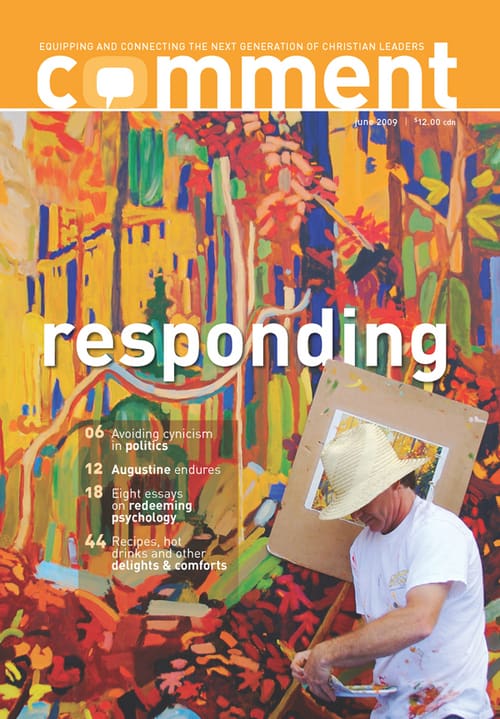
In this summer issue of Comment our writers explore a wide range of topics in the arts and the academy, business and technology, culture and politics, and everyday delights and comforts. But quietly underneath all of these explorations whispers the question: what is it to be human, to be responsible, in these various settings? And while the concrete answers vary along with the settings, the deepest answer that brings coherence to all our diverse concrete responses to circumstance remains that same one word.