

A moonlit sail on a warm summer evening is undeniably romantic. But it’s not why my wife and I took up sailing. In fact, it was for reasons other than romance.
Most marriages, even Christian ones, are based on romance, not calling. The priority is gazing into each other’s eyes more than walking side by side. Few young people make clarity and compatibility in calling a prerequisite for marriage. Roses and shiny things dominate. It is no wonder that so many marriages fail, since they are built on such a transient foundation.
In contrast, Richard Foster counsels, “The basis for getting married that conforms to the way of Christ is a regard for the wellbeing of others and ourselves and a regard for the advancement of the kingdom of God upon the earth … Christian marriage is far more than a private undertaking or a way to personal fulfillment. Christians contemplating marriage must consider the larger question of vocation and calling, the good of others, and the wellbeing of the community of faith, and most of all, how their marriage would advance or hinder the work of the kingdom of God.” Marriage, then, is ideally a partnership in purpose. And it is in the doing of it that friendship emerges and establishes the true basis for intimacy.
C.S. Lewis suggests that true friendship is built not by gazing into each other’s eyes, but walking side-by-side in a shared task. He writes, “Friends are not primarily absorbed in each other. It is when we are doing things together that friendship springs up—painting, sailing ships, praying, philosophizing, fighting shoulder to shoulder. Friends look in the same direction.”
 |
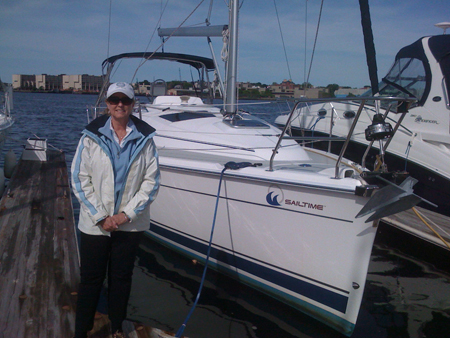
It was for this reason that my wife suggested that we take up sailing. We’re busy DINKs (dual income no kids). Work has us on the road a great deal of the time. We needed a shared leisure activity that fed our souls as well as our marriage. I had grown up sailing; Kathryn had not. So it was a big step for her to learn to sail a Hunter 33 in a very active Boston Harbor.
We couldn’t afford to buy a boat, but we were able to scrape together enough money to participate in fractional sailing through SailTime Boston. This allowed us to become ASA certified and have use of a Hunter 33 seven times per month. Our schedules didn’t allow for much more than this, so it was a perfect fit.
 |
Marriage demands intention—and this includes how one uses one’s leisure hours. Relationally, these are the most precious hours of our lives. When we got married we promised each other that we would become involved in each other’s leisure passions—alpine mountain climbing and search and rescue scuba diving.
Actually, it didn’t work out that way, and that is probably for the best. Neither were activities that we could build into our daily routine. Of this much we were certain: There would be no leisure-activity-widows or widowers under our roof. Whatever we did with our time would be a shared experience. We have both experienced the fragility of marriage and knew that little choices, such as how one spends one’s leisure time, can make or break a marriage.
Sailing fit perfectly. I’m sure there are other pursuits that do as well. We’re in our second season and have discovered six factors that make it what Kathryn had hoped—something we could do together that feeds our souls as well as strengthens our marriage.
- Contrast. Sailing is a radically different experience from our day-to-day work. It is a genuine break from the routine.
- Concentration. Sailing is a leisure activity, but not a passive one. Wind shifts, navigational aids, commercial traffic and right-of-way rules are constantly on our mind. One attends to the task at hand.
- Creation. Sailing places us squarely into God’s creation. Any body of water will do. Walden Pond was big enough for Thoreau. But there is something about the ocean that is unmatched, and the plethora of islands that dot the entrance to Boston Harbor are a sailor’s haven.
- Cooperation. Sailing can be done single-handedly, but its greatest joy is the teamwork it inspires from casting off to docking. There is nothing on the boat that Kathryn cannot do now as well as I can. We rotate tasks with ease; for a long time, she was better at docking, and always took the helm as we came back to our slip.
- Communal. Sailing, particularly on a boat as big as a Hunter 33, which sleeps six, can easily accommodate friends. It has been a joy to share our time on the water with others.
- Communication. Sailing gets us away from the distractions that keep us from talking at a deep level. Perhaps the greatest benefit of sailing is the long in-depth conversations that it fosters. There is no substitute for the space it affords and the sharing it inspires.
Our boat is named “Unity.” It’s a fitting name, for it has served that purpose. Dag Hammarskjöld, himself a sailor, captures the point in the phrase “the self-forgetfulness of concentrated attention.” Marriages need this kind of leisure. Here’s what Hammarskjöld wrote about his own experience of sailing:
With all the powers of your body concentrated in the hand on the tiller,
All the powers of your mind concentrated on the goal beyond the horizon,
You laugh as the salt spray catches your face in the second of rest
Before a new wave
Sharing the happy freedom of the moment with those who share your responsibility.
So—in the self-forgetfulness of concentrated attention—the door opens for you into a pure living intimacy,
A shared, timeless happiness,
Conveyed by a smile,
A wave of the hand.
Thanks to those who have taught me this.
Thanks to the days, which have taught me this.
There is something re-creational about sailing. Its fruit has been a greater friendship, and a sustained romance.