 |
“And you had nothing to say about it and yet made the nothing up into words.”
—The Lady, to Ransom, in Perelandra
My friend Peter, a therapist, likes to use the phrase “emotionally corrective experience.” I’m drawn to this concept, seeing as my childhood filled me with emotionally disturbing experiences that have left decades-long scars. For instance, I’ve always shied away from being out in nature with grown men; in my experience, that means proving yourself, whether with specialized knowledge or specialized gear. (In my case, guns.)
I went dove hunting once. I was around eleven years old, before I could do ten chin-ups, so holding a twelve-gauge shotgun steadily to my shoulder was laughable. Unfortunately, no one shared my sense of humor, so I had to try. I shot three times, and three times I missed. My friends didn’t miss, and their fathers didn’t miss, either. Enter twenty-three years of attendant anxiety regarding grown men in nature.
Recently, Peter asked me to go camping with him and a few guys. I said yes, not knowing that a bunch of well-educated, midwestern evangelicals would be so interested in shooting beer cans with a twelve-gauge. Cue anxiety, shame, peer pressure, and creative excuses. The creative excuses lost out to the peer pressure.
So there I found myself, a 34-year-old man in a water-filled-beer-can-skeet shooting contest with three brothers in Christ. I’ll spare you the drama: in the end, I’d somehow hit all four cans, and I’d clearly won the competition.
“You know what just happened?” Peter asked.
“An Easter miracle?” I wondered.
“That,” said Peter, “was an emotionally corrective experience.”
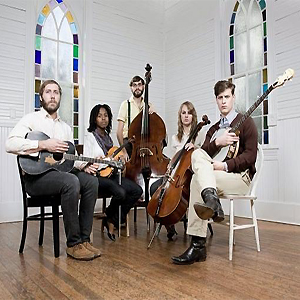
The band Balmorhea (pronounced bal-more-ay, named after a town of 500 in southwest Texas) has been, for me, an emotionally corrective musical experience. Anchored by Austin residents Michael Muller and Rob Lowe, Balmorhea has rotated instrumentalists over the years to produce three full-length albums. Those three albums are devoid of lyrics. This is instrumental music.
And that’s all I feel comfortable saying about it genre-wise. Others, as my research has turned up, have called the music “neoclassical;” “instrumental impressionism;” “exquisite if polite instrumental music;” “chamber rock music;” “classical grandeur [in] a comfortable folk base;” “instrumental music with folk, classical, jazz, and 20th-century classical aspirations;” “Texas post-rock;” “1980s acoustic new-age music . . . [with] an avant-garde edge.” They have dropped the following names: Max Richter, Arvo Part, Philip Glass, Stravinsky, Debussy, Keith Jarrett, the Takoma Records cartel, Steve Reich, Gustav Freytag, John Cage, Kronos Quartet and Ludovico Enaudi.
I know Arvo Part from the film Heaven and from the Welsh rap group Flow of Thought, who used a Part sample as a backing track. Because I’ve spent time at L’Abri, where instrumental/composed music is regularly played and discussed, I’m aware of Glass, Stravinsky, Debussy and Cage, but I have no idea who those other people are. I would say “classical” musicians, but I don’t know enough about what classical entails to know whether I’d be rightly applying it to the list.
So enter, stage right, my years-long anxiety and shame regarding instrumental music. A self-professing music lover, I’ve spent countless hours in all sorts of company discussing who knows how many different types of music. But when the subject of classical music has been raised, so, too, have my anxiety and my fear of being labeled a fraud. I own two CDs of classical music that I’ve listened to more than twice, and naming them has often been enough to buy me time either to change the subject or excuse myself.
As I’ve researched Balmorhea, I’ve come across phrases like “spatial phasing;” “countering intervals;” “triad-based romanticism;” “piano lines that drift downward in diagonal columns;” “atonal cello sustains;” “Tiersen-esque anthemism;” and, my favorite, “arpeggiated acoustic guitars set against a glissando violin.” I know that these terms mean something specific, and I trust that such knowledge could enable me to better appreciate the music. But to my music-theory-ignorant ears, those words might as well be clashing cymbals.
This anxiety, it seems, has a lot to do with words. The reason I don’t engage in conversations about classical music is that I know that my talking about it will expose me as ignorant, but since I am equally uncomfortable remaining silent, I’m liable to speak anyway and hope that I can con my way out of embarrassment.
Even as I write this, I recognize that I struggle with this dilemma in all areas of my life. Regardless of the situation, I want to be considered intelligent, well-read and thoughtful, and when I find myself in a situation where I don’t have the words to do so, my instinct is, again, to fake my way into conversational safety. Unfortunately, the main difference between the music to which I’ve always listened and instrumental music is the lack of words. When given any song with lyrics, even if I’m not able to talk about the aesthetic value of the composition or instrumentation, I can always discuss the lyrics and at least leave you thinking I have something worthwhile to say. Take those lyrics away, and I have nothing but babble and red herring.
Until now. Now I have Balmorhea. No lyrics, save the song titles, which, admittedly, can be helpful. But as I’ve listened to their discography over the last few months, I’ve begun to recognize narrative and emotional structure. And I can explain that to you via description. I can tell you how I respond emotionally to it; I can offer metaphor; I can talk about the way the cello and violin and banjo and guitar affect me, how they make me want to change something in my life.
In the end, even if understanding classical structure and terminology might make it easier for me to communicate my appreciation, there’s a chance that you won’t understand those things, either. Perhaps we don’t need specialized language. Perhaps, ultimately, our ability to communicate a musical experience doesn’t rely entirely on exact, certain words. I began thinking about this while reading David Dark’s book The Sacredness of Questioning Everything, in which he writes,
While we’re often rewarded in life for playing at absolute confidence, the pretense and the mind games are corrosive to the possibility of community, friendship and redeeming love. Imagine letting go of the psychic burden of certainty. Imagine backing down from our imagined infallibility and assuming the mantle of a mere human. Imagine the poetic/prophetic way of relating that would be possible. We might become capable of questioning ourselves out loud. We might let a little air in. In the most life-giving sense, we might get a little religion.
I don’t know whether Muller and Lowe, Balmorhea’s founding members, intend to give us a little religion, but they corroborate this idea. In a recent interview, each was asked what his dream magnum opus would sound like, and they answered thus:
Lowe: “Many many dreams, difficult for me to describe in words. Something that takes you somewhere that you don’t want to leave. Something that makes you want to change and cry and laugh.”
Muller: “Rob put it well. It would be a sound that made the listener (and musician) want to alter their life or live differently than they previously had. Like an alarm call. Wake up. You are alive.”
So I tell you, without anxiety or fear or shame, that I like the music of Balmorhea. It’s grand without being complicated. If this music were a place, the west Texas desert and hill country certainly fits. The up-tempo songs, with their occasional handclaps and lifting strings and furious pianos, embolden my spirit, making me long for thunderstorms and purging. The down-tempo songs remind me of my mortality, make me want to stop and consider what will last.
Some of the songs make me cry when I realize that the ugly ways I often use time and language don’t measure up to the goodness packed into six minutes of music. Some of the songs make me long for certain seasons. Sometimes the music takes too long to build; sometimes the tension is just right. Sometimes it feels like a hint of breeze in a humid summer; sometimes it feels like thunder.
Go listen to a song, and you’ll hear soothing finger-picked guitars and maybe piano and cello or upright bass, maybe a combination of them all. The best way I can describe some songs is that they let air in. In any case, I recommend Balmorhea to you, whether or not you need an emotionally corrective experience; whether or not you think the words “arpeggio” and “glissando” sound smart; whether or not you would call this paragraph coda, mancando, or some other word I’d have to look up.