

The classrooms in my elementary school—built in the 1920s, during what I consider to be a golden age of school design—were characterized by wood flooring, black slate chalkboards, much richly stained wood trim, and, along one wall, a rank of gigantic double-hung wood windows. Though functionally similar to the ones in our home, these windows were (or seemed) four times larger and took up an entire side wall of the classroom. Light poured through them throughout the day, raking streaks of light across the blackboard and giving the teacher fits with roller shades on those rare occasions when a film projector was brought in to show a movie. My education involved many other types of classrooms over the years, but as an architect, I am most fond of the rooms where my earliest schooling took place.
I am old enough to have practiced architecture during a literally dark age—a time when daylight was thought to be unnecessary, indeed contrary, to the goal of educating young people. We seem to have mostly emerged from that perceptual tunnel, but it is worth examining how we went into it in the first place, because the gradual removal of windows from school classrooms is itself a window into modern thinking.
 |
Architects and engineers have been carefully examining classroom lighting since at least the early 1900s, when the Illuminating Engineering Society began to publish “scientific” recommendations for classroom light levels. One might argue that the invention of the light meter eventually led to the elimination of windows in classrooms, as the ability to measure artificial illumination made it possible to standardize and engineer a lighting environment for instruction. Interestingly, the standard has changed substantially over time (moving higher at first, then gradually lower), suggesting that either our children’s eyesight is improving or we were overly generous with electric lighting in the early years of illumination design.
In any case, measurements and standards made school bureaucrats (and, sadly, architects) begin to question the academic purpose of daylight. Windows came to be seen as drafty, poorly insulated producers of “veiling glare,” and worst of all, a distraction from the instruction taking place at the front of the room (which it is, as any schoolboy will gratefully attest). It is a settled fact that windows—even very good ones—are less thermally efficient than walls, and educators (and their architects) began to wonder why windows were necessary in schoolrooms at all. The literature has an appalling lack of empirical studies connecting daylight to “learning outcomes.”
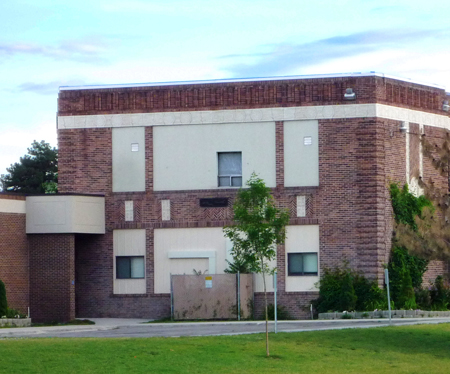
Coupled with a crippling fear of liability issues related to (of all things) stairs, and a formulaic reliance on absurdly generous land area requirements (standardized by professional organizations of both architects and educators), elementary schools in the last sixty years became sprawling one-storey affairs in which educators and designers felt free to create landlocked classrooms with no exterior walls and no windows. Even perimeter classrooms had window areas greatly reduced from the wall of windows in the “old school” model—partly for energy efficiency, and partly to downplay the difference between those classrooms with views to the wider world and those without.
I am guilty of having designed a few of these landlocked classrooms myself, though it never felt right to me. But in the face of energy efficiency demands and illumination standards that assumed daylight was unpredictable and inconsistent (which it is, to a degree), I had little ground to argue for the inclusion of the monstrous double-hung wood windows I remembered so fondly from my elementary school. On what grounds should schoolchildren be afforded views to the outside world when there are precious few minutes allotted for the mastery of important mathematical and language skills?
On the grounds, of course, that we are humans, and not robots. I am perfectly amenable to designing windowless classrooms for robots. Humans, however, need contact with the outside world, even as they attempt to master long division. Recent research has shown that access to daylight and views improves student performance, rather than diminishing it. But even if these studies showed no improvement at all, windowless classrooms would still be wrong. Even prisoners are afforded a sliver of daylight in their cells, and with good reason. Isolation from the natural world, from the movement of the sun through the sky and the change of seasons, is indeed cruel and inhuman punishment.
With a more enlightened approach to schoolroom design now in fashion, one might ask why windowless classrooms were ever thought to be a good idea. The answer, I believe, has to do with the part of human nature that is most difficult to measure: the soul.
There are no standard measures for the soulfulness of a place as yet (though, like a good coffee shop, we know it when we see it). The modern education program, like the “laboratory schools” (what a name!) conceived by education pioneer John Dewey, was a scientific program, focused on measurable inputs and measurable outputs. So the human soul and its needs were never on the checklist for classroom design.
Yet the soul is ultimately affected by things like daylight, but not in ways that we can easily measure. The soul responds, one way or another, to conditions like boredom, mechanization, needless uniformity, blandness and being treated like a laboratory animal. It rebels against these things; it longs to be free, to create. Hence the soul produces the two most common responses to classroom boredom: looking out the window and doodling. I would argue that both are natural and even necessary responses to the tedium of classroom instruction. Doodling is not an aberrant behaviour to be policed, but a sign of the innate creativity of the human spirit longing to break out of an instructional straitjacket.
Architect Greg Papay of Lake|Flato Architects served as design partner for the reconstruction of Francis Parker School in San Diego, California. “The school’s philosophy of education is such that the teachers aren’t freaked out if the kids are not looking directly ahead,” Papay told Architect magazine. The redesigned school is oriented around maximizing daylight and views, a welcome return to the more humane spirit that animated school design prior to World War II.
What is it about the view to the playground that makes a classroom humane? Daylight itself is healthful and salutary. The traverse of the sun through the sky is a hopeful (one might say covenantal) sign that one’s classroom “seat time” (as educators unironically refer to it) is not an eternal sentence to some existential waiting room where the train never arrives. The change of seasons affords the opportunity to see nature’s steady march from the decay of autumn to the bright promise of spring from the vantage point of one’s assigned seat. All these external conditions are hopeful signals to students that their imprisonment is temporary, that one grade leads to the next, and eventually to graduation, and that while long division may feel like the deadness of winter, the summer of freedom is destined to come.