


A friend once wrote a letter to me, saying how much better I’d turned out than she’d expected. Or so I thought. As I recall, the letter said, “In college we secretly voted you ‘Most Likely to Amount to Nothing in Life,’ and in reality you are functional and productive and often delightful. What a surprise!” Sometimes memories and minds play tricks on us, scooting as they do through well-worn neural pathways of long-remembered humiliations and fears, and what we remember isn’t exactly what was said. Probably my friend wrote something more like this: “You’ve matured nicely. I’m glad we’re still friends.”
That letter meant a lot to me, for there is something powerful about having people who know our life’s trajectory, appreciate our warp and woof, and have been privy to the bulk and tenor of our adult choices and consequences.
And I am rich to have fifteen such corroborators, including the letter writer. We call each other the “Wasabis,” a silly name for a group of women who bear witness to (and often change) each other’s lives as we gather each fall.
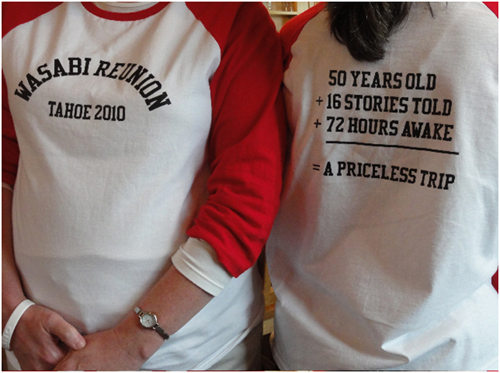 |
Sixteen of us lived together in both sides of a campus duplex our senior year in college, twenty-eight years ago. We enjoyed each other but hardly considered ourselves a unit (or if some did, I didn’t agree, uninitiated and generally disinterested as I was in the ways of female friendships). We were together doing Jane Fonda exercises on the floor, watching each other rush in and out from labs and dates, as we shared a launching pad into the real lives towards which we were hurtling.
We went our separate ways after graduation, some of us heading to the small town down the road and others heading to Sudan (and everywhere in between). We made choices as diverse as we were, as our lives developed in sixteen different ways.
And yet fifteen years after graduation we came back together for a reunion, setting in motion a powerful force, the original “us” reconvened and buttressed.
Now we see each other yearly, as many of us as can get there, with the “there” moving between vacation homes, rented camps, and urban hotels. We have a system for choosing location and time, and it begins anew each spring so we can gather in the fall. We pool resources to be sure all can come.
On the appointed weekend, from the time the last one arrives on Thursday or Friday until the first one leaves on Sunday, we sit in a circle with a single purpose: listening to what has happened in each other’s lives throughout the last year. Listening to hear, not listening to solve or fix. Just listening. We take breaks only for meal preparation, pouring coffee or wine, a long walk or hike each day, and a little sleep.
There’s power in our honesty and in our safety. There are opportunities for us to see both sides of an issue through each other as we skip the “How could someone think that?” in favour of the “Oh, I can see why you feel the way you do.” Maybe one woman has parenting challenges that help another imagine that her own mother did all she could; a rant on health-care annoyances is met with a doctor’s own perspective on her disappointment in her changing profession. Yet we don’t go out of our way to stir up the subjects on which we would disagree (and there are probably several). It’s not a place to be right; it’s a place to be loved.
Of course, individuals flip-flop year to year between feeling vulnerable and strong, admitting struggles and—even harder sometimes—admitting successes. Either is welcome. We’re insurance policies for each other as we realize that we are not alone and that we have a group of cheerleaders. There’s even “safety in numbers.” We take solace, only half joking, in the fact that we’ve already had our “one in eight” breast cancer statistics satisfied, with a couple of us having taken the bullet for the rest. And one woman said this year that her husband would never begrudge her the weekend with us for he knows that, amazingly, none of us are divorced, and he knows that his wife would be too cowardly to be the first one.
Similar as we are, we are actually quite diverse. When not gathered, we’re geographically spread out from California to Georgia, from Arizona to New York. We are Democrat and Republican, employed and at home, quiet and talkative, scientist and artist, doctor and patient. If we lived in the same town (none of us do), we might not even end up hanging out together. We are not each other’s daily comrades, carpool drivers, co-labourers for better communities, work colleagues, dinner party guests, or emergency contacts on our health forms. We don’t even stay in touch consistently between reunions; there might be a flurry of email traffic and then weeks of silence, though various dyads and triads do stay in regular touch. It’s all about the weekend together, the fact of Wasabi wisdom gathered. We are yearly witnesses to life, with a shared view of the glorious, big-picture transformation of each of us from girl to woman.
Part of the beauty of a yearly gathering—as opposed to doing life together day in and day out—is that there is enough distance to see growth. We are each other’s barometers and measuring sticks, seeing faintly scratched pencil marks on a collectively shared doorframe.
So we prioritize and scheme and plan so we can travel to be an assembled group, to hear about the year’s delights and agonies, the occasions of back-sliding or leap-frogging, the loved ones lost and found, the books read, the menopause tips, and the journey itself. We don’t miss it if we can help it. At an age when our memories and bodies are slipping ever so imperceptibly (or are in free-fall, depending on the day), there is power in collective recall, strength found through our peripatetic posse.
When a Wasabi tells me that she’s glad I’m thriving or that she hears the ache in what I’m not saying, I listen. Because she (any one of the fifteen) has done that rare thing that gives her the right to be heard and believed: she’s shown up year after year and listened to me. She knew me when I myself thought I’d amount to nothing and—thanks be to God—she still shows up, for me and for herself.
And when a Wasabi writes me a letter, you better believe it’s a keeper.