

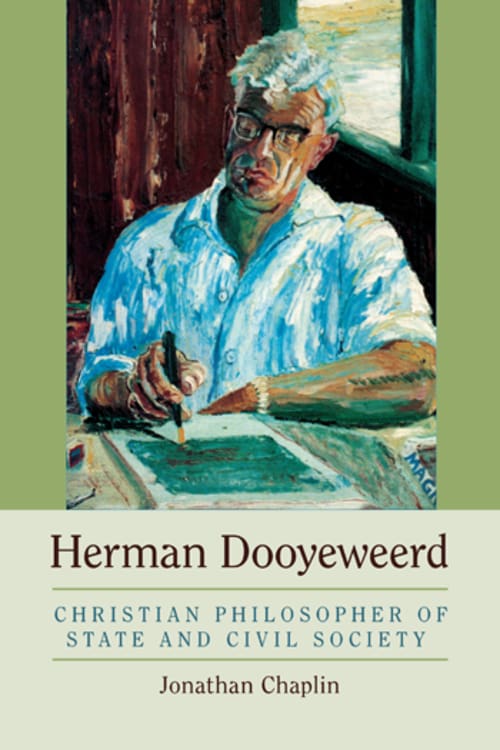
Comment asked two leading Christians who work in politics—Paul Brink, a theorist and Associate Professor of Political Science at Gordon College, and Ray Pennings, a practitioner and Director of Research at Cardus—to reflect on how Jonathan Chaplin’s new book Herman Dooyeweerd: Christian Philosopher of State and Civil Society (UND Press, 2011) might illuminate the work and theory of politics for this, and coming, generations. The week-long series began with Monday’s graphic introduction to Dooyeweerd, continued with “Dooyeweerd Comes to Zumi’s” on September 28, and concludes below.
—Editors
Finding Nuance in the Practice of Politics
Ray Pennings
Reading political theory is not my first love. I am more tempted by the political junkie tell-all, the behind-the-scenes gossip and sometimes ugly details of political tactics. Maybe that reflects my reality, as my career is more focused on the practice of public policy than the theory.
Besides, political practice is reductionist by nature. Election campaigns get reduced to slogans. Voters must decide whether to “throw the bums out” or vote for “experience that you can trust.” Do you want increased government programs, or lower taxes? When it comes to difficult questions, policy wonks may raise compelling arguments for several viewpoints, but the public dialogue gets reduced to the single binary choice. “All in favour? All opposed? Carried.” There’s only room for one X on the ballot. Nuanced theoretical positions don’t fit easily.
Twenty years ago this fall, I was a few weeks into a new job when my supervisor suggested that I would be aided by the writings of Herman Dooyeweerd. The first sentence I read was the sixty-two-worder that opens his 2200 page tome The New Critique of Theoretical Thought. I tripped over both “naive pre-theoretical experience” and “original indissoluble interrelation” and went to get my dictionary.
I wish Jonathan Chaplin’s recently published book had been available to me then. The functional appreciation of Dooyeweerd I have since managed would’ve come much more easily with Chaplin’s aid. It’s not that I recommend reviewing the fifteen modal dimensions as a decision-making template, but appreciating the distinctions between the social, economic, and juridical modes is surprisingly helpful. Our frameworks of understanding reality shape the prioritizing that is relevant to making good decisions.
For those Christians who are serious about engaging in public life, these modes are not simply utilitarian tools. They ultimately reflect our understanding of the world that God created and the reason he put us here. We must have a robust theology of creation if we are to make policy suggestions that will contribute to the healthy functioning of society. Things work better when we follow the structures put into place by the Creator—and this is true whether or not our society acknowledges God.
Making sense of reality and having a sense of how different parts of society fit together is essential for any political practitioner. But what makes this toolbox particularly useful is that these implements deal directly with some of the biggest political questions of our time. The hubris of most contemporary political engagement understands politics to be the father, the state the mother, and every government program a child worth doting over. Dooyeweerd helps us understand that not every public “child” has political parentage. When we spend too much time obsessed with any one modality, the solutions we come up with inevitably become the catalyst for new problems.
In our day, nearly every problem raised has a solution, advocated by at least a few, that begins, “Government should . . . ” We often have disputes over whether this is the remedy or the cause of the diminishment of other social institutions’ public roles. Government, with its leading norms of equality and human rights, has come to dominate and influence our understanding of all of society’s institutions.
Dooyeweerd’s modality toolbox provides a valuable counterbalance to these twentieth century Western notions, because it helps us understand that government is just one of the institutions that matter. It helps us understand how the public-private paradigm, which marginalizes belief, is problematic. It leads us to consider how public justice, rather than private power, gives us a paradigm in which we can maintain an idealism about public life, but also understand the sometimes-messy business which everyday politics brings.
Of course, I am not suggesting that Dooyeweerd provides all of the answers. I have serious questions about certain aspects of his philosophy, and so does Chaplin. In presenting Dooyeweerd as a “Christian philosopher of state and society,” Chaplin questions how certain democratic processes fit within the various spheres of society and relate to concepts of authority. Additionally, Dooyeweerd’s theories did not have the transformative impact we might expect, and Chaplin notes that the “lack of Augustinian bite in Dooyeweerd’s critical social analysis” may be part of the reason.
For an increasing number of people—particularly young people, if the polls are to be believed—the practice and import of politics is less significant today than it once was. That may reflect an increased emphasis on the public roles that other institutions can play in the quality of our shared life, so it is not necessarily as bad as it might first seem. However, if it reflects an individualistic mindset and apathy about what happens in the public square, that is cause for concern.
It’s not as if reading Dooyeweerd will, by itself, prompt a flourishing civil society to rise from the ruins of modernity. In fact, in our pluralistic, democratic context, we can expect various conceptions of the public good to compete for acceptance. Many of these rely on state coercion for their implementation, but Dooyeweerd uniquely places the debate not first within the sphere of government, but within civil society. His transcendental critique of philosophy insists that when we answer the question of the public good, we are making a religious argument. He would contend that a particularly Christian understanding of life and its purpose is what provides the space for the debate, and he would challenge the inconsistency of his so-called tolerant secularist opponents, encouraging them to be similarly honest and not use the myth of public neutrality as a cover for imposing their own points of view, with the aid of state power.
For those who care about these issues, who want to make sense of the social realities around them out of a desire to love God and their neighbour, Jonathan Chaplin’s introduction of the philosophy of Herman Dooyeweerd is a worthwhile time investment. The ideas presented and questions raised are complex and require reflection; this is not Dooyeweerd for dummies. We’ll see if anyone ever succeeds in translating Dooyeweerd into beach reading, but in the meantime, those who are serious about a different take on politics ought to be thinking about how to translate this theory into meaningful alternatives on the issues of the day.