


With its sky-high price point and often outlandish presentation, the world of high fashion has long been as out of range for most North Americans as obscure performance art or “off-off-Broadway theatre.” Outside of the Oscars and a possible visit to New York City’s Fifth Avenue, an absurdly upscale strip mall, couture isn’t something that many have reason to encounter in their daily lives. Couture is largely ignored, therefore, by all but the elite, especially as an art form.
But popular reality television shows such as Project Runway and America’s Next Top Model have come alongside the more plebian “makeover” genre (What Not To Wear) and certain fashion-obsessed dramas (Sex and the City, The Devil Wears Prada) to bring couture, if not within reach, at least within sight. Project Runway and its ilk permit viewers to peek into the process of making fashion, de-mystifying what the big names do before the models hit the catwalk, providing a crash-course in “designspeak,” and prompting audience discussion about favourite designers and garments—which gives license to be critics of a previously untouchable world. The fashion world has taken note, with Project Runway alums beginning to show work at high-fashion events such as New York Fashion Week.
 |
High fashion is undergoing a democratization of sorts, creating around high fashion what philosophers such as Walter Benjamin called the “aura” of art—the awe and buzz perpetuated by widespread experience with a work. Fashion democratization has increased understanding of couture as an art, and has broken through the perception of couture as a closet-filling hobby of the very rich. The recent “blog.mode: addressing fashion” exhibit at the Metropolitan Museum of Art’s Costume Institute (December 18, 2007 to April 13, 2008), sponsored by Manolo Blahnik, speaks to this simultaneous elevation and democratization of high fashion.
The exhibit’s introduction:
As a living art form, fashion is open to multiple readings. A vibrant reflection of contemporary culture, fashion—especially in its most avant-garde expressions—affects us through its intense visual impact. blog.mode: addressing fashion is the first in a series of shows designed to promote critical and creative dialogues about fashion.
There are forty exhibited pieces, all recent acquisitions by “the Met,” including clothing, accessories, and other wearable art. And “art,” it is. The curator is not exaggerating in declaring fashion to be a “living art form.” Upon entrance to the exhibit, the visitor is presented with a red Yohji Yamamoto avant-garde dress:
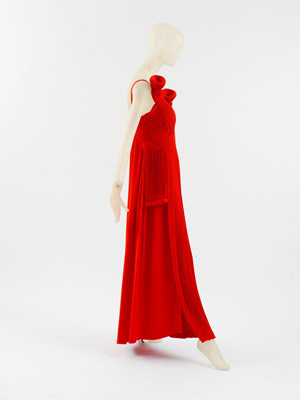 |
The dress is composed of tiny pleats that shape the garment in the way that tucks, seams, and darts traditionally do. The effect is at once evocative and ethereal, suggesting a scarlet sea creature or a stream of water cascading over a smooth stone. “Vibrant” is precisely the right word. This is clothing, and it can be worn, but it’s meant to be looked at and examined.
The exhibit’s pieces are theatrically lit, in a progression of high fashion from the 18th century to 2007: flowing gowns on rotating platforms, aberrant jewelry containing human fluids, top hats made of human hair, and shoes of both the impractical and snow boot varieties—each accompanied by a placard containing not only the name, creator, and date, but also a statement from the curator and often the designer to provide context for the piece and its place in design history. This additional explanation is unusual for artworks at the Met—most exhibits are content with a statement at the entrance and little more—and may speak to the public’s need to connect with the work from the perspective of the maker.
What is most interesting about blog.mode is the “blog bar” located in the center of the exhibit. As indicated by the title of the exhibit, blog.mode has maintained a blog, updated regularly with an image of one of the garments in the exhibit and its accompanying text. Blog visitors can comment on the piece, ideally engaging in the “critical and creative dialogues about fashion” the Met wishes to encourage. Visitors to the exhibit can update the blog without leaving the exhibit, providing immediate feedback both for those who aren’t able to visit the exhibit in person and, one suspects, for the museum staff. blog.mode is a bold move for the Met—long a bastion of conservative, high art culture—and it speaks of two cultural phenomena: the ability, via the internet, for everyone to voice an opinion and act as a critic; and the recognition of couture as an accessible art form—one that the visitor not only can observe and consider visually, but could theoretically wear.
As reality television continues to explore the arts—gourmet cooking and filmmaking have made an appearance, and there are rumors of fine art-oriented shows on deck—it seems possible and even likely that museums such as the Met will recognize the opportunity to attract new audiences and provide them the ability to interact with exhibits in new ways. Fashion may be act as the gateway to all that is art.