

The sky is falling, and taking our food supply with it—or so the news tells us. On June 10, 2008, the New York Times reported that the worldwide wheat harvest was suffering, both from too much rain in Kansas and a drought in Australia. Two weeks later, six percent of the Kansas wheat harvest had been harvested, as opposed to the thirty-six percent normally brought in by June.
Even when the harvest was abundant, you may not have wanted to eat it. If you lived in the American southwest this June, you probably avoided tomatoes; thirty-six states reported over 810 salmonella cases, and many restaurants around the country pulled tomatoes from the menu until the culprit could be identified.
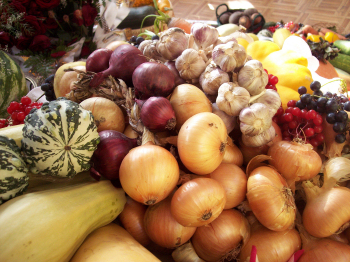
I, on the other hand, happily ate tomatoes throughout the last month, usually with some salt, pepper, spinach, and fresh mozzarella cheese, without fear of salmonella. Do I enjoy living dangerously on the edge, perilously tempting fate? Not usually. I just know where my tomatoes come from, because I buy my produce locally.
 |
I was brought up in household where we participated in community-supported agriculture (CSA) and frequented local farms to buy our Christmas turkeys and beef for our burgers. Judging by the now-trendy nature of these practices, we were ahead of the times. Today, many neighbourhoods in my metropolitan hometown support a CSA farm and host farmers’ markets on the weekends, and many of the restaurants I frequent base their brunch menus on whatever the chef bought at the market that morning. In this way they avoid some of the problems associated with the globalization of the food industry. They provide income to local farms, fisheries, and dairies; and they foster a sense of community among the neighbourhood residents and the farm.
The benefits of buying local food are well documented, and it’s heartening to see communities trending toward support of local agricultural producers. But simply buying local and then thoughtlessly wolfing it down isn’t enough. I’m coming to understand that our conscious food buying practices must be accompanied by conscious food consumption practices, both as an acknowledgement of God’s grace and provision and a way to preserve the culture that has developed around us.
One international organization that has sprung up around this need for safe, local, fresh food and conscious consumption is the cleverly named Slow Food. Begun in Italy in the 1980s, Slow Food’s mission, according to their American website, is to promote the ideas that “the food we eat should taste good; that it should be produced in a clean way that does not harm the environment, animal welfare or our health; and that food producers should receive fair compensation for their work.” The organization’s name is a reaction to “fast food” and the loss of health benefits, a global homogenization or “flattening” of taste, and the increasingly prevalent loss of regional cuisine.
Slow Food claims 85,000 members worldwide, divided into 1,000 convivia, or chapters, which meet together regularly to visit local farms and learn from guest speakers. The Slow Food movement has even spawned the Slow Cities movement, which strives to improve the quality of life for city-dwellers worldwide by advocating non-vehicular forms of transportation when possible and preserving the distinct characteristics and culture of the town. The movement also spawned the Foundation for Biodiversity, which supports artisanal producers of quality products that are at risk of disappearing from the table through their “Ark” project, a sort of home for endangered food products and traditions. They use their financial resources to support and provide for quality food production in less developed countries.
Advocates of the Slow Food movement call for a move away from mindless refueling at the local fast-food joint (or even a convenient eatery) and a return to eating communally with family and friends, focusing on gathering food locally and becoming a partner with farmers in their production. Slow Food encourages its members to act as “co-producers, not consumers, because by being informed about how our food is produced and actively supporting those who produce it, we become a part of and a partner in the production process.”
Some might contend that these food goals are overly idealistic and not economically viable. After all, the globalization of our economy has been prompted, in part, by a quest for the highest profit. However, in the face of an ailing global food supply, buying locally and consuming consciously allow us to conserve the world’s resources. The “Slow” movements’ emphases on local culture are the result, not of xenophobia, but of a desire born of a cosmopolitan ideal to preserve the rich history, tradition, and diversity inherent in human cultures.
For the Christian, the “Slow” movements call us to rest from our labors and re-discover the joys of sharing conversation and fellowship around a table prepared with care and love. It is a call to literally love our neighbours and value their contributions to the quality of life in the place in which we serve God. Although this more conscious form of consumption may cost us a little more time and money, the results just may help us avoid a world of homogeneity and depletion.