
Let me start with an aside: with the eclipse of religion in the West, the art museum has replaced the cathedral as the building type with the greatest architectural, social, and spiritual significance in a community. One could cite many facts to support this claim, but only one is needed: the commissions sought by and awarded to the most highly regarded architects in our day. Nine out of ten are for museums.
Having acknowledged that, let me point out that museum building projects today suffer from an all-too-common problem. Accepting a high-profile design from a “signature” architect, museums often both lose the ability to display art and give up the integrity of their original buildings.
A case in point is the unfortunate Michael Lee-Chin Crystal, the name given to Daniel Libeskind’s addition to the Royal Ontario Museum (the ROM) in Toronto. My first exposure to this project was several years ago in a quest for images of unprovoked hostility on the part of modern architecture toward traditional buildings. Libeskind’s ROM project which had not yet begun construction was a perfect illustration of the point I was trying to make.
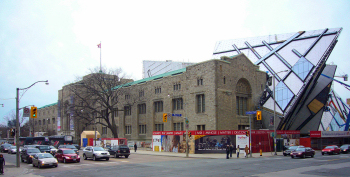 |
As I saw the project nearly complete last year in Toronto, I was impressed at how well the hostility of the design had negotiated the often torturous process of documentation and construction. The Michael Lee-Chin Crystal is every bit as antagonistic toward its host as the viral model on which it must surely be based.
Described simply, the Crystal is a jarring collection of metal and glass shards which appears to have been thrown from a very great distance and landed on the north end of the Royal Ontario Museum. Reports are that the design of the interior is consistent with this approach.
While the cognoscenti ooh and aah over this latest edition of the emperor’s new clothes, average citizens ask more pertinent questions: What is this thing?! How did this happen?! Who thought this was a good idea?! The answers to these questions follow a dark thread back through Freud and Nietzsche all the way to the birth of the Modern era. But the more proximate answer is that this is what you get when you hire Daniel Libeskind.
The personally charming and engaging designer can hardly be accused of concealing his intentions. His first significant building, the Jewish Museum Berlin, is similarly unwelcoming. Critics hailed it as a revelation when it opened, sans exhibits, in 2001. More recently, the Denver Museum of Art opened the Libeskind-designed Frederic C. Hamilton Building, a free-standing building as angular and vertiginous as the Crystal. Also hailed by critics, visitors have found the building off-putting and very unfriendly to art (there is scarcely a vertical wall in the building, save in the washrooms), though one feels obliged to remark on its crystalline beauty under the bright Denver sun.
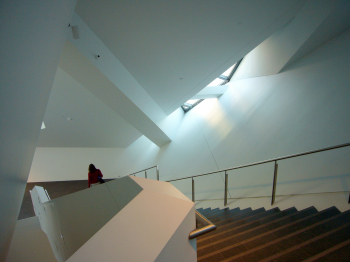 |
So it could not have surprised the ROM trustees that the Michael Lee-Chin Crystal was, well, crystalline, that its interiors cause feelings of disorientation and vertigo, and that it really adds very little usable space to the museum. The only surprising thing is how many times Mr. Libeskind can repeat this trick before even museum boards in the thrall of critics and promoters realize that the emperor has no clothes.
A parallel can be drawn between the ROM addition and another new building that opened in 2007, the Bloch Building at the Nelson Atkins Museum of Art in Kansas City. Designed by another acclaimed architect, Stephen Holl, the Bloch project is much more polite to its neoclassical predecessor. The new galleries are almost entirely underground, but are lit by natural light from several “lanterns,” building-sized objects which project up from the long sloping lawn which defines the Nelson’s site. The lanterns are underwhelming by day, clad in glass channels which to the uninitiated look like metal panels used on industrial buildings, but at night they glow white from within, creating a parade of asymmetrical specters dancing on the lawn of the old museum.
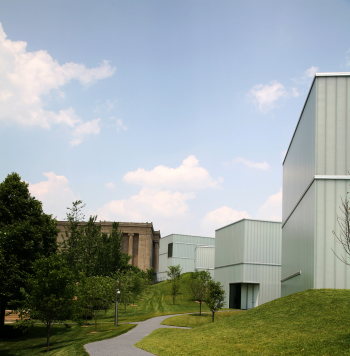 |
Moreover, the galleries of the Bloch Building actually work. Although exceedingly spare, they both display and illuminate the Nelson’s impressive collections of contemporary art to great advantage. Whether they will work as well for Old Masters as the classical galleries in the older building remains to be seen—perhaps they don’t need to.
But having seen both additions in the space of a year, along with the Hamilton building in Denver, I can say without hesitation that Holl’s is the better project. Despite its assertive modernity, it defers graciously to the classical building with which it shares a site, never confronting, but only gently addressing the east façade of the older building. The Michael Lee-Chin Crystal, on the other hand, looks—I’m sorry to say—like a cancer.
Is anything to be done about this attack on the frowsy traditional building that used to house the ROM? The investment in the Crystal is too great, and the pride of accomplishment too recent, to suggest demolition as a preferred option. Perhaps the best advice I can give is the advice Fidel Castro gave to his guerilla army in Cuba in the 1950s: “Capture the transmitters.” Because until the critics, and the journals, and the museums themselves stop hailing Libeskind as a genius, more classical buildings are likely to be assaulted in a manner similar to what has happened in Toronto. And neither Toronto, nor our culture, is the better for it.