

Comment Home / Reviews & Opinions

Editorial: What is to be done?

Gideon Strauss writes about the need for manifestoes and strategic explorations in an editorial on the next few months' theme for Comment Online.

The phrase that will serve as Comment's theme for the next couple of months—What is to be done?—derives its fame from V.I. Lenin's 1902 manifesto of the same title. The title is not original to Lenin. He borrowed it from the 1863 materialist utopian novel of Nikolai Chernyshevsky, a book that had a transformative effect on Russian perceptions of the peasantry.

We are not picking up this theme because we are enamored of the use to which either Chernyshevsky or Lenin put the phrase. Chernyshevsky's propagandistic novel is marred not only by a fundamental misunderstanding of the nature of reality and of the human person, but also by his almost complete lack of imagination and writerly skill. Lenin is not only misguided in the grandest possible sense by the theory of Karl Marx, but in particular argues blatantly for the use of terrorism.

Instead, we are picking up the theme because it has for the past hundred-and-a-bit years come to signify the importance of not only having a grand social vision, but also a practicable strategy. As Lenin wrote in "Where to Begin?" (the newspaper article anticipating his What is to be done?):

It is not a question of what path we must choose (as was the case in the late eighties and early nineties), but of what practical steps we must take upon the known path and how they shall be taken. It is a question of a system and plan of practical work.

Neocalvinism offers Christian cultural activists an historically insightful architectonic critique of the society in which we live, and an adequate social vision for bringing hope and substantial healing to society. But we must admit that at the moment Christian social action lacks a coherent strategy, a sense of movement. We may have some effective tactics for particular situations, we have a number of historical examples that we can study for their strategic successes and failures, but we do not share a strategy that will weave our efforts together across the boundaries of the various spheres in which we are active into a coherent movement. We do not know what is to be done.

Manifestoes and strategic documents are important, in that they focus our attention and our efforts. With varying degrees of success, for example, the communist manifesto, the futurist manifesto, and Francis Schaeffer's Christian manifesto drew people together toward a shared vision and into a shared strategy.

What we hope to offer in Comment Online during the next couple of months can be considered drafts of a manifesto, each oriented to a particular sphere of human endeavour, encouragements toward the beginnings of a discussion of the strategic question.


Help us spread the word:
| More
Gideon Strauss Gideon Strauss
Gideon Strauss is president of the Max De Pree Center for Leadership in California. ... read more »

Posted in Journalism.

Subscribe to our Cardus Monthly Newsletter
A concise digest of upcoming events, recent publications, and major policy updates & developments.
  • Stay up-to-date and informed
  • Only one concise digest email per month
  • We will never share your email address. No Spam!
We will never sell or rent your email address. Your privacy is important to us

Related Articles

Add Your Comments


Copyright © 1974-2013 Cardus. All Rights Reserved.

This Article Belongs To ...

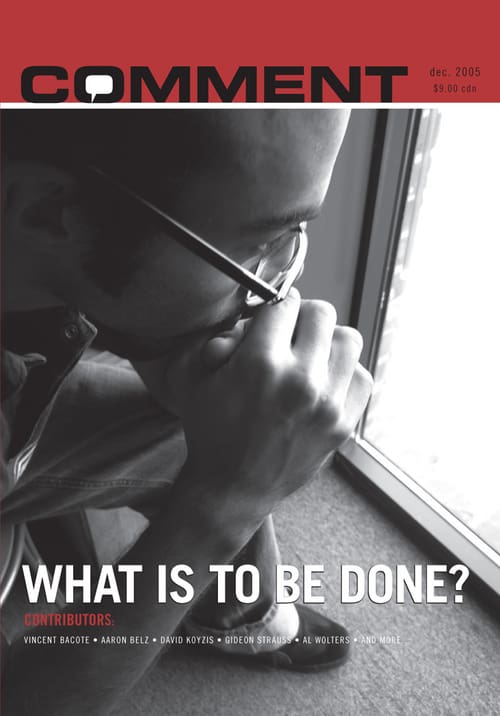
  1. December 2005: What is to be done?
    Comment Magazine - What is to be done?

    What we are offering in this print issue of Comment are notes toward a Christian social manifesto, encouragements toward the beginnings of a discussion of the strategic question. As will become evident from some of our articles, we are not pretending here to provide a comprehensive prescription for Christian cultural engagement. This is not a marxist-leninist tract, replete with misguided utopian hubris. It is, however, a collection of serious efforts to determine what our responsibilities are in this time, given our deepest commitments and the spirit of the times.

Buy this issue »

Feature Essays

  1. Renewing Social Architecture by Building Bridges

    May 3, 2013 | Graham Scharf

    A community in which diverse organizations share a common agenda, continually communicate, share data, and employ shared measurement systems is extraordinarily rare. In fact, I'...

Reviews & Opinions

  1. Activism, Justice, and Longing for Shalom

    May 17, 2013 | Tyler Wigg-Stevenson

    I care about justice; must I be an activist?
  2. Responsible Activism and Social Change

    May 10, 2013 | Tyler Wigg-Stevenson with James K.A. Smith

    If it's up to this generation to save the world, what will happen to our faith lives if there's still saving to be done when we're finished with it?

Cardus Blog

  1. More is Not Enough

    May 23, 2013 | Brian Dijkema

    More is not enough, and it never will be. This is both a true description of the way markets work, and why those who are concerned about morality in economic behaviour and struc...
  2. When Democracy Loses its Moral Authority

    May 22, 2013 | Ray Pennings

    "Hard to believe Obama's claims of ignorance in IRS Scandal"—May 20, 2013 Fox News headline. "Harper government had to know $90,000 payment to senator crossed all sorts of...

Print Issue

  1. March 2013: Persuasion
    Comment Magazine - Persuasion In a fragmented world, what we get is not persuasion, but posturing, pronouncements, and political ultimatums. In other words, we get just the sort of public discourse we deserv...