

When I was last in my husband’s hometown of Mackenzie, I visited Beth. She pulled at my clothes and gazed at my aubergine eyeglasses. All the while her hair getting caught in the chandelier earrings I’d worn for Christmas.
Beth didn’t notice the letters on the periphery of my glasses: P-R-A-D-A, and she made no inquiry about who designed my bohemian frock. She didn’t even ask where I found the earrings she’d been admiring all day long. But, then, Beth is only five.
Beth hasn’t yet discovered the allure of high fashion. All too soon she will. Our culture will make sure of it.
Whether we like it or not, fashion rules our lives. We are all clothes horses. Every morning we rise, shower, and dress. Even if we don’t have designer labels like Manolo Blahnik and Vivienne Westwood, our closets are filled with Levi’s, Banana Republic, and American Apparel. We step out the door and the aesthetic judgments begin.
As Calvin Seerveld writes in Rainbows for the fallen world, “Culture [to a Christian] is not optional.” So clothes and the multi-billion dollar fashion industry, under a biblical lens, demand our attention.
Since the moment Adam and Eve nibbled that succulent pomme, fashion became our problem, or our possibility depending on how you look at it. For the Canadian fashion designer Paul Hardy there’s never been anything but possibility.
 |
The Calgary-born couturier who has dressed the likes of Alanis Morissette and Bette Midler is a committed believer in Jesus Christ and is less than shy about his personal faith. Hardy’s collections have ranged from the silent to the operatic with themes ranging from Mary Poppins to the biblical story of the woman at the well. A 2006 Fashion Television feature on Hardy shows him praying aloud to a personal God, mere hours before a blockbuster fashion show in the heart of downtown Toronto.
We’ve heard of missionaries to foreign lands, urban centres, and remote reserves. We’ve even heard of cultural missionaries engaging the moral divide. Yet have you ever heard of a missionary to New York Fashion Week?
I recently spoke with Paul Hardy about his life among our fashion elite.
Christina Crook: Why fashion? What first drew you to this work?
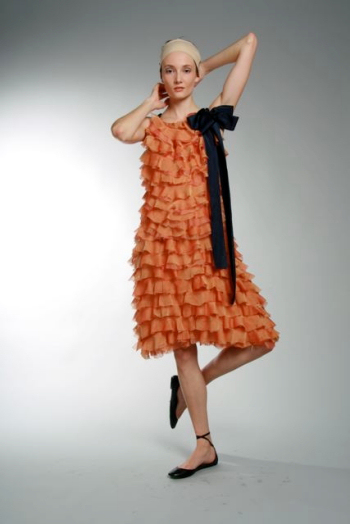
Paul Hardy: I always felt called to it. Since the age of three I was telling my mom I wanted to sew. Many of my friends graduated university not knowing what they wanted to do; I have always felt blessed with the opportunity of knowing. Initially I wanted to be a breadwinner for missions and charities, but quickly discovered this industry is a lot of smoke and mirrors. High public profile does not mean financial success. Three years into designing I decided that if I’m not making money then it’s about having a voice. That’s where the power is.
 |
Christina Crook: What is it like to be a Christian in this industry? You’ve been quoted saying, “I’m of an embattled minority.”
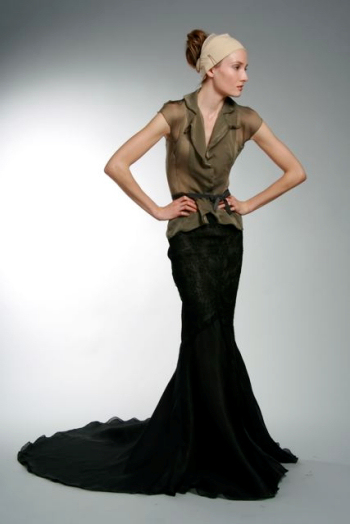
Paul Hardy: There aren’t very many people who share my viewpoint. I think my credibility comes from the consistency with which I’ve modelled my professed beliefs. My first four seasons were biblical references, but I have since explored more mainstream storylines. Each season is a reflection on what God is teaching me. One season I used Edgar Allan Poe‘s fear of death as a symbolic reference for the fears which bind us all. That show was a turning point. I decided to turn the tables and invite the media into my world—to a cathedral. It’s been said that I’m the only person who could get fashionistas out to church on a Friday night!
 |
Christina Crook: In the recent book, The Year of Living Biblically, author A. J. Jacobs found that wearing white robes made him feel pure and even holy. Do you think clothes shape us, or vice versa?
Paul Hardy: It can go either way. In fashion, as in any other creative field, imagination can be used as an expression of edification or can prey on the insecurities of others. I’ve always thought that on its own, designing clothes is pretty trivial, but a friend reminded me years ago that from a biblical perspective fashion designers were like the first priests. God anointed the artisans in the tabernacle with a unique wisdom to create the first priestly garments: “You shall speak to all the skillful, whom I have filled with a spirit of skill, that they make Aaron’s garments to consecrate him for my priesthood” (Exodus 28:3).