 |
I recently delivered a eulogy. My hope, as I wrote it, was that I would simultaneously be sensitive to those who wanted only to cry, not hear a lecture, and be truthful about the situation. For some of those listening, a call to grief is exactly what was needed. For me, then, the eulogist, my job was to speak faithfully about reality, especially the reality of the heart: anger, despair, hope, sorrow, shame. I urged them to accurately name their emotions. I urged them to grieve.
Afterward, a man approached me and said, “Thank you for cutting through all the rainbow bull****.”
I was touched. “You’re welcome,” I said. I’d spoken truly, I think, about one aspect of reality, and he responded with gratitude—something good had occurred.
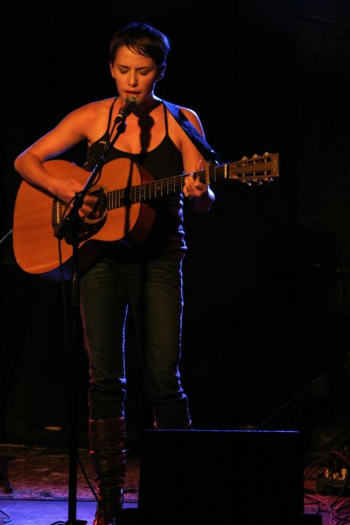
Kelley McRae, an artist living in Brooklyn, made her CD debut in 2006 with the album Never Be. The song “Johnny Cash,” especially, put her on the map—the Lower Manhattan bar and nightclub map. With her forthcoming release, Highrises in Brooklyn, she deserves more longitude: at least three more time zones.
This is an album that should be all over the map. Not because Kelley arrived in Brooklyn by way of Baltimore, Dallas, and Starkville, Mississippi, but because she, like me and you and everyone I know, makes a daily commute through joy, despair, gratitude, doubt, hope, fear, shame, and the rest. Big cities like New York, in my experience, have a way of uprooting us existentially and daring us to call them home. The city asks a lot of us. The most sustainable answer is emotional honesty. In many ways, Highrises in Brooklyn is Kelley’s answer to that call. She chides Brooklyn’s highrises, confesses co-dependence on late-night bars and diners, both rues and needs the BQE—the Brooklyn-Queens Expressway. Textually, she reminds me of Jonathan Safran Foer’s Extremely Loud and Incredibly Close, in its own way a response to the boroughs. With her focus on the tiny individual, alone, in an overwhelming environment, she evokes Miranda July, with fewer neuroses and more compassion.
Another reason she’s all over the map is that she lists as influences James Baldwin, Nina Simone, Betty Smith, Lucinda Williams, Anne Lamott, Johnny Cash, Cormac McCarthy, Otis Redding, Gabriel Garcia Marquez, Patty Griffin, Marilynne Robinson, and Joni Mitchell. “None of them,” she says, “is afraid of the darkness that’s here.” For her, these are people who “just dare you not to believe them.” Kelley believes them and, in turn, dares herself. I asked Kelley, a former visual artist and stage actress, why she turned to song. She replied, “I found that I was much better at singing what I meant than saying what I meant.” I buy that. And I’m willing to follow where she takes me sonically, whether it’s electronica (banjo and synthesized hand claps), gospel and blues (piano, choir, and saloon!), folk (I swear I hear Over the Rhine in there at times), synthesized pop, harmonies, and swaying rhythms (I faintly detect Mates of State), or simple, beautiful Americana. Some best speak truth in fiction, some at the graveside, some by acts of hospitality, and some, like Kelley, through song.
 |
What I like best about this CD, though, is that it’s aurally romantic—smooth, adapting, beckoning vocals—without being ideologically romantic. I react strongly to that combination; it speaks faithfully to reality. There is proper longing, proper despair. I feel shame and I have reason for gratitude. Some days, as she sings, “I feel like a sparrow sold for a penny or two,” or “like a burden to everyone I know,” and some days I rejoice in a spiritual reality by chiding the world, “You cannot have my heart, you cannot have my home.” One minute a Psalm of Ascent, another of Lament.
Yet for all that transparency, Kelley refuses to bow to a “literary egoism” that, as the French critic Ferdinand Brunetière labelled Romantic art, elevated individuality at the expense of a larger world. Instead, by pairing sound with emotion, by faithfully naming, through song, a heart that often looks like a NYC transit map, she elevates life over art. Her music is a conduit, an individual voice speaking truthfully about reality. Her voice is soft enough to call me, but hard enough to cut through the rainbow bullcrap. She speaks truly. I’m grateful. Highrises in Brooklyn is something good.