

Introduction
Euthanasia and assisted suicide were legalized in Canada in 2016 under the term “medical assistance in dying” (MAiD), and the legislation was expanded in 2021. Canada’s program has drawn international attention and concern, particularly due to its high uptake: 1 in 20 deaths as of 2024. 1 1 In 2024, 5.1% of total deaths in Canada were MAiD deaths, as per Health Canada, Sixth Annual Report, 11. For examples of international media coverage, see: Yousif, “Assisted Dying,” BBC; “Canada’s Rate,” The Guardian; Moniuszko, “Medically-Assisted Dying in Canada,” CBS News. Complete citations are provided for all sources at the end of this report. To better understand Canada’s MAiD program and possible ways to strengthen safeguards and limits, this brief is the first in a series that compares the parameters of MAiD in Canada with those of other countries in which some form of assisted dying is legal.
This first brief focuses on eligibility criteria: who can receive an assisted death, and for what reasons. In this brief we examine:
- Age criteria
- Suffering criteria
- terminal prognosis
- non-terminal suffering
- psychiatric suffering as a sole underlying condition
This comparison is presented through a series of tables, accompanied by discussion. We find that Canada’s program is much more permissive than those of Australia, New Zealand, and the United States. Eligibility criteria in Canada are similar to that of Spain and the Benelux countries (Belgium, Netherlands, and Luxembourg). Canada’s criteria relating to suffering is, however, more subjective than in Belgium or the Netherlands: in those countries, a physician’s agreement on a lack of reasonable alternatives is required.
Official governmental sources, including government websites, annual reports, legislation, and court cases were used for determining the legal parameters of assisted dying in a given country. Secondary sources, such as scholarly articles, were used to confirm this determination. Where official documents were not available in either English or French, translations were used and additional secondary sources were examined. 2 2 Where translations were not available, Google Translate was used. This process was more difficult in the cases of Uruguay, where assisted dying has only become available recently, and relevant peer-reviewed sources published in English were not found.
This brief relies on the legislation and policies as written, which does not tell us how the criteria and safeguards are functioning in practice. When possible, we refer to academic studies that provide such assessments.
Two Modes of Assisted Dying
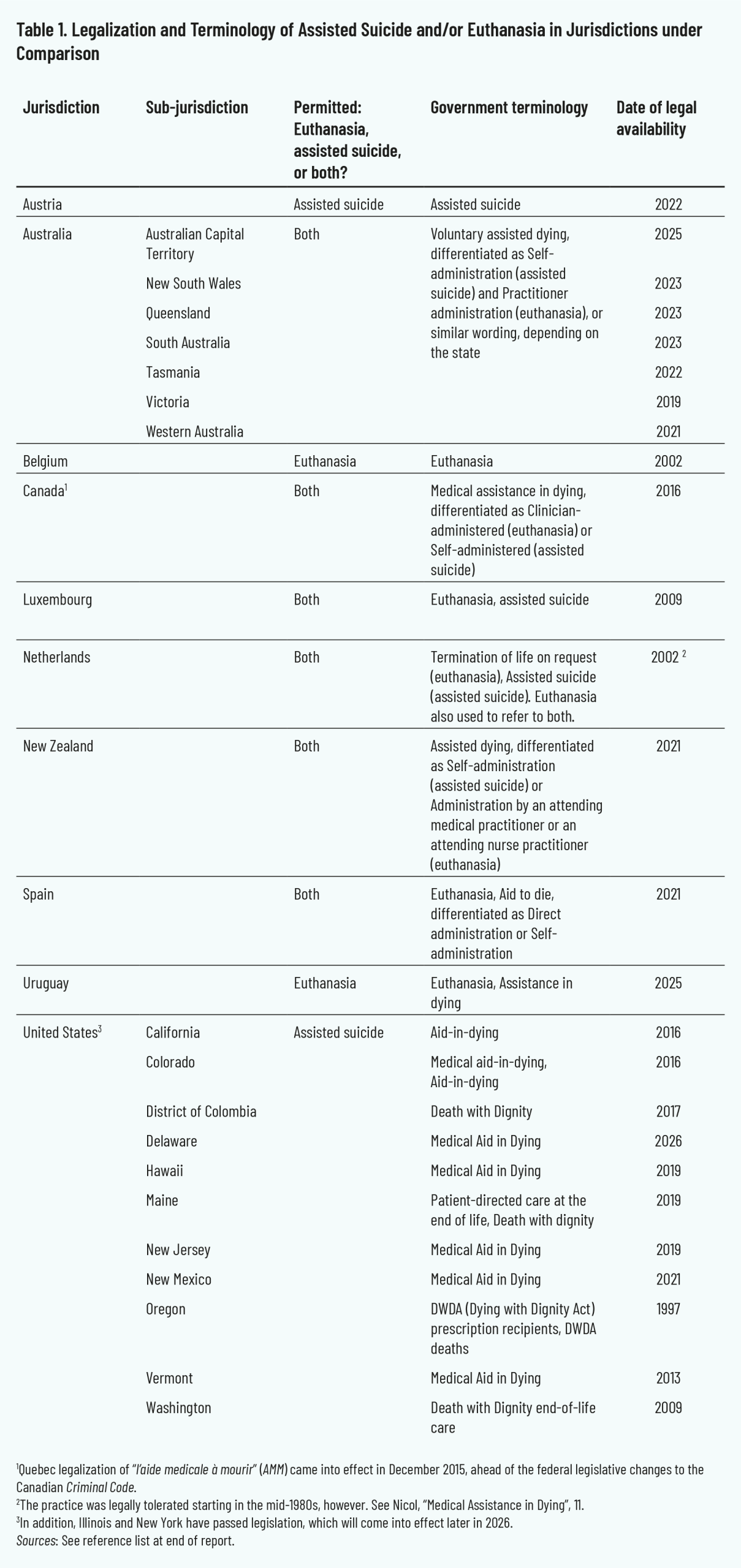
The term “medical assistance in dying” (MAiD) in Canada refers to: (1) euthanasia or clinician-administered assisted death, and (2) assisted suicide or self-administered assisted death. The language used to refer to either or both practices varies by jurisdiction, as summarized in table 1. The international jurisdictions that are compared in this research brief permit one or both practices, and use a variety of terms (table 1). Australian states, for instance, allow both euthanasia and assisted suicide and refer to both as “voluntary assisted dying.” Some US states use the term “medical aid in dying” or “MAiD” but permit only assisted suicide, not euthanasia.
In this paper, we use “assisted dying” to refer to the legal availability of either or both practices in a given jurisdiction. When differentiation is needed, we use “euthanasia” for clinician-administered death and “assisted suicide” for self-administered death. We use “MAiD” when referring to the Canadian situation specifically.
Euthanasia usually occurs through clinicians administering lethal drugs intravenously, whereas assisted suicide is generally provided through clinicians prescribing or providing lethal drugs that patients self-ingest orally. 3 3 For a review of the drugs used, see Worthington et al., “Efficacy and Safety of Drugs Used.” In US states that allow assisted suicide, physicians prescribe the lethal medication for patients to take orally at a later point, but are not often present at the time of death. 4 4 In 2024 in Oregon, for instance, a majority of patients using prescribed lethal drugs did not have either the prescribing physician or another health care provider present at their deaths. Oregon Health Authority, 2024 Oregon Death with Dignity Act Data Summary, 10. Typically in these US states, approximately one-third of those who are prescribed the lethal drug do not fill the prescription, or fill it but do not use it, for such reasons as a change of mind, incapacity, or occurrence of a natural death. 5 5 Pullman, “Slowing the Slide,” 68. By contrast, in jurisdictions such as Canada that allow both assisted suicide and euthanasia, clinician supervision is usually required for assisted suicide, and clinicians can “complete” the death intravenously (i.e., euthanize) if the assisted suicide fails or does not result in death in a certain amount of time. 6 6 Worthington et al., “Efficacy and Safety of Drugs Used.” For Canada, see guidance provided in Canadian Association of MAiD Assessors and Providers, “Intravenous MAiD Medication Protocols in Canada”; Canadian Association of MAiD Assessors and Providers, “The Oral MAiD Option in Canada Part 1”; Canadian Association of MAiD Assessors and Providers, “The Oral MAiD Option in Canada Part 2.”
Although some jurisdictions allow both euthanasia and assisted suicide, in most places euthanasia accounts for the vast majority of assisted deaths. In Canada, fewer than five of the 15,343 MAiD deaths in 2023 (0.03 percent) were cases of assisted suicide. In 2024, all cases were euthanasia. 7 7 Health Canada, Fifth Annual Report, 17. Health Canada, Sixth Annual Report, 12. Citing privacy reasons, Health Canada does not provide an exact number of assisted suicides in its annual reports. The Sixth Annual Report is the first where zero self-administered cases were reported. Similarly, in the Netherlands in 2024, 1.88 percent of assisted deaths were assisted suicide, and 0.18 percent were a combination of assisted suicide and euthanasia, with clinicians “completing” the death when the patient did not die within the time frame agreed upon. 8 8 Regional Euthanasia Review Committees, Netherlands, Annual Report 2024 (Eng. Trans.), 16.
In Australia, however, the proportions are not quite as stark. Although Australian legislation at the state level allows both euthanasia and assisted suicide, the proportion of cases that are assisted suicide is much higher than in Canada or the Netherlands. For instance, the state of Queensland reported that in 2024-25, 27 percent of cases were assisted suicide and 73 percent were euthanasia. The proportion has decreased over time in Queensland, however. In 2023-24 the proportions were 33 percent assisted suicide / 67 percent euthanasia, and in 2022-23 the proportions were 43 percent assisted suicide / 57 percent euthanasia. 9 9 Queensland Voluntary Assisted Dying Board, Queensland Voluntary Assisted Dying Review Board Annual Report 2024–2025, 17; Annual Report 2023-2024, 18; Annual Report 2022-2023, 15.
The Australian state of Victoria has an even higher preponderance of assisted suicide over euthanasia, with about 82.5% of cases between 2019 and 2024 being assisted suicide. 10 10 Victoria State Government, Voluntary Assisted Dying Review Board Annual Report, July 2024 to June 2025, 39. Percentage calculated based on data from Table 11. In this jurisdiction, assisted suicide is set as “the default method and practitioner-administration is permitted only if the patient is physically unable to self administer or ingest the VAD [voluntary assisted dying] substance.” Further, it is “understood that many patients would opt for practitioner-administration if this option were available.” 11 11 Victoria State Government, Review of the Operation of Victoria’s Voluntary Assisted Dying Act 2017, 93. The proportion of cases that are assisted suicide has decreased in Victoria over the years, and the proportion that are euthanasia has increased.
Jurisdictions for Comparison
For the purposes of this brief, jurisdictions in which assisted dying has been legalized as of January 1, 2026 are included (table 1).
Although most of the jurisdictions are reported at a national level, reporting is provided at the sub-national level for countries whose constitutional structure permits sub-national jurisdictions to make their own laws regarding assisted dying (Australia and the United States). The Canadian province of Quebec, although governed by criminal law at the federal level, differs from the situation in other provinces, which will be mentioned when relevant. The province of Alberta, just prior to the publication of this brief, passed legislation which, when in effect, will create additional limits on eligibility and increase some safeguards. These will be discussed as relevant.
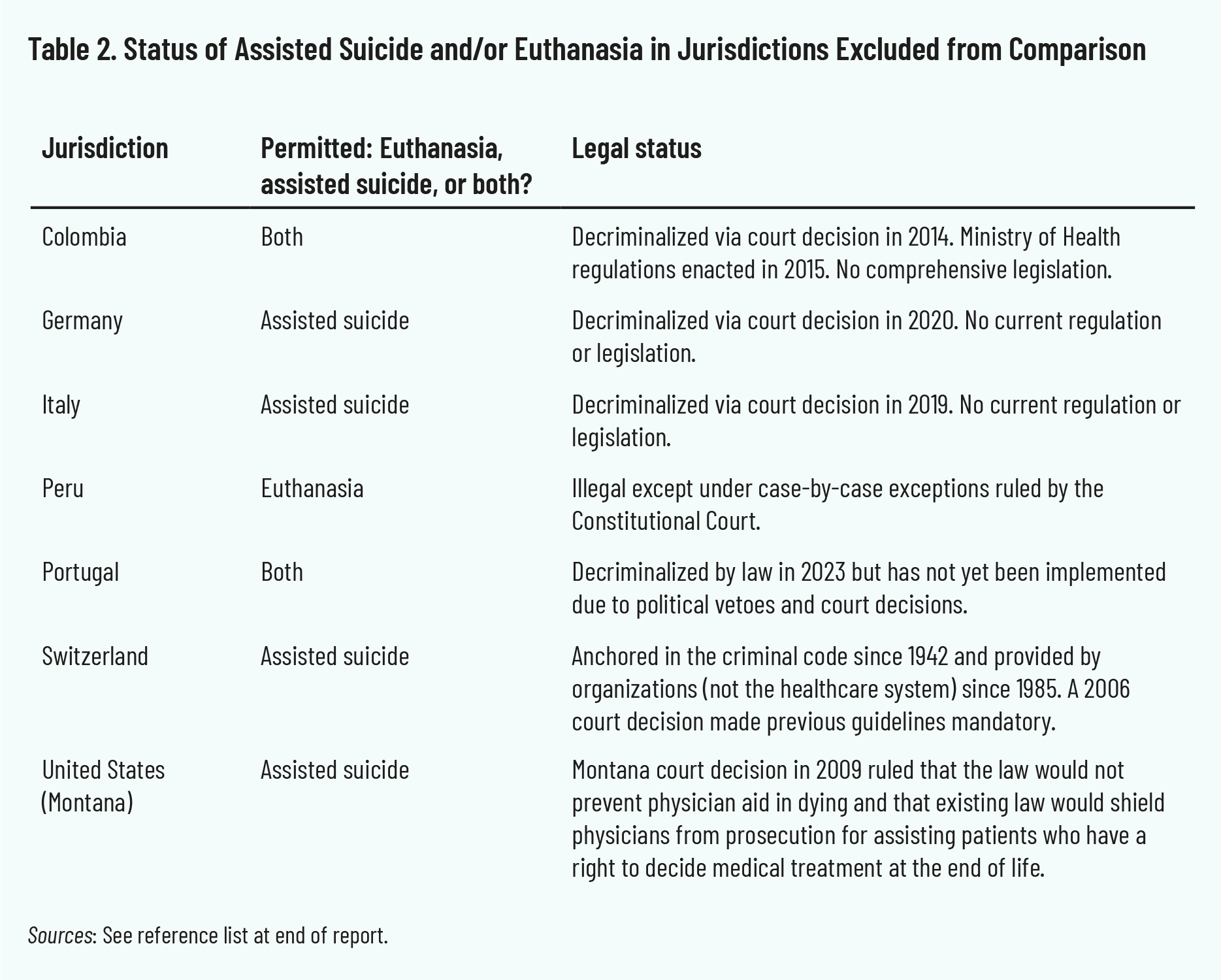
Table 2 presents jurisdictions that are excluded from the comparison. In most cases, assisted dying is decriminalized or legally tolerated to some extent in these jurisdictions, but a legislative framework that regulates the practice is lacking.
Eligibility Criteria
Eligibility for assisted dying typically involves criteria related to age, suffering, competency (capacity to make the decision), and residency. Age and suffering criteria are discussed in the present brief. Capacity and residency will be discussed in forthcoming briefs.
Age
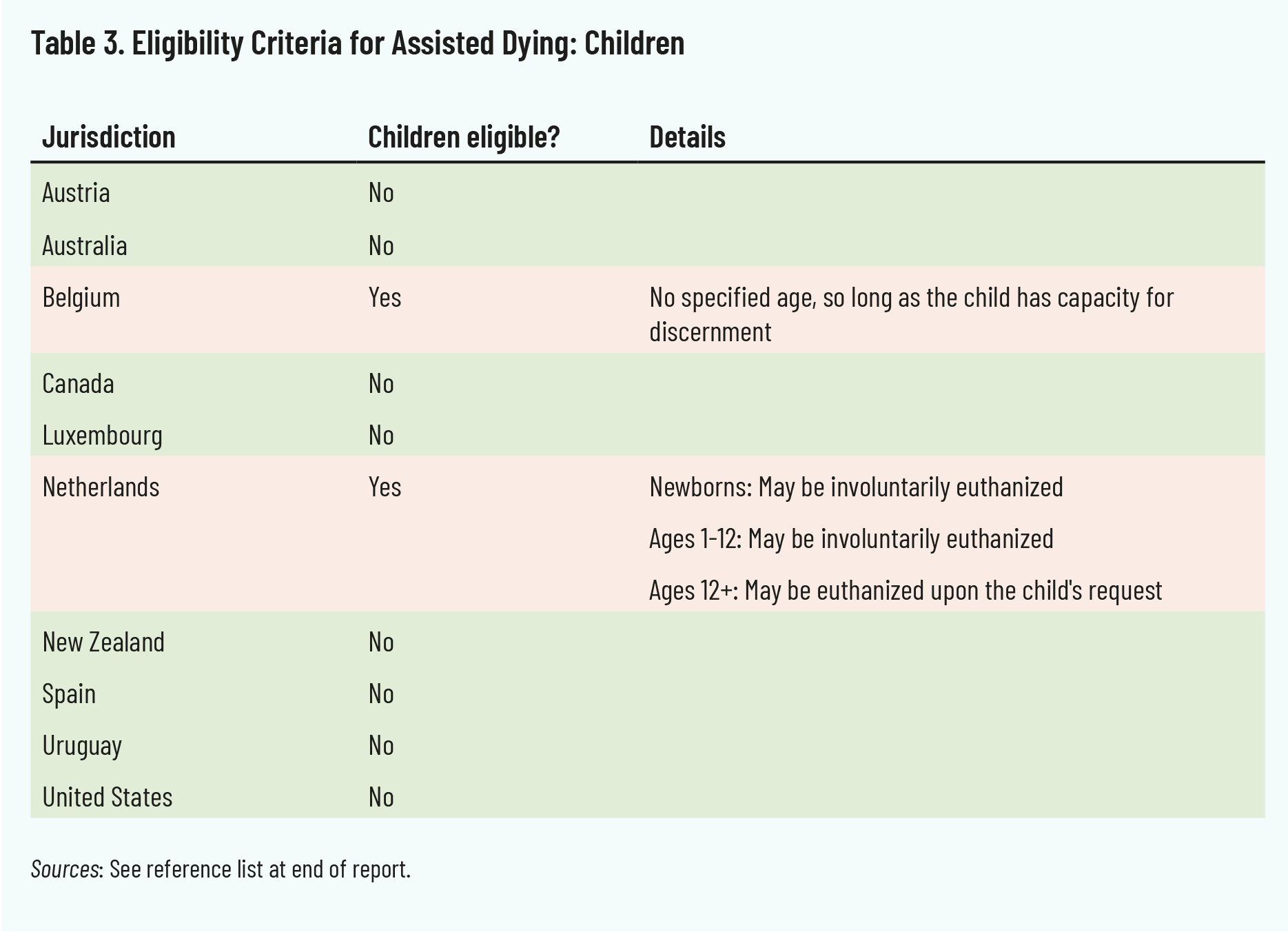
In most countries of comparison, eligibility is restricted to adults. Only two of the other jurisdictions allow assisted dying for children: Belgium and the Netherlands. Canada has studied and considered the possibility of MAiD for “mature minors.” 12 12 Special Joint Committee on Medical Assistance in Dying, Medical Assistance in Dying in Canada, 54-63; Council of Canadian Academies, The State of Knowledge.
Belgium does not provide an age limit but specifies that emancipated (legally independent) minors or any child with “capacity for discernment” can be found eligible. 13 13 Government of Belgium, Loi relative à l’euthanasie; Government of Belgium, “Euthanasie en Belgique.” A 2015 constitutional court decision specifically excluded newborns and young children, given they lack this capacity.
Beyond the criteria applying to adults, children in Belgium must meet additional criteria, specifically:
- Child psychiatrist or psychologist must be consulted when the patient is an unemancipated minor, to understand the minor’s capacity for discernment.
- Physical suffering must be constant, intolerable, and not able to be relieved; assisted death on the basis of psychiatric suffering is excluded.
- The condition must be serious and incurable, and expected to lead to death in the short term.
- Parents/guardians must provide written consent. 14 14 Government of Belgium, “Euthanasie d’une personne mineure.”
In the Netherlands, the age is set at 12 for a child to be eligible to request euthanasia, with varying additional criteria depending on age:
- Children aged 12 to 15 must have parent/guardian consent, and must have the capacity to understand what is best for themselves.
- Children aged 16 to 17 must have parent/guardian consultation (parental consent is not required). 15 15 Government of the Netherlands, “Is Euthanasia Legal in the Netherlands?”
The Netherlands also allows involuntary euthanasia for terminally ill children aged 1 to 12, when decided upon by parents and the doctor. 16 16 Government of the Netherlands, “Termination of Life for Terminally Ill Children.” Severely ill newborn infants may be euthanized according to the Groningen Protocol. 17 17 Verhagen and Sauer, “The Groningen Protocol”; Government of the Netherlands, “Termination of Life Newborn Infants and Late-Term Abortion.”
Suffering
Each jurisdiction has criteria relating to suffering, but the parameters differ in important ways. In each jurisdiction, eligibility involves the following:
- Some characterization of the nature of the condition or illness, usually with a requirement that it be irremediable, incurable, or irreversible. Some jurisdictions require that the condition or illness be terminal, often with a specific time frame specified.
- Some characterization that the suffering is severe and unbearable. The jurisdictions differ as to (1) whether the tolerability of the suffering is determined solely by the patient or together with the physician/assessor, and (2) whether reasonable alternatives to relieve suffering must be tried.
Prognosis
Perhaps the most significant difference in eligibility criteria across the jurisdictions is whether assisted dying is limited to those who are dying, or is available more generally to those who are suffering but not necessarily dying.
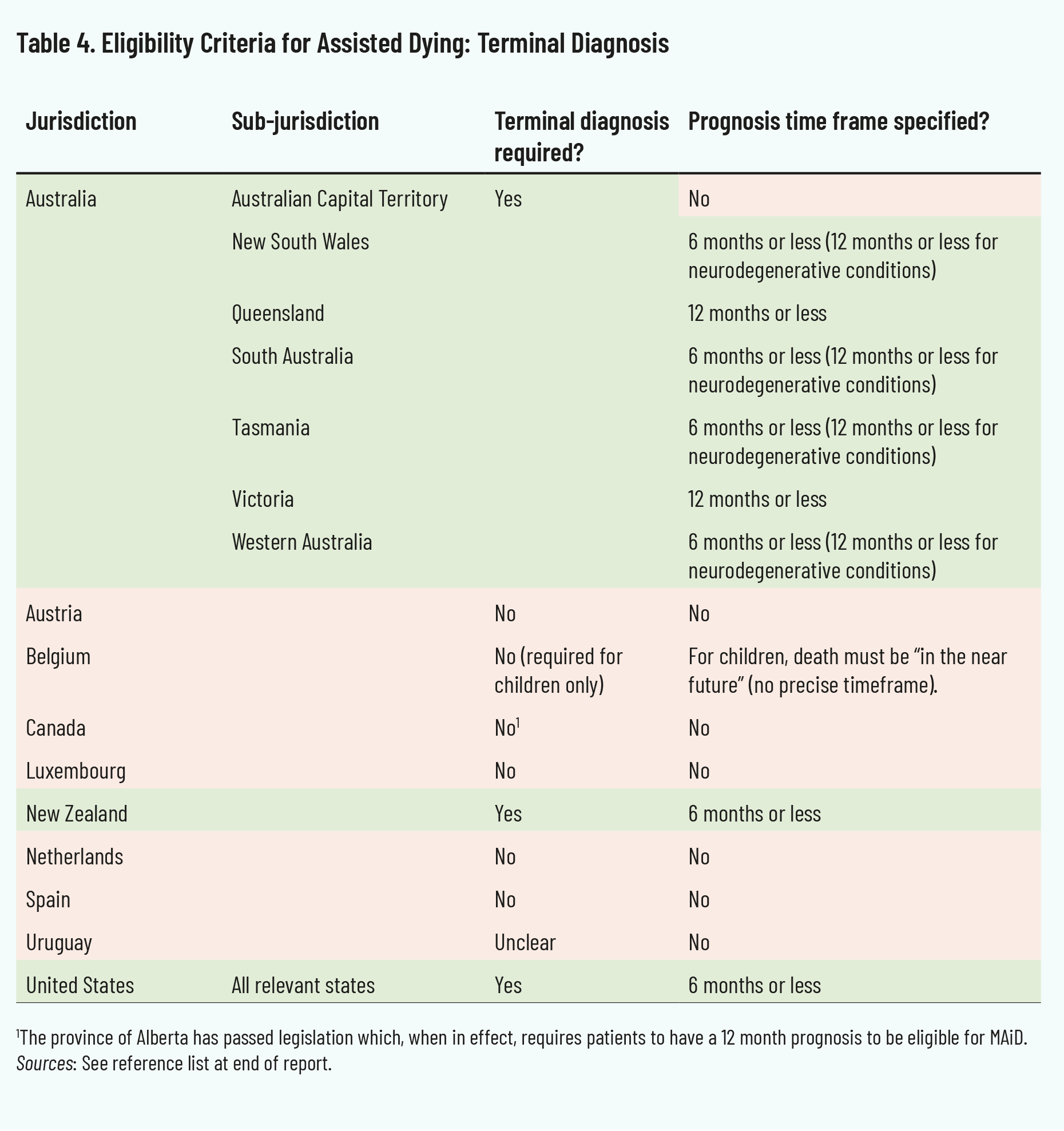
As indicated in table 4, US states, Australian states, and New Zealand limit eligibility to those who are terminally ill—with all but one of these specifying a prognosis of six to twelve months or less. 18 18 The Australian Capital Territory, whose voluntary assisted dying program came into effect in November 2025, diverges from other Australian states by requiring that the patient’s condition(s) must be “expected to cause death,” without providing a timeframe for the expected death. Further, when defining an “advanced condition,” the law specifies that “an individual may be approaching the end of their life even if it is uncertain whether their relevant conditions will cause death within the next 12 months.” ACT Government, Voluntary Assisted Dying Act 2024, at § 11 (1)(b) and § 11(6).
The Criterion of “Reasonably Foreseeable Natural Death” in Canada
Canadian legislation passed in 2016 required that the patient’s “natural death has become reasonably foreseeable,” but also that a prognosis of any particular length is not required. 19 19 Bill C-14. As discussed in a Justice Department document, this criterion would not limit MAiD to those with a “fatal disease,” as the “medical condition that is causing the intolerable suffering would not need to be the cause of the reasonably foreseeable death.” 20 20 Government of Canada, Legislative Background, 10. Without a definition as to what “reasonably foreseeable” meant in practice, a wide range of interpretations resulted, including ones in which the death may be even ten years away. 21 21 McMorrow et al., “Interpreting Eligibility”; Stafinski et al, “Descriptions and Experiences,” 9.
After a Quebec court decision (Truchon), the Canadian Parliament passed new legislation in 2021 which, alongside other changes, created “Track 2” MAiD for those whose deaths were not reasonably foreseeable. 22 22 For more information about the court cases, legislation, and ‘tracks’ of MAiD, see also Raikin, “From Exceptional to Routine” and Cardus, “Ethical Issues.”
The lack of definition in Canada of “reasonably foreseeable death” continues to create significant challenges for differentiating between eligibility for Track 1 and Track 2, and consequently for knowing when certain safeguards, such as the ninety-day assessment period for Track 2, must apply. 23 23 Shannon, “We Should Not Lightly Assume,” 74–75. Some researchers have expressed concerns about how MAiD assessors and providers may enable patients who more clearly qualify for Track 2 to qualify for Track 1 and thus access MAiD without the longer assessment period (with Track 1, there is no specific assessment period length, and assessment and receipt of MAiD can occur on the same day in some cases). 24 24 Coelho, “Disability and MAiD,” 192–93. For example, the Canadian Association of MAiD Assessors and Providers provides the following guidance:
A person may meet the “reasonably foreseeable” criterion if they have demonstrated a clear and serious intent to take steps to make their natural death happen soon or to cause their death to be predictable. Examples might include stated declarations to refuse antibiotic treatment of current or future serious infection, to stop use of oxygen therapy, to refuse turning if they have quadriplegia, or to voluntarily cease eating and drinking. 25 25 Canadian Association of MAiD Assessors and Providers, “The Interpretation and Role of ‘Reasonably Foreseeable’.”
In other words, if a patient normally considered to be Track 2 communicates that they intend to stop eating and drinking or refuse effective treatment, a provider could then potentially approve their MAiD request under Track 1, as the patient has now made their death “reasonably foreseeable.”
The province of Alberta recently passed a bill which, when it takes effect, removes Track 2 MAiD and adds a 12 month prognosis requirement. 26 26 Government of Alberta, “Protecting vulnerable Albertans.”
Non-Terminal Suffering
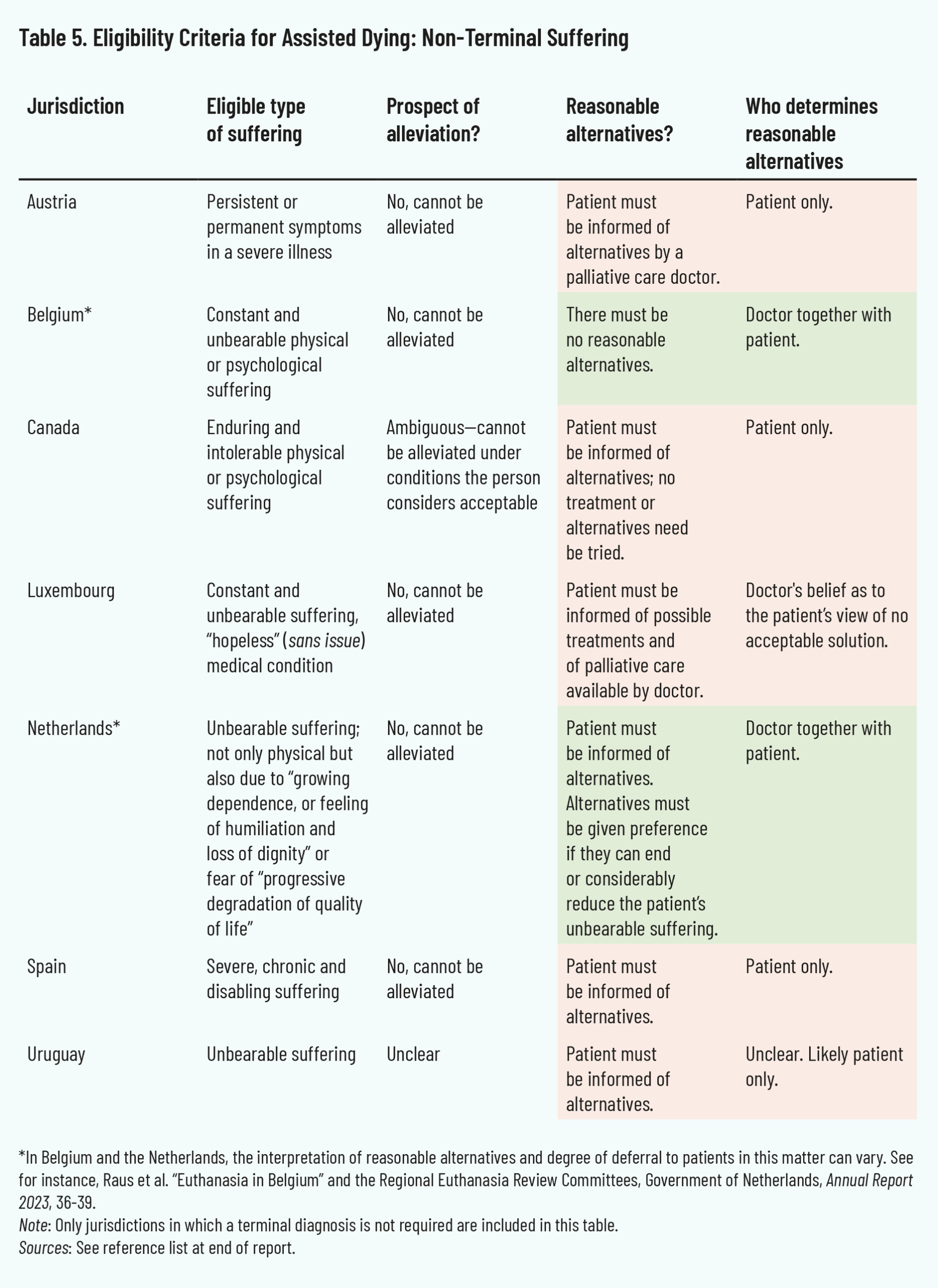
Some jurisdictions do not restrict eligibility to those with terminal illnesses only. Canada is one of these. Table 5 provides a comparison of the criteria related to suffering in these jurisdictions (note: this is not a comparison of the nature of the medical conditions). The table indicates how criteria differ regarding:
- the possibility that the suffering will improve
- whether there are reasonable alternatives to relieve the suffering
- the role of physician discretion in determining whether reasonable alternatives exist
As table 5 shows, Canada’s law is significantly more permissive here. Researchers Scott and Scott have concluded that Canada’s “suffering eligibility criterion leaves the law open to unintended forms of interpretation, thus instituting perhaps the most unbounded and risk-prone form of assisted death in the world.” 27 27 Scott and Scott, “Suffering as a Criterion,” 211, 214. In Canada it is the patient who decides that the suffering is intolerable, and the patient must only consider reasonable alternatives; there is no requirement for the patient to try treatment or alternatives.
Belgium and the Netherlands require physicians to assess the suffering. For a patient to become eligible, the physician must confirm it to be intolerable and must also confirm that alternatives are lacking.
The Netherlands also requires that “the physician must ensure that all potentially effective methods to alleviate suffering have been tried before having recourse to death as a solution,” whereas “in Canada, the physician does not have a duty to ensure that all viable treatments have been tried before having access to death as the solution.” 28 28 Mishara and Kerkhof, “Canadian and Dutch Doctors’ Roles,” 727. Scholars Mishara and Kerkhof report that “this obligation to treat is the main reason for refusing requests” in the Netherlands, and they note that “most people in the Netherlands who are refused on these grounds do not repeat their request for MAID after trying the recommended treatments . . . [which] avoids the expedited death of many people who requested euthanasia or assisted suicide.” 29 29 Mishara and Kerkhof, “Canadian and Dutch Doctors’ Roles,” 727-28. These authors cite a report available in Dutch: Onwuteaka-Philipsen et al., “Derde evaluatie Wet toetsing levensbeëindiging op verzoek en hulp bij Zelfdoding,” 2017. These scholars also contrast the “premise” of the laws in the two countries. The Netherlands’s law is premised on “a responsibility to alleviate suffering by allowing people to choose to die when life is unbearable, but there is also an obligation of the state to protect vulnerable individuals who may choose to die when there are viable treatments and interventions available to alleviate the suffering,” whereas in Canadian law, the premise is that the patient is the sole arbiter.
Further, as will be explored in another brief in this series, the Benelux countries have committees specifically to review euthanasia case files, to monitor and enforce compliance. Canada lacks a national body to do likewise. 30 30 See also Kotalik, “Medical Assistance in Dying”; Lyon, “Canada’s Medical Assistance in Dying System.”
When comparing the wording of the criteria in table 5, note that some variation may be due to translation into English. The Netherlands Euthanasia Review Committees publish English translations of their reports from the original Dutch. The Belgium and Luxembourg laws were consulted in French. For jurisdictions in which the laws were published in neither English nor French, third-party or Google Translate translations were used, and academic literature in English was also reviewed to confirm our word choices.
Mental Illness as Sole Underlying Condition
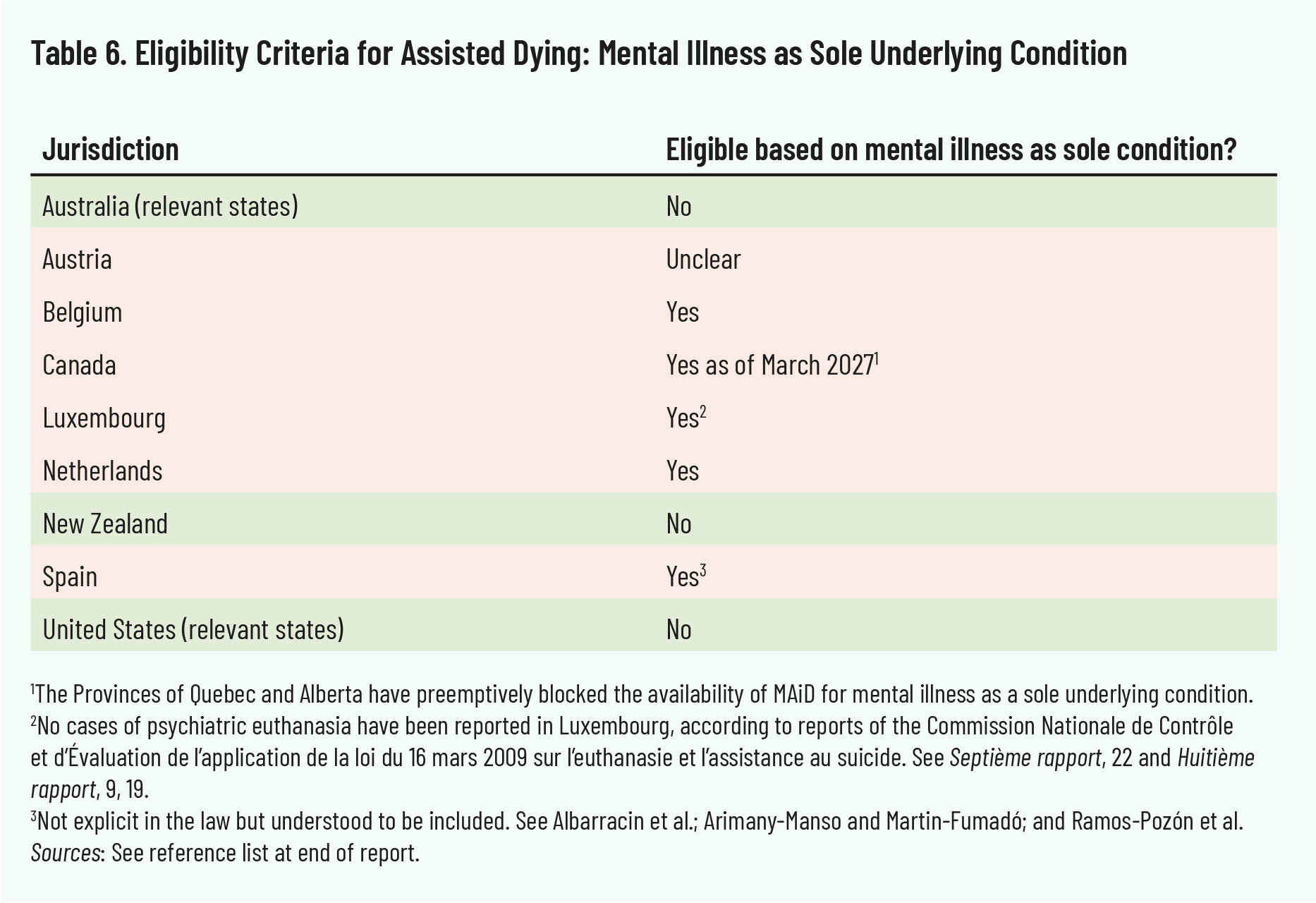
Assisted dying for those whose sole underlying condition is a mental illness is available in a small number of jurisdictions (table 6). Canada is set to join them as of March 17, 2027.
In some jurisdictions that do not allow assisted dying in such cases, patients with a mental illness may still receive an assisted death, so long as they qualify on another basis. The degree to which jurisdictions take steps to screen out persons who may be requesting an assisted death due to their mental illness varies; these safeguards will be discussed in a later brief in this series.
Canadian Context
In Canada, the possibility that mental illness would affect requests for MAiD was a concern of both the courts and the parliament. As researcher Alexander Raikin has noted, the 2012 and 2015 court decisions and the original 2016 legislation created an expectation that safeguards would be able to screen out those seeking MAiD because of a mental illness. 31 31 Raikin, “In Contrast to Carter,” 22-23. Raikin points to Canadian data demonstrating a feeble screening process.
The situation became more complicated with the expansions passed into law in 2021, when Canadians without a “reasonably foreseeable death” could also become eligible. Initially, the 2021 legislation that was passed in the House of Commons explicitly excluded from eligibility those with mental illness as a sole underlying condition, but the Senate added a sunset clause whereby this exclusion would expire in 2023. 32 32 Bill C-7, at Section 1 (2.1) and Section 6. For the original text of the bill, prior to the Senate amendment, see First Reading, October 5, 2025, Summary (b). The expiration date was subsequently pushed back to March 2024, and then to March 2027. 33 33 Bill C-39; Bill C-62. A joint parliamentary committee reconvened in February 2026 to evaluate the matter.
Conclusion
This cross-country comparison of the eligibility criteria for assisted dying illustrates important differences between jurisdictions. The most significant of these is whether a terminal diagnosis is required, as is the case in Australia, New Zealand, and the United States, in which the patient must generally have a prognosis of 6 or 12 months or less to live.
The other model, which is followed by the Benelux countries and Canada, is based solely on evaluating suffering, determining whether suffering is intolerable, what alternatives are available, and whether the alternatives must be tried. Even within this group, Canada stands out as unusually permissive, since most Benelux countries require physician involvement in determining if alternatives have been tried, and these alternatives must be given preference if they can reduce the patient’s suffering. The Canadian MAiD regime leaves the patient as the sole arbiter of their own suffering and requires only consideration, not trial, of alternative solutions. This makes Canada’s regime extremely permissive, and may help to explain Canada’s very high incidence of MAiD deaths in relation to total deaths. 34 34 See Raikin “From Exceptional to Routine” for an international comparison of the numbers.
Unlike in Belgium and the Netherlands, MAiD is not available to minors in Canada, nor is it available to patients whose sole underlying condition is a mental illness. Eligibility for patients whose sole underlying condition is a mental illness remains in the legislation, and this provision will come into effect in 2027, unless it is repealed or deferred once more.
References
References are listed by jurisdiction, in alphabetical order, and broken out by sub-national jurisdiction when relevant. References that discuss more than one jurisdiction are placed in a final section, titled “Other.”
Reporting on the operation of assisted dying (i.e. statistical data summaries, annual reports, quarterly reports, etc.) are cited throughout the report. A general reference for each jurisdiction’s reporting is included when applicable, through which individual reports can be identified by year.
Australia
Ferris, L. “Bills Digest: Restoring Territory Rights Bill 2022.” Bills Digest No. 5, 2022-23. Parliament of Australia, Department of Parliamentary Services, August 3, 2022. https://www.aph.gov.au/Parliamentary_Business/Bills_Legislation/bd/bd2223a/23bd005.
Northern Territory Government, Voluntary Assisted Dying Independent Expert Advisory Panel, Report into Voluntary Assisted Dying in the Northern Territory: Final Report 2024. 2024. https://cmc.nt.gov.au/__data/assets/pdf_file/0018/1420722/vad-report-2024.pdf.
Parliament of Australia. Restoring Territory Rights Act 2022: An Act To Amend the Law in Relation to the Legislative Powers of Territories, and for Related Purposes. No. 95, 2022. https://www.legislation.gov.au/C2022A00095/asmade/text.
Waller, K., K. Del Villar, L. Willmott, and B.P. White. “Voluntary Assisted Dying in Australia: A Comparative and Critical Analysis of State Laws.” UNSW Law Journal, 2023. https://www.unswlawjournal.unsw.edu.au/article/voluntary-assisted-dying-in-australia-a-comparative-and-critical-analysis-of-state-laws.
Australian Capital Territory
ACT Government. Summary of the ACT’s Model for Voluntary Assisted Dying. 2024.
ACT Government. Voluntary Assisted Dying Act 2024. A2024-24. https://www.legislation.act.gov.au/View/a/2024-24/current/html/2024-24.html.
New South Wales
NSW Government, NSW Health. First Request Patient Information Guide: Voluntary Assisted Dying. 2023. https://www.health.nsw.gov.au/voluntary-assisted-dying/Publications/first-request-patient-guide.pdf.
NSW Government, NSW Health. “NSW Voluntary Assisted Dying Board—Voluntary Assisted Dying.” https://www.health.nsw.gov.au:443/voluntary-assisted-dying/Pages/board.aspx.
NSW Government. Voluntary Assisted Dying Act 2022 No 17. 2023. https://legislation.nsw.gov.au/view/html/inforce/current/act-2022-017.
NSW Voluntary Assisted Dying Board. Annual Report: 2024-25. 2025. https://www.health.nsw.gov.au/voluntary-assisted-dying/Publications/annual-report-2024-2025.pdf.
NSW Voluntary Assisted Dying Board. Annual Report: 2023-24. 2024. https://www.health.nsw.gov.au/voluntary-assisted-dying/Publications/annual-report-2023-2024.PDF.
NSW Voluntary Assisted Dying Board. Interim Report: Voluntary Assisted Dying in NSW, 28 November 2023 to 29 February 2024. n.d. https://www.health.nsw.gov.au/voluntary-assisted-dying/Documents/interim-board-report-2024.pdf.
Queensland
Queensland Government, Queensland Health. “Voluntary Assisted Dying Review Board Annual Reports.” https://www.health.qld.gov.au/research-reports/reports/departmental/voluntary-assisted-dying-review-board-annual-report.
Queensland Government. Voluntary Assisted Dying Act 2021. https://www.legislation.qld.gov.au/view/html/asmade/act-2021-017.
South Australia
Government of South Australia, SA Health. “Voluntary Assisted Dying Reporting.” https://www.sahealth.sa.gov.au/wps/wcm/connect/public+content/sa+health+internet/services/community+and+specialised+services/voluntary+assisted+dying/reporting/voluntary+assisted+dying+reporting.
Government of South Australia. Voluntary Assisted Dying Act 2021. https://www.legislation.sa.gov.au/lz?path=%2FC%2FA%2FVOLUNTARY%20ASSISTED%20DYING%20ACT%202021.
Government of South Australia. Voluntary Assisted Dying Regulations 2022. https://www.legislation.sa.gov.au/lz?path=/C/R/Voluntary%20Assisted%20Dying%20Regulations%202022.
Tasmania
Tasmanian Government. End-of-Life Choices (Voluntary Assisted Dying) Act 2021. No. 1 of 2021. https://www.legislation.tas.gov.au/view/html/asmade/act-2021-001.
Tasmanian Government, Department of Health. “Voluntary Assisted Dying Commission: Reports and Updates.” https://www.health.tas.gov.au/health-topics/voluntary-assisted-dying-1/voluntary-assisted-dying-services/voluntary-assisted-dying-commission#reports-and-updates.
Victoria
Victoria State Government. Voluntary Assisted Dying Act 2017. 61/2017, Version 006. https://www.legislation.vic.gov.au/in-force/acts/voluntary-assisted-dying-act-2017/006.
Victoria State Government. Voluntary Assisted Dying Amendment Act 2025. 50/2025, https://www.legislation.vic.gov.au/as-made/acts/voluntary-assisted-dying-amendment-act-2025.
Victoria State Government, Department of Health. Review of the Operation of Victoria’s Voluntary Assisted Dying Act 2017. 2024. https://www.health.vic.gov.au/sites/default/files/2025-02/review-of-operation-voluntary-assisted-dying-act-2017-final-report.pdf.
Victoria State Government, Department of Health. “Voluntary Assisted Dying Review Board: Information About the Board Members and Annual Reports.” https://www.health.vic.gov.au/voluntary-assisted-dying/voluntary-assisted-dying-review-board.
Western Australia
Government of Western Australia, Department of Health. “Voluntary Assisted Dying Board.” [See section on annual reports]. https://www.health.wa.gov.au/Articles/U_Z/Voluntary-Assisted-Dying-Board.
Government of Western Australia. Voluntary Assisted Dying Act 2019. https://classic.austlii.edu.au/au/legis/wa/consol_act/vada2019302/.
Austria
Government of Austria. Sterbeverfügungsgesetz [Death Decree Act—Amendment to Law]. Law no. 20011782. 2022. https://ris.bka.gv.at/eli/bgbl/i/2021/242/P1/NOR40240919.
Government of Austria. Sterbeverfügungsgesetz Sowie Änderung des Suchtmittelgesetzes und des Strafgesetzbuches [Law on the Disposition of Deaths and Amendments to the Narcotics Act and the Criminal Code]. 2021. https://www.ris.bka.gv.at/Dokumente/BgblAuth/BGBLA_2021_I_242/BGBLA_2021_I_242.html.
Khakzadeh, L. “Assisted Suicide in Austria—The New Legal Framework.” BioLaw Journal no. 1 (2022): 135-43. https://teseo.unitn.it/biolaw/article/view/2242/2221.
Kitta, A., F. Ecker, E. L. Zeilinger, L. Kum, F. Adamidis, and E. K. Masel. “Statements of Austrian Hospices and Palliative Care Units after the Implementation of the Law on Assisted Suicide: A Qualitative Study of Web-Based Publications.” Wiener Klinische Wochenschrift 136 (2024): 382-89. https://doi.org/10.1007/s00508-023-02157-9.
Masel, E. K. “Perspective: Legal, Ethical, and Medical Perspectives of the Landscape of Assisted Suicide in Austria.” Wiener Klinische Wochenschrift, 136 (2024): 380-381. https://doi.org/10.1007/s00508-024-02344-2.
Belgium
Government of Belgium. Loi relative à l’euthanasie [Law on Euthanasia]. 2002. https://www.ejustice.just.fgov.be/eli/loi/2002/05/28/2002009590/justel.
Government of Belgium, Santé publique. Commission fédérale de contrôle et d’évaluation de l’euthanasie. [See Publications for Annual Reports.] https://organesdeconcertation.sante.belgique.be/fr/organe-d%27avis-et-de-concertation/commission-federale-de-controle-et-devaluation-de-leuthanasie.
Government of Belgium, Santé publique. Euthanasie d’une Personne Mineure: Informations pour les Professionnels de la Santé [Euthanasia for Minors: Information for Health Professionals].
Government of Belgium, Santé publique. “Euthanasie en Belgique” [Euthanasia in Belgium].
Raus, K., B. Vanderhaegen, and S. Sterckx. “Euthanasia in Belgium: Shortcomings of the Law and Its Application and of the Monitoring of Practice.” Journal of Medicine and Philosophy 46, no. 1 (2021): 80-107. https://doi.org/10.1093/jmp/jhaa031.
Canada
Bill C-7, An Act to Amend the Criminal Code (Medical Assistance in Dying). 43rd Parl, 2nd Sess. First Reading. October 5, 2020. https://www.parl.ca/documentviewer/en/43-2/bill/C-7/first-reading.
Bill C-7, An Act to Amend the Criminal Code (Medical Assistance in Dying). 43rd Parl, 2nd Sess. 2021. https://www.parl.ca/LegisInfo/en/bill/43-2/c-7.
Bill C-14, An Act to Amend the Criminal Code and to Make Related Amendments to Other Acts (Medical Assistance in Dying). 42nd Parl, 1st Sess. 2016. https://www.parl.ca/LegisInfo/en/bill/42-1/C-14.
Bill C-39, An Act to Amend An Act to Amend the Criminal Code (Medical Assistance in Dying). 1st Sess, 44th Parl. 2023. https://www.parl.ca/LegisInfo/en/bill/44-1/c-39.
Bill C-62, An Act to Amend An Act to Amend the Criminal Code (Medical Assistance in Dying). No. 2, 1st Sess, 44th Parl. 2024. https://www.parl.ca/LegisInfo/en/bill/44-1/c-62.
“Canada’s Rate of Medically Assisted Deaths Rises to Record High.” The Guardian, December 12, 2024. https://www.theguardian.com/world/2024/dec/12/canada-medically-assisted-death.
Canadian Association of MAiD Assessors and Providers. “Intravenous MAiD Medication Protocols in Canada.” 2020. https://camapcanada.ca/wp-content/uploads/Intravenous-MAiD-Medication-Protocols-in-Canada-April-2020.pdf.
Canadian Association of MAiD Assessors and Providers. “The Interpretation and Role of ‘Reasonably Foreseeable’ in MAiD Practice.” 2022. https://camapcanada.ca/wp-content/uploads/2022/03/The-Interpretation-and-Role-of-22Reasonably-Foreseeable22-in-MAiD-Practice-Feb-2022.pdf.
Canadian Association of MAiD Assessors and Providers. “The Oral MAiD Option in Canada Part 1: Medication Protocols; Review and Recommendations.” 2018. https://camapcanada.ca/wp-content/uploads/Oral-MAiD-Option-in-Canada-Pt-1-Medication-April-2018.pdf.
Canadian Association of MAiD Assessors and Providers. “The Oral MAiD Option in Canada Part 2: Processes for Providing; Review and Recommendations.” 2018. https://camapcanada.ca/wp-content/uploads/Oral-MAiD-Option-in-Canada-Pt-2-Processes-April-2018.pdf.
Cardus. “Ethical Issues in Euthanasia and Assisted Suicide in Canada.” 2023. https://www.cardus.ca/research/ethical-issues-in-euthanasia-and-assisted-suicide-in-canada/.
Coelho, R. “Disability and MAiD.” In Unravelling MAiD in Canada: Euthanasia and Assisted Suicide as Medical Care, edited by R. Coelho, K. S. Gaind, and T. Lemmens. McGill-Queen’s University Press, 2025.
Council of Canadian Academies. The State of Knowledge on Medical Assistance in Dying for Mature Minors. The Expert Panel Working Group on MAID for Mature Minors, 2018. https://cca-reports.ca/wp-content/uploads/2018/12/The-State-of-Knowledge-on-Medical-Assistance-in-Dying-for-Mature-Minors.pdf.
Government of Canada, Department of Justice. Canada’s Medical Assistance in Dying (MAID) Law. 2024. https://www.justice.gc.ca/eng/cj-jp/ad-am/bk-di.html.
Government of Canada, Department of Justice. Legislative Background: Medical Assistance in Dying (Bill C-14). 2016. https://www.justice.gc.ca/eng/rp-pr/other-autre/ad-am/ad-am.pdf.
Government of Canada. Medical Assistance in Dying: Overview. https://www.canada.ca/en/health-canada/services/health-services-benefits/medical-assistance-dying.html.
Health Canada. Fifth Annual Report on Medical Assistance in Dying in Canada, 2023. December 2024. Updated February 1, 2025. https://www.canada.ca/en/health-canada/services/publications/health-system-services/annual-report-medical-assistance-dying-2023.html.
Health Canada. Sixth Annual Report on Medical Assistance in Dying in Canada. 2025. https://www.canada.ca/en/health-canada/services/publications/health-system-services/annual-report-medical-assistance-dying-2024.html.
Kotalik, J. “Medical Assistance in Dying: Challenges of Monitoring the Canadian Program.” Canadian Journal of Bioethics 3, no. 3 (2020): 202–9. https://doi.org/10.7202/1073799ar.
Kotalik, J. “Monitoring of MAID: Deficits of Transparency and Accountability.” In Medical Assistance in Dying (MAID) in Canada: Key Multidisciplinary Perspectives, edited by J. Kotalik and D. W. Shannon. Springer, 2023. https://doi.org/10.1007/978-3-031-30002-8.
Lyon, C. “Canada’s Medical Assistance in Dying System Can Enable Healthcare Serial Killing.” HEC Forum, 37 (2025): 65-105. https://doi.org/10.1007/s10730-024-09528-3.
McMorrow, T., E. Wiebe, R. Liyanage, S. Tremblay-Huet, and M. Kelly. “Interpreting Eligibility Under the Medical Assistance in Dying Law: The Experiences of Physicians and Nurse Practitioners.” McGill Journal of Law and Health 14, no. 1 (2020): 51. https://mjlh.mcgill.ca/publications/volume-14-issue-1-141-2020/interpreting-eligibility-under-the-medical-assistance-in-dying-law-the-experiences-of-physicians-and-nurse-practitioners/.
Moniuszko, S. “Medically-Assisted Dying in Canada Reached Record High in 2023, About 1 in 20 Deaths.” CBS News, December 13, 2024. https://www.cbsnews.com/news/medically-assisted-deaths-canada-2023/.
Raikin, A. “From Exceptional to Routine: The Rise of Euthanasia in Canada.” Cardus, 2024. https://www.cardus.ca/research/from-exceptional-to-routine/.
Raikin, A. “In Contrast to Carter: Assisted Dying’s Impact on Canadians with Disabilities.” Cardus, 2025. https://www.cardus.ca/research/health/reports/in-contrast-to-carter.
Shannon, D.W. “‘We Should Not Lightly Assume’: A Review of Legislative, Regulatory and Jurisprudential Developments of MAID Safeguards.” In Medical Assistance in Dying (MAID) in Canada: Key Multidisciplinary Perspectives, edited by J. Kotalik and D.W. Shannon. Springer, 2023. https://doi.org/10.1007/978-3-031-30002-8.
Special Joint Committee on Medical Assistance in Dying. Medical Assistance in Dying in Canada: Choices for Canadians. No. 2. Parliament of Canada, 44th Parliament, 1st Session, 2023. https://www.parl.ca/Content/Committee/441/AMAD/Reports/RP12234766/amadrp02/amadrp02-e.pdf.
Stafinski, T., C. Rumsey, D. Menon, and C. Ekaeze. “Descriptions and Experiences with Medical Assistance in Dying Models Across Canada: A Mixed Methods Study.” Healthcare 14, no. 6 (2026): 797. https://doi.org/10.3390/healthcare14060797.
Yousif, N. “Assisted Dying Now Accounts for One in 20 Canada Deaths.” BBC, December 12, 2024. https://www.bbc.com/news/articles/c0j1z14p57po.
Alberta
Government of Alberta. “Protecting vulnerable Albertans seeking MAID.” https://www.alberta.ca/protecting-vulnerable-albertans-seeking-maid.
Government of Alberta. Safeguards for Last Resort Termination of Life Act. 2026 [Passed 3rd Reading; waiting on assent]. https://docs.assembly.ab.ca/LADDAR_files/docs/hansards/han/legislature_31/session_2/20260422_1330_01_han.pdf#page=17.
Quebec
Government of Quebec. Aide médicale à mourir [Medical Aid in Dying]. September 11, 2024. https://www.quebec.ca/sante/systeme-et-services-de-sante/soins-de-fin-de-vie/aide-medicale-a-mourir.
Government of Quebec, Commission sur les soins de fin de vie. Publications: “Données sur l’aide médicale à mourir” [Data on Medical Aid in Dying] and “Rapports annuels d’activités” [Annual Reports]. https://csfv.gouv.qc.ca/publications.
Government of Quebec. S-32.0001, Act Respecting End-of-Life Care. https://www.legisquebec.gouv.qc.ca/en/document/cs/s-32.0001.
Colombia
Espericueta, L. “Analysis of the Legal Situation Regarding Euthanasia in Ecuador, Colombia, and Peru: Towards a Latin American Model of Medical Assistance in Dying?” Developing World Bioethics (2024): 3-4. https://doi.org/10.1111/dewb.12457.
Germany
Associated Press. “German Lawmakers Fail to Agree on New Rules Regulating Assisted Suicide.” CTV News. July 6, 2023. https://www.ctvnews.ca/world/german-lawmakers-fail-to-agree-on-new-rules-regulating-assisted-suicide-1.6469112.
Farr, L., J. Poeck, C. Bozzaro, and J. Bleidorn. “Requests for Physician-Assisted Suicide in German General Practice: Frequency, Content, and Motives—a Qualitative Analysis of GPs’ Experiences.” BMC Primary Care 26, no. 1 (2025): 122. https://doi.org/10.1186/s12875-025-02830-0.
Göken, H., and F. Zwießler. “Assisted Suicide in Germany: The Landmark Ruling of the German Federal Constitutional Court of February 26, 2020.” German Law Journal 23, no. 4 (2022): 661–71. https://doi.org/10.1017/glj.2022.34.
Italy
Cecchi, R., M. Sassani, F. S. Romolo, et al. “Medically Assisted Suicide in Italy: Recent Legal Developments on a Controversial Topic.” Medicine, Science and the Law 64, no. 1 (2024): 77–81. https://doi.org/10.1177/00258024231182373.
Ciliberti, R., L. Alfano, C. Robba, and N. A. Patroniti. “End of Life in Italy: Ethical and Legal Perspectives.” Healthcare 13, no. 6 (2025): 6. https://doi.org/10.3390/healthcare13060666.
Riva, L. “The Physician-Assisted Suicide Pathway in Italy: Ethical Assessment and Safeguard Approaches.” Journal of Bioethical Inquiry (2024) 21: 185-92. https://doi.org/10.1007/s11673-023-10302-2.
Luxembourg
Government of the Grand Duchy of Luxembourg, Health Department. Euthanasia: Assisted Suicide. See “Reports” section for Annual Reports. https://santesecu.public.lu/en/espace-citoyen/departement-sante/fin-de-vie/euthanasie-soins-palliatifs/euthanasie.html.
Government of the Grand Duchy of Luxembourg. Loi du 16 mars 2009 sur l’euthanasie et l’assistance au suicide [Law of 16 March 2009 on Euthanasia and Assisted Suicide]. A46, 4909. https://legilux.public.lu/eli/etat/leg/loi/2009/03/16/n2/jo#intituleAct.
Ministère de la Santé et al. Euthanasia and Assisted Suicide, Law of 16 March 2009: 25 Questions, 25 Answers. June 2010. https://sante.public.lu/dam-assets/fr/publications/e/euthanasie-assistance-suicide-questions-reponses-fr-de-pt-en/euthanasie-assistance-suicide-questions-en.pdf.
Ministère de la Santé et al. L’euthanasie et l’assistance au suicide, Loi du 16 mars 2009: 25 questions, 25 réponses. June 2010. https://santesecu.public.lu/dam-assets/fr/publications/e/euthanasie-assistance-suicide-questions-reponses-fr-de-pt-en/euthanasie-assistance-suicide-questions-fr.pdf.
Netherlands
Government of the Netherlands. “Is Euthanasia Legal in the Netherlands?” Onderwerp. Ministerie van Algemene Zaken, November 21, 2013.
Government of the Netherlands. “Termination of Life for Terminally Ill Children Aged 1 to 12.” Onderwerp. Ministerie van Algemene Zaken, January 21, 2025. https://www.government.nl/topics/euthanasia/termination-of-life-for-terminally-ill-children-aged-1-to-12.
Government of the Netherlands. “Termination of Life Newborn Infants and Late-Term Abortion.” Onderwerp. Ministerie van Algemene Zaken, September 4, 2011. https://www.government.nl/topics/euthanasia/late-term-abortion-and-termination-of-life-newborn-infants.
Government of the Netherlands. Wet toetsing levensbeëindiging op verzoek en hulp bij zelfdoding [Termination of life on request and assisted suicide assessment act]. https://wetten.overheid.nl/BWBR0012410/2012-10-10.
Regional Euthanasia Review Committees, Government of the Netherlands. Documents: Annual reports (English, Spanish, French and German).
Regional Euthanasia Review Committees, Government of the Netherlands. Euthanasia Code: Review Procedures in Practice. January 2026 version. https://www.euthanasiecommissie.nl/site/binaries/site-content/collections/documents/2026/01/01/euthanasiecode/euthanasiacode-jan-2026-en-pdf.pdf. English-language relevant statutory provisions from the 2001 law are found in the Annex of the Code.
Verhagen, E., and P. J. J. Sauer. “The Groningen Protocol—Euthanasia in Severely Ill Newborns.” New England Journal of Medicine 352, no. 10 (2005): 959–62. https://doi.org/10.1056/NEJMp058026.
New Zealand
Ministry of Health New Zealand–Manatū Hauora. “Assisted dying regulation and reporting.” https://www.health.govt.nz/regulation-legislation/assisted-dying/regulation-and-reporting.
Parliament of New Zealand. End of Life Choice Act 2019. 2019 No 67, 16 Nov. 2019. https://www.legislation.govt.nz/act/public/2019/0067/latest/whole.html.
Peru
Espericueta, L. “Analysis of the legal situation regarding euthanasia in Ecuador, Colombia, and Peru: Towards a Latin American model of medical assistance in dying?” Developing World Bioethics (2024): 3-4. https://doi.org/10.1111/dewb.12457.
Portugal
Couto, G. “Portugal—Assisted Dying Law Yet To Be Implemented.” Dignitas. May 20, 2025. https://dignitas.ch/en/news/portugal-assisted-dying-law-yet-to-be-implemented/.
Espericueta, L. “Euthanasia and Assisted Suicide in Spain and Portugal: A Legal Comparison.” Revista Bioética 33 (2025): 1-9. https://doi.org/10.1590/1983-803420253842EN.
Government of Portugal. Lei no 22/2023 de 25 de maio [Law on medically assisted death]. https://files.diariodarepublica.pt/1s/2023/05/10100/0001000020.pdf?lang=EN.
Spain
Albarracin, P., F. Mayor, M. Aparicio, and E. Herrero. “Euthanasia and Psychiatric Patients: A Spanish Glance to the Dutch Experience.” European Psychiatry 66, no. S1 (2023): S874. https://doi.org/10.1192/j.eurpsy.2023.1849.
Arimany-Manso, J., and C. Martin-Fumadó. “Medicolegal Aspects of Euthanasia Regulation Law in Spain.” Spanish Journal of Legal Medicine 47, no. 3 (2021): 89–91. https://doi.org/10.1016/j.remle.2021.04.001.
Espericueta, L. “Euthanasia and Assisted Suicide in Spain and Portugal: a Legal Comparison.” Revista Bioética 33 (2025): 1-9. https://doi.org/10.1590/1983-803420253842EN.
Government of Spain. Ley Orgánica 3/2021, de 24 de marzo, de regulación de la eutanasia [Organic Law 3/2021 of 24 March on the regulation of euthanasia]. https://www.boe.es/eli/es/lo/2021/03/24/3/con [English translation of the law available at https://wfrtds.org/wp-content/uploads/2021/03/Spain-law-EN.pdf].
Government of Spain, Ministerio De Sanidad. “Información para profesionales” [Information for professionals]. Annual Reports available in subsection “Informes anuales.” https://www.sanidad.gob.es/eutanasia/profesionales/home.htm.
Martínez-León, M., J. F. Velaz, D. Q. Burón, and C. Martínez-León. “Medico Legal Study of the Organic Law of the Regulation of Euthanasia in Spain Compared to the Rest of the Countries That Regulate Euthanasia and / or Assisted Suicide.” Spanish Journal of Legal Medicine 48, no. 4 (2022): 166–74. https://doi.org/10.1016/j.remle.2022.01.006.
Ramos-Pozón, S., N. Terribas-Sala, A. Falcó-Pegueroles, and B. Román-Maestre. “Persons with Mental Disorders and Assisted Dying Practices in Spain: An Overview.” International Journal of Law and Psychiatry 87, no. 101871 (2023): 1–6. https://doi.org/10.1016/j.ijlp.2023.101871.
Velasco Sanz, T., P.P. Pastor, B. Moreno-Milán, L.F.M. Hanlon, and B. Herreros. “Spanish Regulation of Euthanasia and Physician-Assisted Suicide.” Journal of Medical Ethics 49, no. 1 (2023): 49–55. https://doi.org/10.1136/medethics-2021-107523.
Switzerland
Bartsch, C., K. Landolt, A. Ristic, T. Reisch, and V. Ajdacic-Gross. “Assisted Suicide in Switzerland.” Deutsches Ärzteblatt International 116, nos. 33–34 (2019): 545–52. https://doi.org/10.3238/arztebl.2019.0545.
Montagna, G., C. Junker, C. Elfgen, A.R. Schneeberger, and U. Güth. “Long-Term Development of Assisted Suicide in Switzerland: Analysis of a 20-Year Experience (1999–2018).” Swiss Medical Weekly 153, no. 3 (2023): 1-9.
Swiss Confederation, Federal Department of Justice and Police. “Euthanasia: Enforcing Applicable Law.” May 31, 2006. https://www.bj.admin.ch/bj/en/home/aktuell/mm.msg-id-5336.html.
Swiss Confederation. SR 311.0—Swiss Criminal Code of 21 December 1937. https://www.fedlex.admin.ch/eli/cc/54/757_781_799/en#art_115.
United States of America
Pope, T. “Legal History of Medical Aid in Dying: Physician Assisted Death in U.S. Courts and Legislatures.” New Mexico Law Review 48, no. 2 (2018): 267–301.
California
California Department of Public Health. “Research and Analytics Branch. End of Life Option Act. Annual Reports.” https://www.cdph.ca.gov/Programs/CHSI/pages/end-of-life-option-act-.aspx#.
California Health and Safety Code, part 1.85. End of Life Option Act [443 – 443.22]. 2nd Ex. Sess., Ch. 1, Sec. 1., 2015. https://leginfo.legislature.ca.gov/faces/codes_displayText.xhtml?lawCode=HSC&division=1.&title=&part=1.85.&chapter=&article=.
Colorado
Colorado Department of Public Health and Environment. “Medical Aid in Dying: Annual statistical report.” https://cdphe.colorado.gov/center-for-health-and-environmental-data/registries-and-vital-statistics/medical-aid-in-dying#Annual.
Colorado Revised Statutes, Title 25, Art. 48. End-of-Life Options [25-48-101 — 25-48-124]. 2016. https://advance.lexis.com/api/document/collection/statutes-legislation/id/61P5-WW41-DYDC-J38S-00008-00?cite=C.R.S.%20Title%2025%2C%20Art.%2048&context=1000516.
Delaware
Delaware. House Bill no. 140: An Act To Amend Title 16 of the Delaware Code Related to End of Life Options. 2025. https://legis.delaware.gov/json/BillDetail/GenerateHtmlDocument?legislationId=79026&legislationTypeId=1&docTypeId=2&legislationName=HB140.
District of Columbia
D.C. Health. “Death with Dignity Annual Reports.” https://dchealth.dc.gov/publication/death-dignity-annual-reports.
D.C. Law 21-182. Death with Dignity Act of 2016. 2016. https://code.dccouncil.gov/us/dc/council/laws/21-182.
Hawaii
Hawaii Department of Health. “Our Care, Our Choice Act (OCOCA) Legislative Reports.” https://health.hawaii.gov/opppd/ococ/legislative-reports/.
Hawaii. Revised Statutes, Chapter 327L. Our Care, Our Choice Act. https://www.capitol.hawaii.gov/hrscurrent/Vol06_Ch0321-0344/HRS0327L/HRS_0327L-.htm.
Illinois
Illinois. 410 ILCS 22. End-of-Life Options for Terminally Ill Patients Act. 2025.
Office of the Governor JB Pritzker. “Governor Pritzker Signs Bill Expanding End-of-Life Options for Terminally Ill Patients.” State of Illinois Newsroom, December 12, 2025. https://gov-pritzker-newsroom.prezly.com/governor-pritzker-signs-bill-expanding-end-of-life-options-for-terminally-ill-patients.
Maine
Maine Department of Health and Human Services. “DHHS Reports.” https://www.maine.gov/dhhs/data-reports/reports. See “Patient-Directed Care” or “Death with Dignity” reports.
Maine Legislature. LD 1313, HP 948. An Act To Enact the Maine Death with Dignity Act. 2019. https://legislature.maine.gov/legis/bills/bills_129th/chapters/PUBLIC271.asp.
Montana
Robert Baxter v State. 2009. MT 449. https://law.justia.com/cases/montana/supreme-court/2009/114a49a4-b6fb-42b4-a9a0-b805297edb6c.html.
New Jersey
New Jersey Department of Health. “Medical Aid in Dying.” See “Reports.” https://www.nj.gov/health/advancedirective/maid/.
New Jersey. P.L.2019, C.59, S. 1-20. Medical Aid in Dying for the Terminally Ill Act. 2019. https://www.njconsumeraffairs.gov/Statutes/Medical-Aid-in-Dying-for-the-Terminally-Ill-Act.pdf.
New Mexico
New Mexico Department of Health. Elizabeth Whitefield End-of-Life Options Act. https://www.nmhealth.org/about/erd/bvrhs/vrp/maid/.
New Mexico Department of Health. HB47. Elizabeth Whitefield End-of-Life Options Act. 2021. https://www.nmlegis.gov/Sessions/21%20Regular/final/HB0047.pdf.
New York
Office of Governor Kathy Hochul. “Governor Hochul Signs Medical Aid in Dying Act into New York State Law.” February 6, 2026. https://www.governor.ny.gov/news/governor-hochul-signs-medical-aid-dying-act-new-york-state-law.
New York State Senate. Senate Bill S138. Medical Aid in Dying Act. 2025. https://www.nysenate.gov/legislation/bills/2025/S138.
Oregon
Oregon Health Authority. “Death with Dignity Act Annual Reports.” https://www.oregon.gov/oha/PH/PROVIDERPARTNERRESOURCES/EVALUATIONRESEARCH/DEATHWITHDIGNITYACT/Pages/ar-index.aspx.
Oregon Legislature. Revised Statutes, Chapter 127. The Oregon Death with Dignity Act. 2025 [1997]. https://www.oregonlegislature.gov/bills_laws/ors/ors127.html.
Vermont
Vermont Department of Health. “Patient Choice & Control at End of Life.” https://www.healthvermont.gov/systems/end-life-decisions/patient-choice-control-end-life.
Vermont General Assembly. Statutes, Title 18, Chapter 113. Patient Choice at End of Life Law. 2013. https://legislature.vermont.gov/statutes/fullchapter/18/113.
Washington
Washington State Department of Health. “Death with Dignity Data.” https://doh.wa.gov/data-and-statistical-reports/health-statistics/death-dignity-act/death-dignity-data.
Washington State Legislature. Revised Code of Washington, Chapter 70.245. The Washington Death with Dignity Act. 2008. https://app.leg.wa.gov/rcw/default.aspx?cite=70.245&full=true.
Uruguay
Government of Uruguay. Ley No. 20431, Ley de Muerte Digna; Eutanasia [Dignified Death Act; Euthanasia]. 24/10/2025. https://www.impo.com.uy/bases/leyes/20431-2025.
“In a regional first, Uruguay passes a law allowing euthanasia.” Associated Press. Oct. 16, 2025. https://apnews.com/article/uruguay-euthanasia-law-076a2f4d2ba5ce990e65ac4dd4798d49.
Other
Downie, J., M. Gupta, S. Cavalli, and S. Blouin. “Assistance in Dying: A Comparative Look at Legal Definitions.” Death Studies 46, no. 7 (2022): 1547–56. https://doi.org/10.1080/07481187.2021.1926631.
Kono, M., N. Arai, and Y. Takimoto. “Identifying Practical Clinical Problems in Active Euthanasia: A Systematic Literature Review of the Findings in Countries Where Euthanasia Is Legal.” Palliative & Supportive Care 21, no. 4 (2023): 705–13. https://doi.org/10.1017/S1478951522001699.
Mishara, B.L., and J.F.M. Kerkhof. “Canadian and Dutch Doctors’ Roles in Assistance in Dying.” Canadian Journal of Public Health 109 (2018): 726–28. https://doi.org/10.17269/s41997-018-0079-9.
Nicol, J. Medical Assistance in Dying: The Law in Selected Jurisdictions Outside Canada. Nos. 2015-116-E. Library of Parliament, 2021. https://lop.parl.ca/sites/PublicWebsite/default/en_CA/ResearchPublications/2015116E.
Pullman, D. “Slowing the Slide Down the Slippery Slope of Medical Assistance in Dying: Mutual Learnings for Canada and the US.” American Journal of Bioethics 0, no. 0 (2023): 1–9. https://doi.org/10.1080/15265161.2023.2201190.
Scott, J. F., and M. M. Scott. “Suffering as a Criterion for Medical Assistance in Dying.” In Medical Assistance in Dying (MAID) in Canada: Key Multidisciplinary Perspectives. Springer, 2023.
Worthington, A., I. Finlay, and C. Regnard. “Efficacy and Safety of Drugs Used for ‘Assisted Dying.’” British Medical Bulletin 142, no. 1 (2022): 15–22. https://doi.org/10.1093/bmb/ldac009.