

Introduction
Canada’s federal budget for 2021 included a $27 billion commitment to establish a $10-a-day child care program within five years. Combined with additional funding, a total of $30 billion was committed in years one through five, with a projected annual cost of at least $9.2 billion in year five and later. The federal government then entered into negotiations with each province and territory (negotiating a unique, asymmetrical agreement with Quebec, which had a program already) to jointly determine the funding and goals. These negotiations resulted in a Canada-Wide Early Learning and Child Care Agreement with each province and territory (which we refer to as “the Agreement” in this brief). As of December 2025, eleven provinces and territories have renewed their Agreements through fiscal year 2030–31, and Alberta and Ontario signed one-year extensions.
Cardus conducted its own costing estimate in 2021 prior to the release of the Agreements, concluding that the federal government had underestimated the cost and complexity of implementing a national child care program. 1 1 A. Mrozek, P.J. Mitchell, and B. Dijkema, “Look Before You Leap: The Real Costs and Complexities of National Daycare,” Cardus, 2021, https://cardus.ca/research/family/reports/look-before-you-leap. Cardus is now studying the funds spent and goals achieved in each province and territory as data become available.
The Agreement with Ontario was signed on March 27, 2022. 2 2 Government of Canada, Canada—Ontario Canada-Wide Early Learning and Child Care Agreement—2021 to 2026, https://www.canada.ca/en/early-learning-child-care-agreement/agreements-provinces-territories/ontario-canada-wide-2021.html.
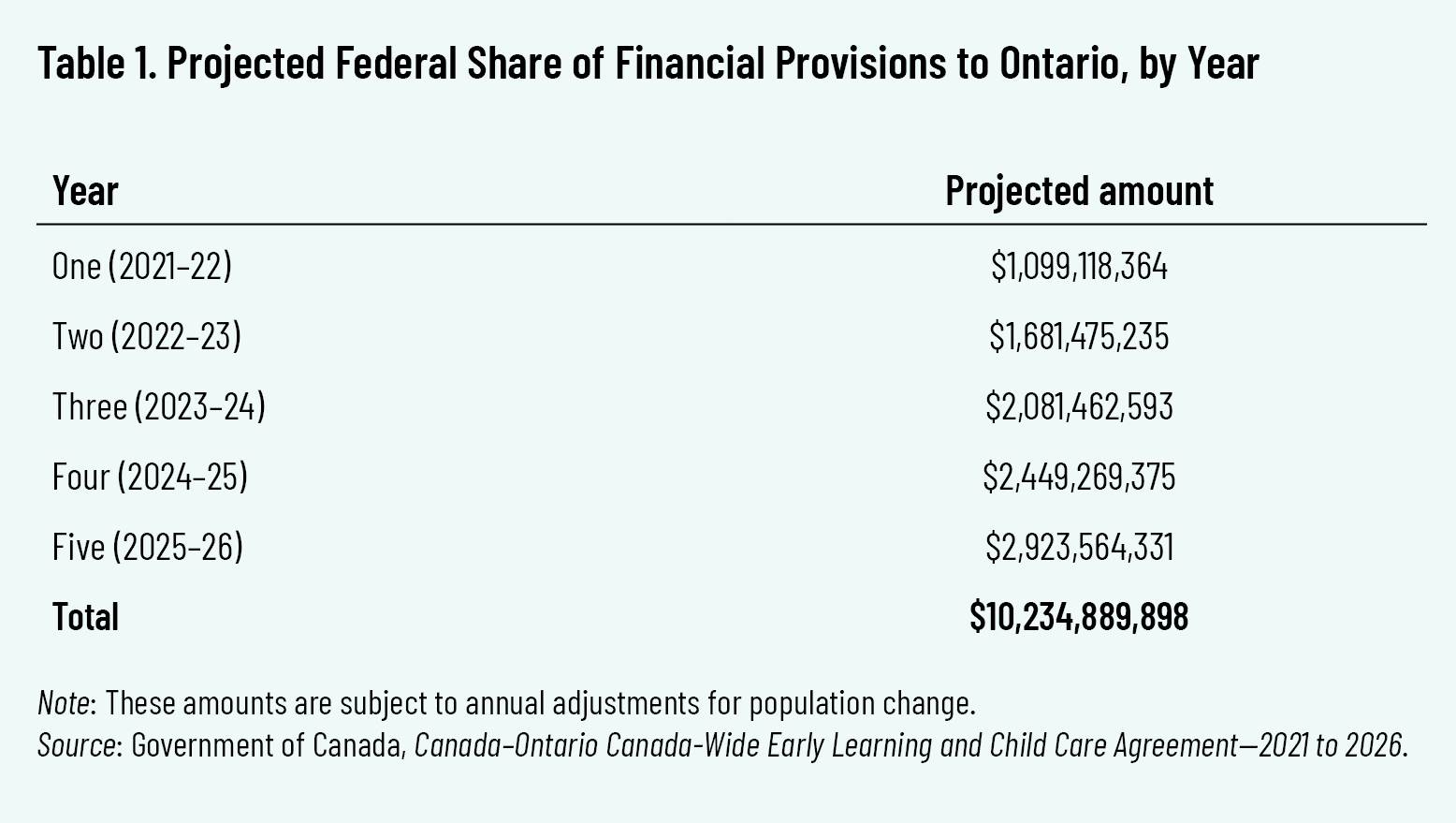
This brief presents the results for Ontario for fiscal years 2022–23 and 2023–24, which are April 1, 2022, to March 31, 2023; and April 1, 2023, to March 31, 2024. 3 3 Ontario received an estimated $1,099,118,364 for 2021–22 that was carried over into 2022–23.
Summary
As the last province to sign on to the federal program (in March 2022), Ontario’s first active year of the Agreement was 2022–23. The province initiated a 25 percent parent fee reduction retroactive to April 2022, reaching a 50 percent fee reduction by December 2022 based on 2022 fee rates established prior to the signing of the Agreement in 2022–though the Agreement establishes 2020 as the baseline year for measuring fee reductions.
Ontario was permitted to count 15,000 previously created spaces toward the targeted 86,000 spaces to be created by the end of 2026. Provincial data show that the number of net new CWELCC spaces as of December 2022 was 12,629 compared to 2019 —the baseline year identified in the Agreement for measuring space growth. This is 2,371 fewer spaces than the 15,000 carried into the Agreement. By December 2023, 25,571 net new CWELCC spaces were created since 2019, short of the 42,000 net new spaces targeted by that date. Even with the new spaces, the Office of the Auditor General of Ontario found that 27 percent of CWELCC spaces in 2023 were empty or not operational.
Ontario met or exceeded most of its inclusion targets for 2022–23 and 2023–24. The province created an Access and Inclusion framework, exceeded targets for the number of French-language and bilingual spaces, and exceeded the budget allocation goal for Special Needs Resources. Despite exceeding the targets, the supply of qualified staff for language and special needs programs continued to be a challenge. Progress toward developing a collaborative strategy with First Nations was slow.
Ontario established a wage floor for workers, which included annual wage increases. While the workforce grew, the province remained shy of the targeted 60 percent of workers holding Registered Early Childhood Educator (RECE) certifications.
The province frequently bundled federal and provincial funding, and directed the funding through service system managers, making it difficult to track spending per Agreement target. The province strategized to carry forward the majority of annual Agreement funding from the early years of the Agreement into its latter years. We estimate that with the carry-over amount from 2023–24 and the estimated allocation for 2024–25, the province had about $4 billion in federal CWELCC funding at its disposal in 2024–25.
Agreement at a Glance
Term: April 1, 2021, to March 31, 2026. 4 4 Ontario signed the Agreement in March 2022 at the end of the first fiscal year of the program. Ontario received funding for the first fiscal year that was carried forward into fiscal year 2022–23.
Federal Funding Estimate
Table 1 displays the projected federal share of financial provisions for each year of the Agreement.
Major Targets
- A 25 percent reduction in parent fees from 2020 levels, retroactive to April 2022, and a 50 percent reduction in parent fees from 2020 levels by December 2022.
- An average parent fee of $10 a day by March 2026.
- Increase the net number of licensed child care spaces based on 2019 levels by 76,700 as of March 2026, and to 86,000 net new spaces by December 2026 (including 15,000 spaces previously created when the Agreement was signed).
- Increase the portion of workers who are Registered Early Childhood Educators (RECEs) to at least 60 percent of all program staff by March 2026.
Pre-Agreement Baseline Measures
- Provincial child care budget over $2 billion in 2020–21 (including $303 million for the Ontario Child Care Tax Credit). 5 5 Ontario Ministry of Education, Ontario’s Early Years and Child Care Annual Report 2021 (2023), http://www.ontario.ca/page/ontarios-early-years-and-child-care-annual-report-2021.
- Average parental fee of more than $46 a day in 2021. 6 6 Government of Canada, Canada–Ontario Canada-Wide Early Learning and Child Care Agreement—2021 to 2026 (2022), https://www.canada.ca/en/early-learning-child-care-agreement/agreements-provinces-territories/ontario-canada-wide-2021.html.
- 298,000 licensed spaces in 2021 for children under age six. 7 7 Canada–Ontario Canada-Wide Early Learning and Child Care Agreement—2021 to 2026.
Agreement Targets and Progress
The Canada-wide Agreements share a similar structure, focusing on four priorities: affordability for parents, increasing access through space creation, making child care more inclusive, and improving the quality of care.
The tables shown here summarize the commitments made, the years in which targets are to be achieved, and the federal funding allocated to the targets under the Agreement. The tables also summarize the progress made toward the target. 8 8 Unless otherwise noted, the results reported here are taken from the following publicly available sources: Government of Canada, Canada—Ontario Canada-Wide Early Learning and Child Care Agreement—2021 to 2026, https://www.canada.ca/en/early-learning-child-care-agreement/agreements-provinces-territories/ontario-canada-wide-2021.html; Ontario Ministry of Education, Ontario’s Early Years and Child Care Annual Report 2023 (March 6, 2024; updated July 11, 2025), https://www.ontario.ca/page/ontarios-early-years-and-child-care-annual-report-2023; Ontario Ministry of Education, Ontario’s Early Years and Child Care Annual Report 2024 (Dec. 5, 2024; updated Oct. 24, 2025), https://www.ontario.ca/page/ontarios-early-years-and-child-care-annual-report-2024; Office of the Auditor General of Ontario, Performance Audit: Canada-Wide Early Learning and Child Care Program (Oct. 1, 2025), https://www.auditor.on.ca/en/content/specialreports/specialaudits/en2025/AR-PA_CELandCCP_en25.html. The following sources were acquired through Freedom of Information Access requests: Pricewaterhouse Coopers LLP, Ontario Ministry of Education—Canada-Wide Early Learning and Child Care (CWELCC) Statement of Revenue and Expenditures for the Period from April 1, 2022 to March 31, 2023; Pricewaterhouse Coopers LLP, Ontario Ministry of Education— Canada-Wide Early Learning and Child Care (CWELCC) Statement of Revenue and Expenditures for the Period from April 1, 2023 to March, 31, 2024; Government of Canada and Government of Ontario, Canada—Ontario Canada-Wide Early Learning and Child Care Program Review Report Jointly Prepared by Canada and Ontario.
Unlike other provinces and territories, federal and provincial child care funding in Ontario flows through forty-seven service system managers (Consolidated Municipal Service Managers, and District Social Services Administration Boards) who plan and manage the provision of child care. Some service system managers also operate municipal/regional child care centres.
Financial reporting does not align with specific targets as it does in the other provinces and territories. The provincial annual reports and the audited financial statements consolidate funding directed to service system managers. Furthermore, the province combines both federal and provincial funds in the annual reports and the audited statements for CWELCC expenditures for 2022–23 and 2023–24.
Affordability
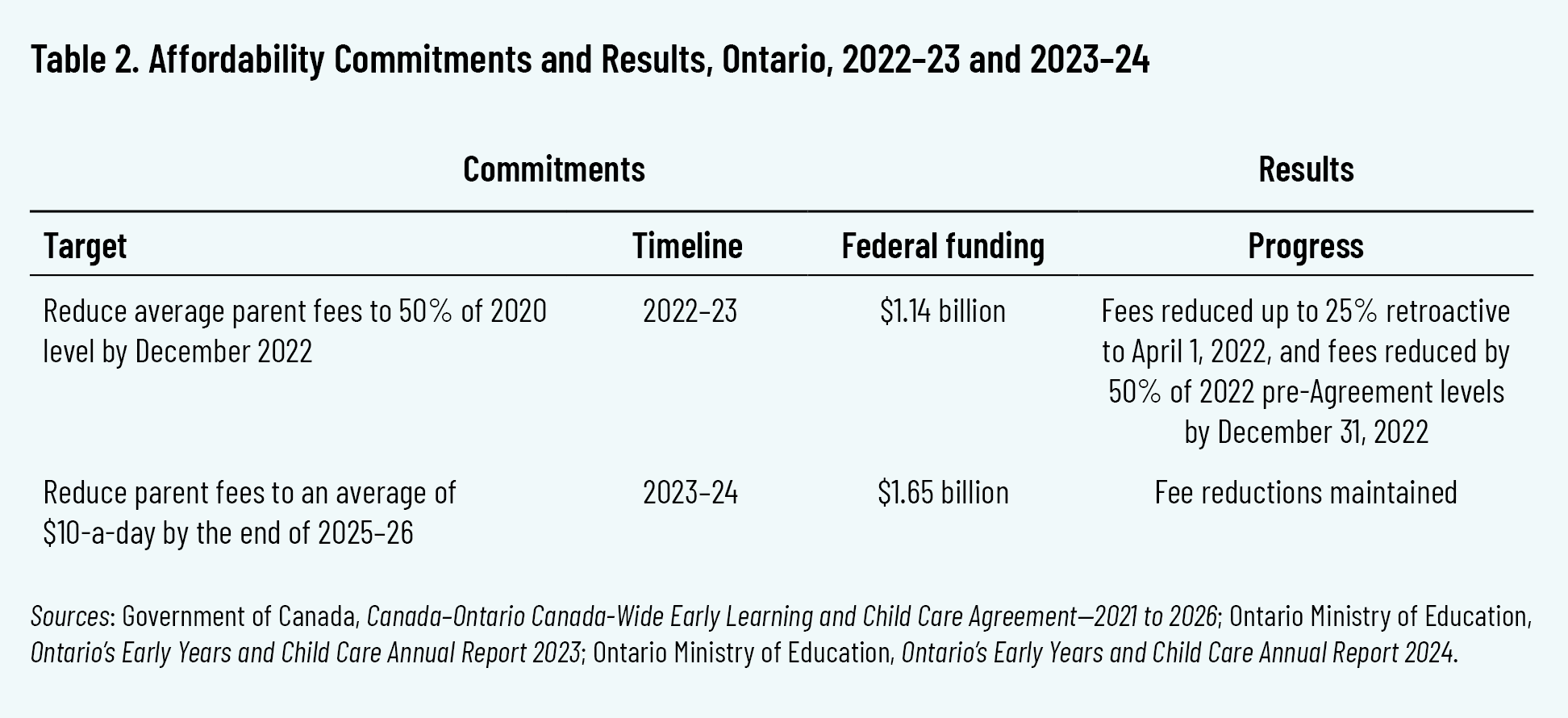
Ontario targeted a 50 percent reduction of parent fees from 2020 levels for children under age six by the end of 2022. The province began by implementing a reduction of 25 percent to a minimum payment of $12 a day, retroactive to April 2022. A second fee reduction was implemented on December 31, 2022, with an estimated average fee reduction of between 48 percent and 55 percent depending on the age group, when compared to the average parent fee in March 2022 before the fee reductions were implemented. The 50 percent fee reduction was essentially maintained in 2023–24. The provincial action plan allocated $1.14 billion in 2022–23 and $1.65 billion in 2023–24 toward fee reductions.
As noted previously, the provincial annual reports and audited financial statements do not isolate fee reduction expenditures from workforce compensation directed to service system managers, making it difficult to compare expenditures with allocations listed in the Agreement.
Accessibility
The province set several targets for space growth over the course of the Agreement. The baseline year to measure space creation growth was 2019. The province was permitted to count toward the Agreement total 15,000 spaces that were created after 2019 but before the Agreement was signed.
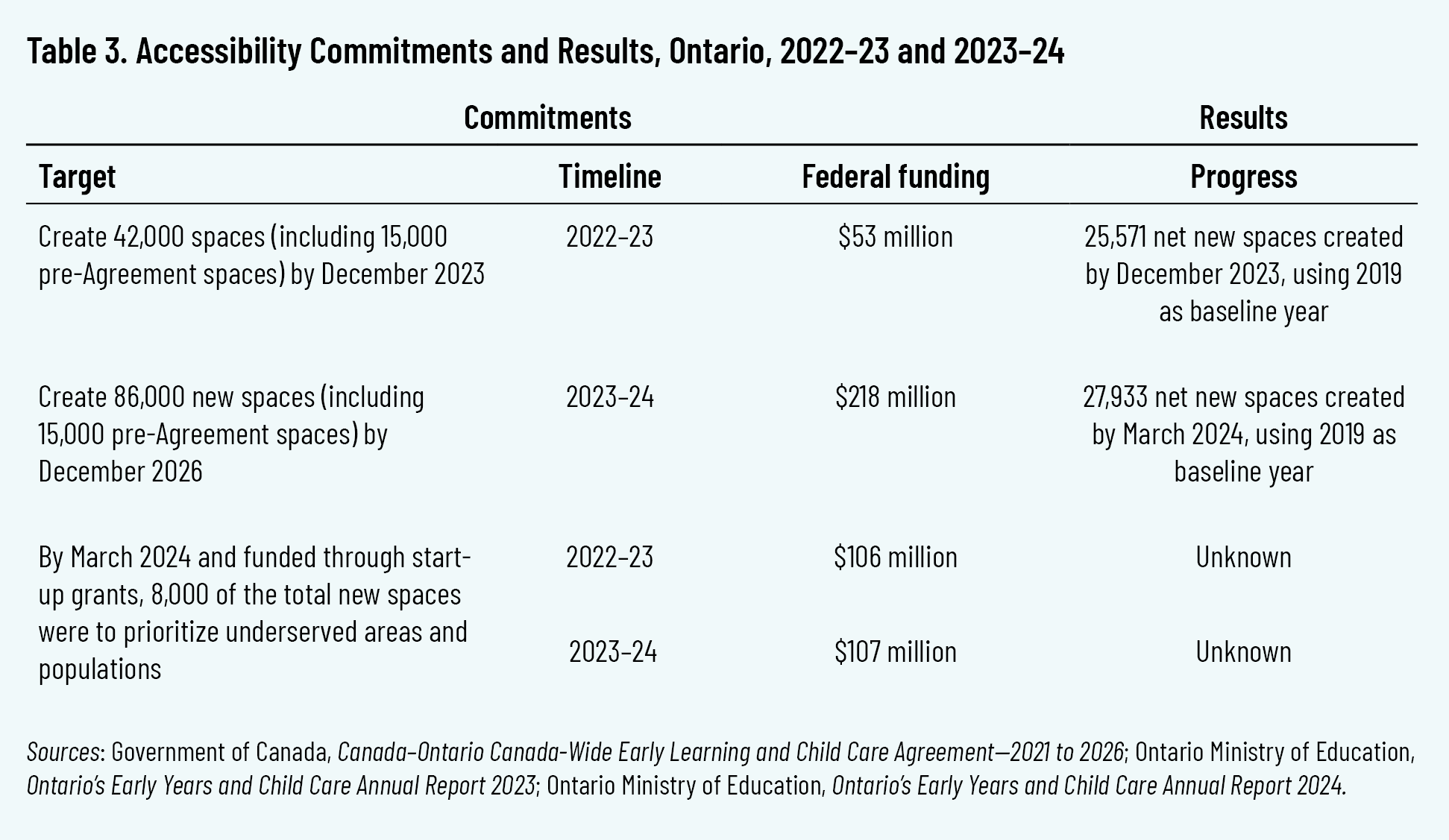
The first target was 42,000 net new spaces by December 2023, when including the previously created 15,000. The second target was 76,000 net new spaces by March 31, 2026, including the 15,000 existing spaces. Finally, the province committed to reaching 86,000 net new spaces by December 2026, when counting the existing 15,000.
By December 2022, the province reported 12,629 net new CWELCC spaces since 2019. Curiously, this total is short of the 15,000 spaces created since 2019 that were to be carried into the Agreement. It should be noted that the 12,629 spaces predate the distribution of Agreement space creation funding to service system managers in the spring of 2023.
A year later in December 2023, a total of 25,571 net new CWELCC spaces had been created since 2019, well short of the targeted 42,000 net new spaces. By the end of the fiscal year in March 2024, 27,933 net new CWELCC spaces had been created. 9 9 In 2022–23 and 2023–24, the province recorded additional new licensed spaces that were not counted toward the CWELCC program.
The Agreement specifies that 18,000 of the 86,000 net new spaces are to be created in underserved areas and for underserved populations such as vulnerable children, children with special needs, Francophone children, and Indigenous children. Priority areas were to be determined by service system managers. The first 8,000 spaces were to be created by March 2024.
The province’s approach to space creation requires the service system managers to create a Direct Growth Plan, prioritizing underserved regions and populations. Service system managers were to administer a start-up grant based on the directed growth plan. Whether the implementation of the Direct Growth Plans achieved the target of 8,000 spaces by March 2024 is not specified in the provincial annual report nor listed in the mid-term implementation assessment. In the fall of 2024 the province revised how spaces were to be allocated across regions. The 2025 Office of the Auditor General of Ontario’s report concluded that the province shifted focus from underserved regions to regions with higher potential to create spaces. 10 10 Office of the Auditor General of Ontario, Performance Audit: Canada-Wide Early Learning and Child Care Program (2025), 21, https://www.auditor.on.ca/en/content/specialreports/specialreports/en25/AR-PA_CELandCCP_en25.pdf.
Inclusion
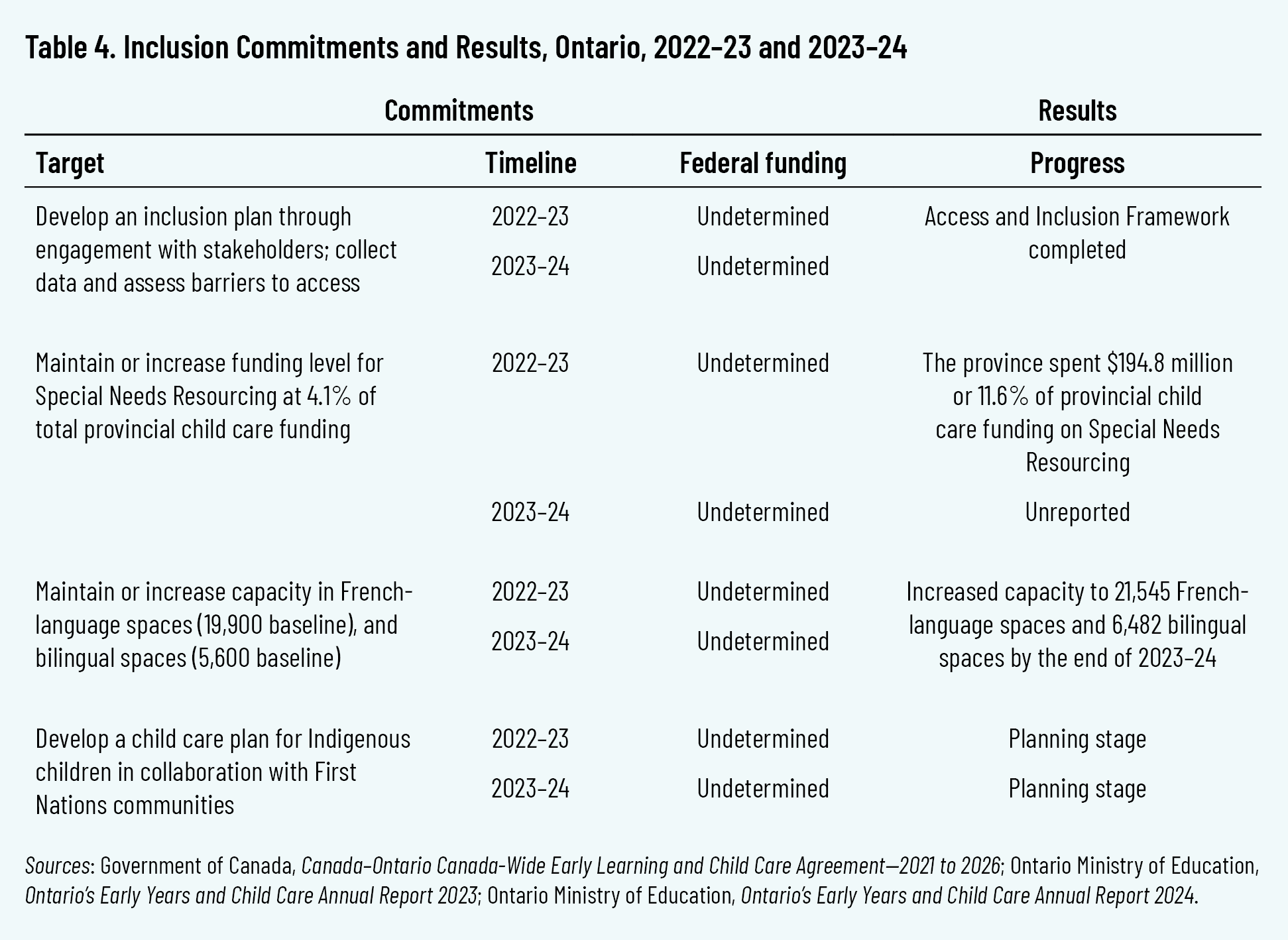
The action plan identified four target areas related to inclusion, but it did not determine the amount of funding allocated to each target.
The province developed an Access and Inclusion Framework in consultation with stakeholders as specified in the action plan.
Ontario committed to maintaining or increasing the level of spending on Special Needs Resourcing at 4.1 percent of total provincial child care funding. The province reported spending $194.8 million or 11.6 percent of provincial child care funding on Special Needs Resourcing, serving 44,092 children in 2023.
The province also committed to maintaining or increasing the baseline number of French-language child care spaces (19,900 spaces) and the number of bilingual child care spaces (5,600 spaces) for children under age six. By the end of 2023–24, Ontario exceeded the baseline number of spaces, increasing the number of French-language spaces to 21,545 spaces and the number of bilingual spaces to 6,482 spaces.
In 2022–23 and 2023–24, the province stated that it was in the early stages of developing a plan for Indigenous child care in consultation with First Nations leaders. The mid-term implementation assessment of the federal child care plan in Ontario stated that on-reserve First Nation leaders were concerned about lack of access to federal CWELCC funding.
Despite the relative success in implementing inclusion targets in 2022–23 and 2023–24, the mid-term implementation assessment stated that there was a shortage of French-speaking RECEs and a shortage of qualified staff to serve children with diverse needs.
Quality
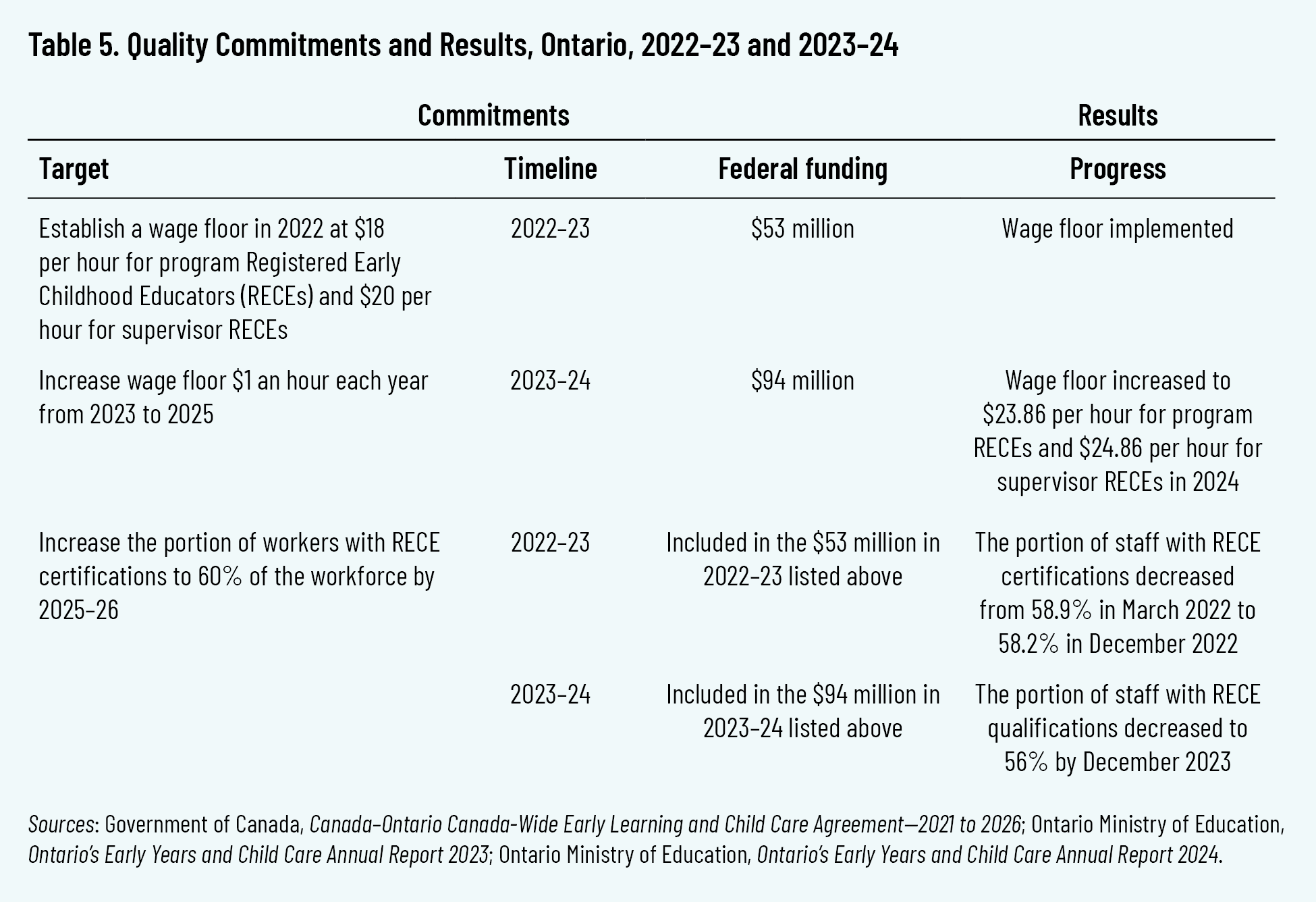
The province identified two quality issues to be addressed under the Agreement. 11 11 The province also pursued additional workforce initiatives under a separate bilateral agreement not reported here. First, Ontario committed to establishing a wage floor for workers that included an annual wage increase. Second, the province committed to increasing the portion of workers who were certified RECEs.
In 2022, the wage floor was established at $18 per hour for RECEs and $20 per hour for RECE supervisors. These amounts increased to $23.86 per hour for RECEs and $24.86 per hour for supervisors in 2024. The wage eligibility ceiling topped out at $26 per hour for RECEs and $29 per hour for supervisors. The number of workers receiving wage increases rose during 2022–23 and 2023–24. The province stated in the mid-term implementation assessment report that increases in wages were limited because parental fee reductions required a significant amount of federal funding, preventing the province from spending more on wage enhancements.
The portion of qualified workers declined from 58.9 percent in March 2022 to 56 percent by December 2023. As the workforce expanded, the portion of non-RECE workers increased faster that the portion of certified RECEs.
The province allocated a total of $53 million toward quality initiatives under the Agreement in 2022–23, and $94 million in 2023–24. Workforce expenditures and fee reduction expenditures were combined in the audited financial statements, and included federal and provincial funding, making it difficult to determine how much federal funding the province spent on quality initiatives.
Administration
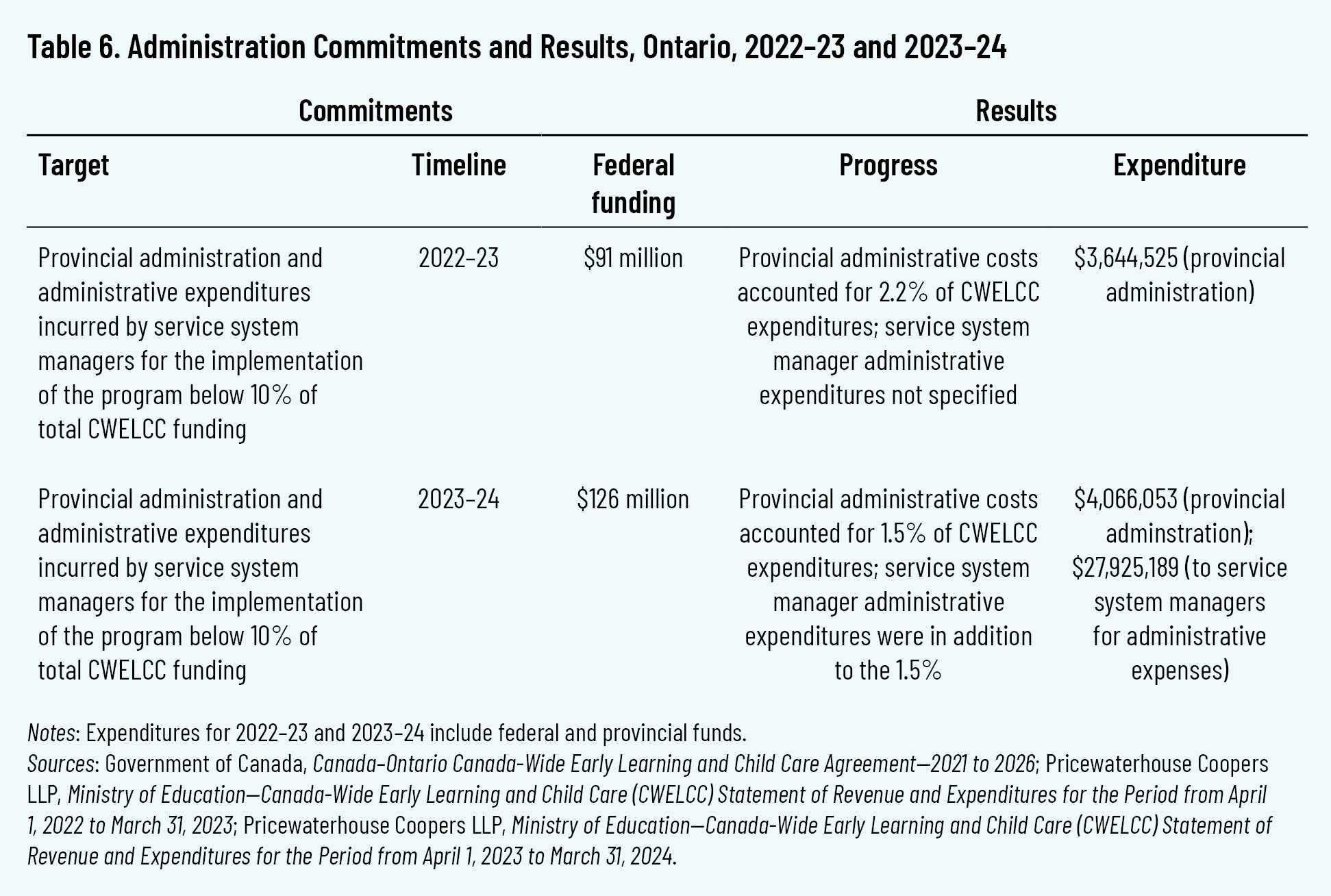
The provinces and territories are permitted under the Agreement to spend up to 10 percent of funding on administration costs related to the implementation of the program. As with other regions, Ontario spent well below the 10 percent cap.
The province reported spending $3,644,525 on provincial administration in 2022–23, and $4,066,053 in 2023–24. Records suggest that the province allocated $27,925,189 to the service system managers for administrative expenses incurred while implementing aspects of the CWELCC program in 2023–24. Similar expenditures for 2022–23 are not specified in the audited financial statements.
Overview of Expenditures
Annual federal allocations increase year over year for all provinces and territories. Ontario’s agreement is similarly structured; however, as the province signed the Agreement at the close of the first fiscal year (2021–22), Ontario was permitted to receive and carry forward the first-year allocation into the second year (2022–23). The province strategized to carry forward large portions of federal funding from the early years of the Agreement into the latter years, anticipating a rapid growth in expenditures.
Having carried over 100 percent of the 2021–22 allocation into 2022–23, Ontario was permitted to carry over 95 percent of the funding amount for 2022–23 into 2023–24, but actually carried over 90 percent, or $1,508,405,552, into 2023–24.
In 2023–24, the province carried over 75 percent of that year’s allocation into 2024–25, which was the full allowable portion, accounting for $1,556,023,316.
With the combination of carry-over funds and federal annual allocations, Ontario entered 2022–23 with $2,780,768,546 on hand, and $3,587,002,293 in federal funding in 2023–24. We estimate that with the 2023–24 carry-over and 2024–25’s forecasted federal allocation, Ontario had over $4 billion in federal CWELCC funding entering 2024–25.
Despite this strategy, the province reported in the mid-term implementation assessment that if the terms of the current Agreement were carried into 2026–27, the CWELCC initiative would face a $1.95 billion shortfall for that fiscal year.

Legislative and Policy Changes
The transition to the CWELCC program required many policy adjustments across the country. Perhaps the most significant policy change in Ontario was the introduction of a revenue replacement funding model in 2022. The intent of the formula was to replace money that providers lost due to the introduction of the parental fee reductions. This policy governed the funding arrangement between providers and service system managers through the 2022–23 and 2023–24 fiscal years reviewed in this report.
One challenge faced by many providers under the formula was that funding risked falling short of operational costs. Providers agreed to freeze parent fees when they joined the CWELCC program, but operational costs continued to increase. Furthermore, some operators had frozen their fees in response to the COVID-19 pandemic, and their fees remained artificially low when they joined the CWELCC program—an unsustainable situation. The province responded by exploring options for a new funding formula in 2023, eventually introducing a cost-recovery model in January 2025.
Additional Observations
The Office of the Auditor General of Ontario released a performance audit of the CWELCC program in Ontario in October 2025. The report reviewed data over the course of the Agreement, and provided findings correlating with 2022–23 and 2023–24.
Among the striking findings, the report revealed a decline in the portion of lower income families using CWELCC spaces. Enrollment among “typically lower-income” families decreased by 31 percent when compared to 2019. 12 12 Performance Audit: Canada-Wide Early Learning and Child Care Program, 4.
The Auditor General’s report highlighted an important, yet under-reported, aspect of accessibility. In 2023, 80,500 CWELCC spaces were empty or non-operational, accounting for 27 percent of all CWELCC spaces in the province. 13 13 Performance Audit: Canada-Wide Early Learning and Child Care Program, 25. Furthermore, the report found that 43 percent of centres enrolled in the CWELCC program were operating at or below 80 percent capacity in 2023. 14 14 Performance Audit: Canada-Wide Early Learning and Child Care Program, 25.