

Table of Contents
Table of Contents
Key Points
- Social isolation and loneliness has been recognized as a pressing issue of public health, with profound health consequences for those affected.
- Various research studies have suggested that religion or spirituality can help protect against isolation and loneliness, as well as alleviate it if it does occur. Yet the role that faith communities play in this respect has been little studied.
- In 2025, Cardus conducted a nationwide survey of Christian clergy and church leaders on the topic. The results are not generalizable but provide an exploratory account of these leaders’ concerns with isolation and loneliness within their congregations and in the surrounding community, and the potential solutions they offer.
- The survey found that many church leaders are concerned about isolation and loneliness—and believe that these problems have worsened over the past five years. Respondents estimated that about one-fifth of their congregants are affected, across all demographic groups.
- Churches provide significant support and connection for their congregants through the primary purpose of the church: worship. In addition, they offer many programs and informal practices that keep congregants and the broader community connected and that help to address the risk of isolation for those who are ill, homebound, or facing other challenging circumstances.
- Governments and civil-society organizations should bring focused attention to isolation and loneliness in Canada, to study its prevalence and effects and to gather evidence to better understand the important role that civil-society groups, including faith communities, play in alleviating this public health crisis.
Introduction
Social isolation and loneliness has been recognized as a pressing issue of public health, with profound consequences for those affected, including higher rates of illness and death, and implications for the health system at large.
Polling by the Angus Reid Institute in partnership with Cardus, as well as survey data from Statistics Canada, reveal that approximately one half of Canadians say that they experience isolation or loneliness. 1 1 Angus Reid Institute, “A Portrait”; Statistics Canada, Table 45-10-0048-01: Loneliness by Gender and Province. Complete citations are provided for all sources at the end of this report. Canadians in marginalized groups, such as Indigenous persons, new immigrants, or those living with disabilities, are more likely than others to say that they often or always feel lonely, a finding that suggests a connection between isolation and loneliness and socioeconomic inequality. The Angus Reid Institute–Cardus poll also finds that Canadians who are more religiously active are less likely to say that they experience isolation or loneliness.
Although research suggests that religion or spirituality can help protect against isolation and loneliness, and help alleviate it if it does occur, little research explores how faith communities, as opposed to an individual’s religious beliefs and practices, may contribute to these outcomes.
Social isolation refers to an objective lack of social relationships, whereas loneliness refers to a subjective lack of social relationships, in which the person perceives the quality of their relationships as insufficient. These concepts and their health consequences are explored in more detail in a previous Cardus report, which laid out the existing research on the relationship between isolation, loneliness, and religion: namely, that those who actively practice a faith are less likely to experience isolation and loneliness than those who do not. 2 2 Vachon and Allatt, “Social Isolation,” 19. Although research suggests that religion or spirituality can help protect against isolation and loneliness, and help alleviate it if it does occur, little research explores how faith communities, as opposed to an individual’s religious beliefs and practices, may contribute to these outcomes.
To better understand the role that faith communities play in addressing this issue, Cardus conducted a nationwide survey of Christian clergy and church leaders in the spring of 2025. 3 3 The scope was limited to Christian communities for practical reasons—both to limit the population of potential respondents and to capitalize on Cardus’s existing connections with Christian church leaders. Research on other faith communities in Canada is needed, and the present study may help inform such future research. It examined (1) these leaders’ concerns with isolation and loneliness within their church communities, (2) the programs and activities, and informal practices, that their churches offered, (3) what challenges, if any, their churches faced in addressing the issue, and (4) what solutions might exist for responding to those challenges.
Methodology
Survey Development
The survey instrument was developed in consideration of existing research discussed in the previous Cardus report and in consultation with faith leaders already known to the researchers, from various Christian denominations. The survey was created in English and translated into French.
The target respondents were Christian clergy and others involved in a leadership position in a church. For the purposes of the study, a church was defined as a place of worship. The researchers asked that just one respondent per church complete the survey.
The survey was disseminated in several ways. It was sent by email to approximately 1,200 clergy and church leaders whose contact information was already in Cardus’s database. It was also sent to approximately 13,000 subscribers to Cardus newsletters, with a request that, if they belonged to a church, they forward it to their clergy or church leader. Follow-up emails were sent to remind and encourage participation.
The researchers also contacted the leaders of several church denominations to request their assistance in disseminating the survey to their member churches. This denominational information was identified online. 4 4 Given that dissemination of the survey relied heavily on existing church lists and contact information that was publicly available from denominations, the researchers’ outreach to non-denominational churches was relatively limited and thus represents a weakness of this study. The researchers made particular effort to contact churches in regions where Cardus email lists had less reach, such as northern regions and Atlantic Canada. Approximately 7,000 people were directly contacted by Cardus personnel. 5 5 PDFs of the survey questions were also included in outreach emails, because researchers thought that church leaders would be encouraged to participate if they could quickly get a sense of the survey without having to click through the Survey Monkey version, and because researchers hoped that the denominational leaders contacted would be more likely to forward the survey to their member churches. In two cases, respondents answered directly on the PDF document and returned the file to the research team by email. In these two cases, the researchers manually entered the data into Survey Monkey.
The survey was open from March 24 to May 3, 2025, and Survey Monkey was used to collect the responses. Later in this period, the researchers engaged in additional outreach, through the means already described, to reach more respondents in regions and denominations with low response rates, such as Catholics in northern regions.
In total, over 20,000 people were contacted, and an unknown additional number were reached who learned of the survey through media coverage of the project or who were forwarded the survey by people outside of Cardus. 6 6 Amundson, “Cardus Studies Faith Response to Loneliness.”
Analysis
A total of 468 survey responses were received, of which 368 remained after data cleaning. 7 7 Data cleaning included removing duplicate responses, where the same respondent had attempted the survey more than once (n=3), and removing incomplete surveys (n=93). In a few cases, where multiple leaders of a church responded, the lead pastor’s responses were privileged. Any additional data provided by other respondents from the same church were added into the main response (n=4). The 48 French and 320 English responses were combined into a single data set for analysis, with the original language of the response indicated. The data were then broken out according to various demographic, denominational, and linguistic (French and English) groups. The list of denominations used in the survey, and the researchers’ later grouping of these denominations into broader categories, were based on the categorization used in previous polls conducted by Angus Reid Institute polls with Cardus, which is itself based on Statistics Canada’s list of Christian denominations. For comparison purposes, the findings are reported according to these broader categories: Catholic, Mainline Protestant, and Evangelical Christian. The very small number of respondents who were Orthodox Christian (n=3) or “Other denomination” (n=1) precludes meaningful comparison.
Overall, Evangelical churches had the highest portion of responses (41 percent of total responses), followed by Mainline Protestants (32 percent of total responses). Catholic responses were quite low considering the large number of Catholic churches in the country. However, some Catholic respondents indicated that they pastored more than one church. 8 8 Denominational responses also varied by region, such as a low Catholic response in Ontario. Such differences are likely related to the means of dissemination, with people in Cardus’s existing network more likely to share the survey in some denominations and regions than others, rather than reflecting the actual number of churches in a denomination in a particular region. Although some notable differences were seen at a specific denominational level (e.g., Mennonite or United Church respondents), the researchers regarded such differences with considerable caution, due to the small sample size.
For reporting of findings, the Atlantic provinces were grouped together, as were Manitoba and Saskatchewan (referred to as the Prairies in this report), and the territories. Because just four responses from the territories were received, despite outreach efforts, they are not presented in most comparisons.
The survey also classified respondents by church size. To gauge size, the researchers asked respondents both for their average weekly attendance and for their registered membership. Average weekly attendance was assumed to be the better measure of regular, active participation in the church, but we inquired about registered membership also, since it may include members who are unable to attend weekly services, such as the homebound, but who are still engaged with the church through pastoral visits or in other ways. (Note that “registered membership” does not apply to some churches if they do not use that sort of structure.) Sixty-two percent indicated an average weekly attendance of 1–150, which was classified as “small” in this analysis.
Content analysis was used to assess the qualitative data resulting from the survey’s four short-answer questions. This analysis was conducted in stages. First, three researchers reviewed the responses to each question independently and documented their observations. 9 9 English is the first language of two of the researchers, and French is the first language of the third. The researchers also differed by Christian denomination, allowing for a wider range of experience in reviewing the responses. Each researcher identified similarities, differences, and overall themes across the responses, according to a protocol established by the research lead. This approach helped prevent one person’s analysis from biasing another’s and increased researchers’ confidence in observations that all three made independently. 10 10 This approach can lend a “certain degree of inter-subjectivity and inter-researcher reliability” to qualitative analysis. Van Thiel, Research Methods, 150.
The research team then met in person to discuss their independent observations and to create a codebook of themes. 11 11 A codebook lists and organizes codes: “A code is a shorthand way of indicating what a certain qualitative data unit (such as a text fragment or interview report) actually means. It is, as it were, a brief summary of the main attributes or features of the unit. By assigning the same code to data units that pertain to the same or a similar subject, the researcher creates the possibility to compare the different data units.” Van Thiel, Research Methods, 143. NotebookLM was then used to organize the data based on this codebook and facilitate the analysis of themes. 12 12 Google’s NotebookLM is an AI tool. The anonymized qualitative data were entered, as was the codebook. Direction was then provided to NotebookLM to analyze the data based on the codebook. Because NotebookLM cites back to the source material it is given, the researchers were able to confirm how the analysis was organized and presented.
Limitations
The study aimed to be exploratory, and it does not attempt a comprehensive description of the data. An exploratory approach is often appropriate when little prior research exists, as is the case here, where previous research has established a relationship between faith adherence and lower social isolation and loneliness, but little research has studied the possible influence of Christian churches in this relationship. As such, the findings presented here should be taken as preliminary rather than conclusory.
Because the sample was not random, nor sufficiently large that it could be weighted for representativeness, the results should not be taken as representing the entire population of Christian churches in Canada. The results describe the sample and further study is warranted.
Findings
Concern About Social Isolation and Loneliness
Overall, respondents indicated a significant level of concern about isolation and loneliness in their congregants. Respondents estimated that about one-fifth of their congregation was isolated or lonely. This finding was consistent across regional, denominational, urbanicity, and church size groups. 13 13 Respondents from a few Protestant denominations reported a higher percentage than the national average. Without further research and larger samples, the reason is unclear.
When asked, “To what extent do you agree that social isolation and/or loneliness is a challenge for your church community?,” over two-thirds (64 percent) agreed that it was. 14 14 Agreement here and throughout the paper refers to the total of “strongly agree” and “agree” responses. Disagreement refers to the total of “strongly disagree” and “disagree” responses. The level of agreement was noticeably higher among French respondents, at 73 percent agreement, than among English respondents, at 62 percent.
Respondents in Quebec, the Atlantic provinces, and Alberta had slightly higher levels of agreement, and those in British Columbia slightly lower, than the national average. Respondents in the Atlantic provinces also had a notably lower level of disagreement, at 7 percent, compared to those in other regions, where disagreement ranged from 13 to 22 percent.
Agreement was slightly higher among Evangelicals than among Mainline Protestants or Catholics. However, disagreement was also slightly higher among Evangelicals, at 18 percent (net), and Mainline Protestants, at 17 percent, compared to Catholics, at 12 percent.
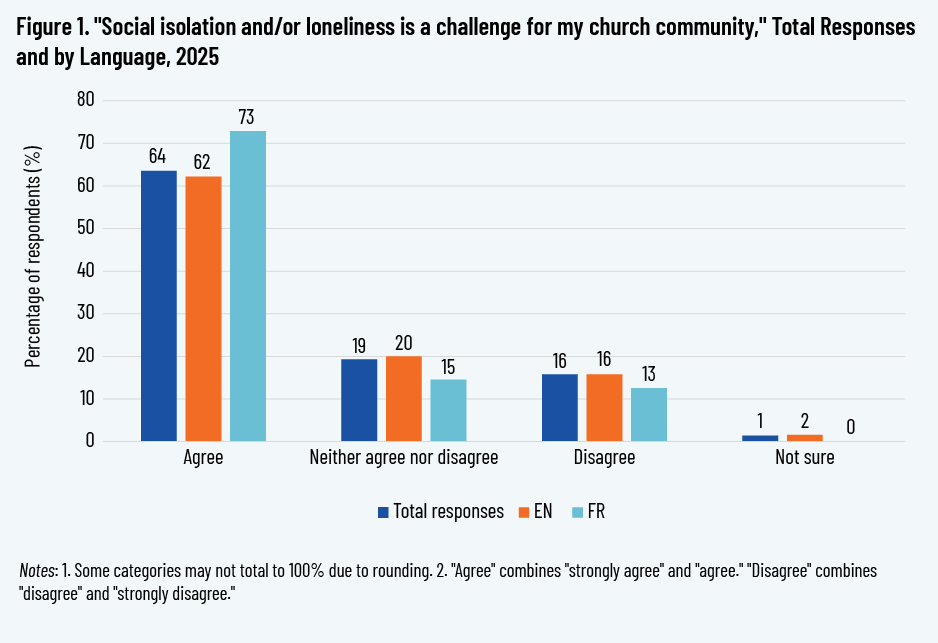
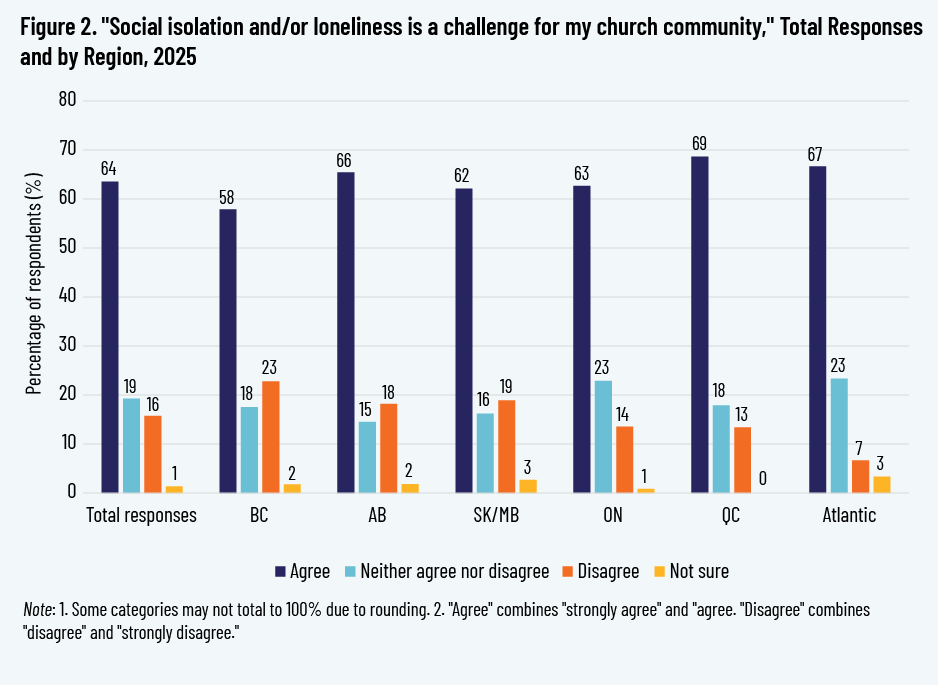
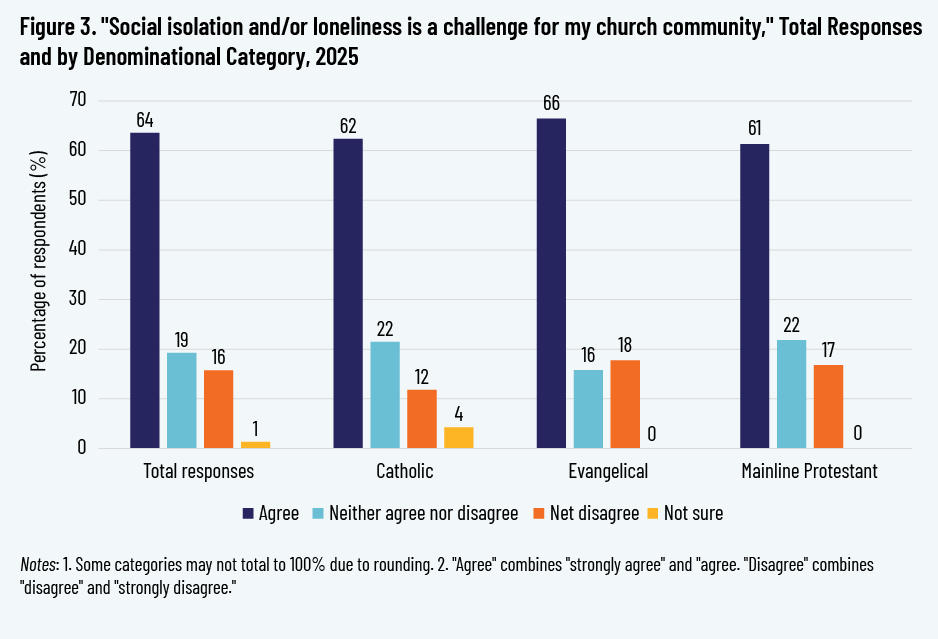
Respondents estimated that about one-fifth of their congregation was isolated or lonely. This finding was consistent across regional, denominational, urbanicity, and church size groups.
Of respondents who indicated that isolation and loneliness was a challenge for their congregants, a large majority (73 percent) indicated that there had been an increase in isolation and loneliness over the past five years.
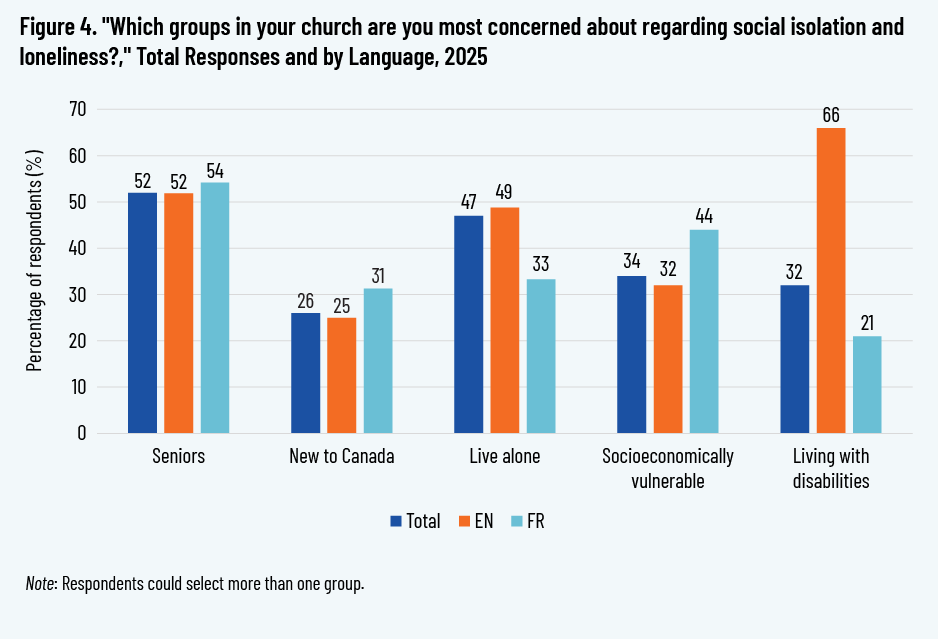
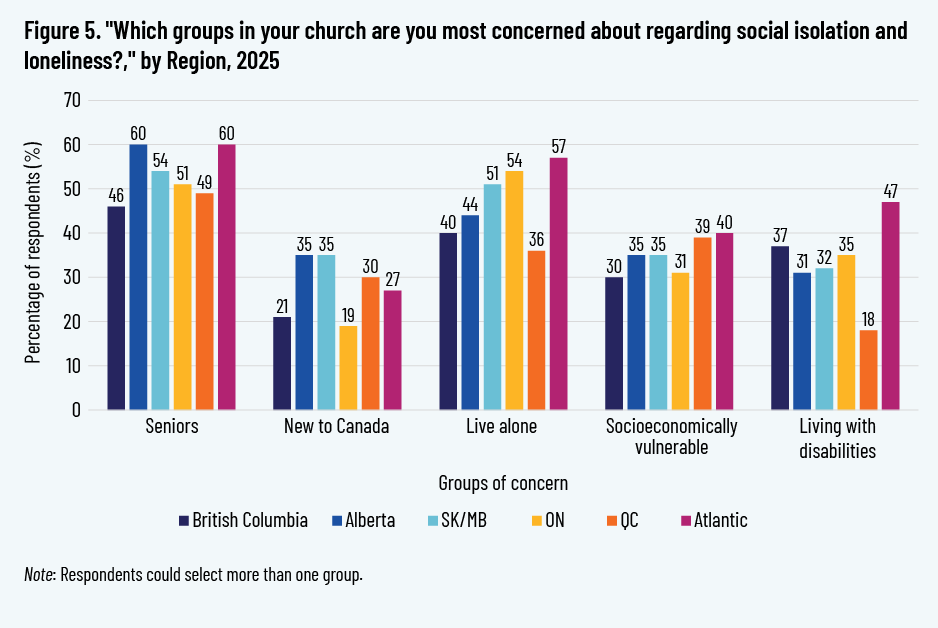
The respondents who agreed that isolation and loneliness was a challenge were also asked which groups in their church they were most concerned about in this regard. 15 15 Respondents were able to select all groups they were most concerned about from a listing of the following groups: Seniors; New to Canada; Those who live alone; Those who live with socioeconomic vulnerabilities; Those who experience challenges with physical, intellectual or developmental disabilities. Options of “Not sure,” “Not applicable,” or “Other (please specify:_____)” were also provided. These groups were identified through the literature reviewed as part of the Cardus backgrounder report. See Vachon and Allatt, “Social Isolation.” Because the wording of the question referred to groups “most concerned about,” it is possible that respondents were still concerned to some extent about groups they did not select. Approximately one half of these respondents (52 percent) indicated a concern for seniors, and for those who live alone (47 percent). Concern for seniors was higher (at 60 percent) among respondents in the Atlantic provinces and in Alberta. Across denominational categories, concern was quite similar for seniors (50 to 56 percent) and for those living with socioeconomic vulnerabilities (33 to 37 percent). For those new to Canada, rates of concern varied across denominational categories: 18 percent for Mainline Protestant respondents, 29 percent for Evangelicals, and 32 percent for Catholics. (It is possible that new Canadians are more likely to attend Evangelical or Catholic churches and thus this item measured presence of new Canadians in the congregation as much as it measured concern.) Concern for those who lived alone also varied among denominational categories, with Catholics at 35 percent, Mainline Protestants at 48 percent, and Evangelicals at 53 percent.
Differences between French and English responses on this question can be seen as well. A notably lower percentage of French respondents (21 percent) expressed concern that congregants with physical, intellectual, or developmental disabilities were lonely or isolated, compared to 66 percent of English respondents.
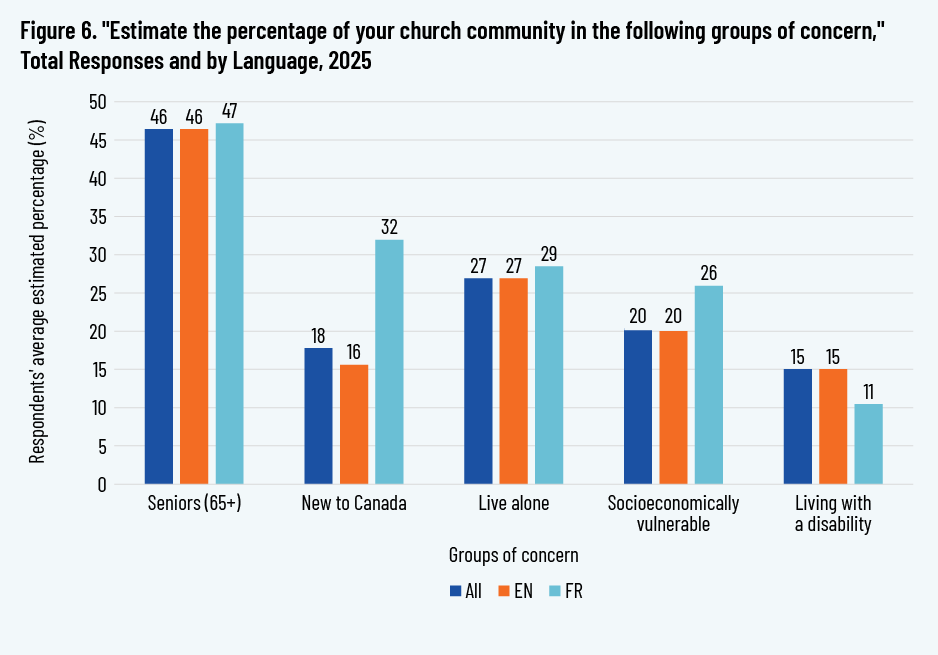
That respondents were concerned about isolation or loneliness for these groups is quite pertinent, given the size of such groups within congregations. For instance, when asked about the percentage of their congregation that belonged to each specified group, respondents estimated that seniors made up almost half of their congregations (47 percent), on average. Interestingly, French respondents estimated that new Canadians made up a higher percentage of their congregation (32 percent) than did English respondents (16 percent). 16 16 Respondents were asked to estimate the percentage of their congregants in each group. The totals do not equal 100 percent, as the groups are not mutually exclusive.
Church Programs Offered
Overview
Respondents were asked about programs their church offered and how effective they thought these programs were in addressing isolation and loneliness. The list of programs and activities that the survey offered as response options was developed based on available literature 17 17 See for instance: Garland, Simmons, and Hadgraft, Right Up Your Street; Banu, Liladrie, and Noka, The Role of Faith Communities. and with the input of members of several church denominations.
Respondents could select all relevant programs from a list, and could add one or more “other” programs not listed. The research team subsequently categorized each program as “faith-focused,” “practical-needs focused,” “social-needs focused,” or “N/A,” based on the team’s best judgement of each program’s primary purpose.
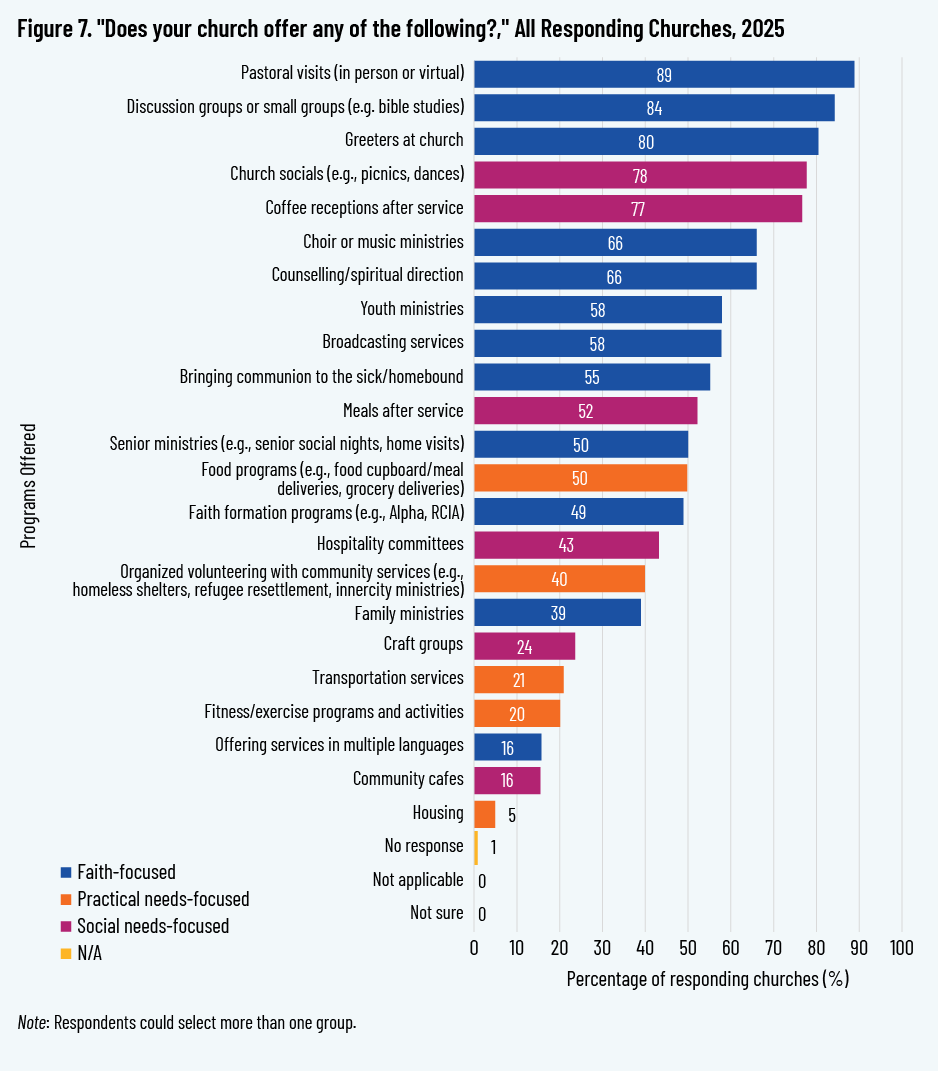
The most common programs offered were pastoral visits (89 percent of respondents indicated that their church offered this), followed by discussion groups or small groups (84 percent), greeters at church services (80 percent), church socials (78 percent), and coffee receptions after church service (77 percent). Of note, approximately half of respondents said that their church offered programs specifically for seniors and youth, which are populations at a greater risk of isolation or loneliness. 18 18 For more information about the incidence of isolation and loneliness among seniors and youth, see Vachon and Allatt, “Social Isolation.”
By Region
The most common programs that respondents said their church offered varied across the country. In Atlantic Canada, 70 percent of respondents indicated that their church offered food programs, compared to 37 percent of Quebec respondents, and ranging between 45 and 57 percent for the remaining regions. Given that Atlantic Canada has the highest concentration of seniors relative to its population as a whole, 19 19 Office of the Seniors’ Advocate Newfoundland and Labrador, Seniors’ Report 2024, 2. it was unsurprising that this region had the highest percentage of respondents who said that their church had programs for seniors (67 percent, compared to between 42 and 56 percent in the other regions). The lowest percentage of respondents who said that their church offered counselling and spiritual direction was in Atlantic Canada, at 47 percent, compared to 71 percent in Alberta, or between 64 and 69 percent in the other regions.
About half of all respondents said that their church offered Communion to the sick or homebound, with the highest percentage in Alberta, at 67 percent, followed by Atlantic Canada (63 percent). In some churches, Communion is practiced infrequently or not at all, so it would not be relevant to all respondents.
Central Canada had the highest percentage of respondents whose church offered broadcasting services, whereby worship services are streamed online for congregants to watch live or at another time, at 67 percent in Ontario and 61 percent in Quebec, compared to between 49 and 53 percent in other regions. British Columbia had the highest percentage of respondents whose church offered meals after church services, at 65 percent, compared to 37 percent in Quebec and between 49 and 56 percent in the other regions.
Some interesting differences appear when comparing the responses from Quebec with the rest of Canada. Pastoral visits was the program most often mentioned in Quebec: three-quarters (75 percent) of respondents said that their church provided pastoral visits, but this is noticeably lower compared to the rest of Canada, where it was reported by 92 percent of respondents.
Interestingly, only 24 percent of respondents in Quebec said that their church offered organized volunteering, such as with community services (e.g., homeless shelters, refugee resettlement, inner-city ministries), compared to 44 percent in the rest of Canada. Similarly, a quarter of Quebec respondents (25 percent) said that their church had a hospitality committee, compared to nearly half (47 percent) of respondents outside of Quebec, and about 60 percent of Quebec respondents said they offered coffee receptions and greeters at church services, compared to 80 percent of respondents outside of Quebec. A similar pattern emerged with discussion groups: about 64 percent of Quebec respondents indicated that their church offered discussion groups, as did 89 percent of respondents in the rest of Canada. However, Quebec had the highest percentage of respondents whose church offered services in more than one language (31 percent compared to the rest of Canada at 12 percent).
Despite these regional differences, the overall breakdown by program category did not vary much. On average, across Canada as a whole, 60 percent of programs are focused on faith, 24 percent on social needs, and about 10 percent on practical needs.
By Denomination
The programs differed notably by church denomination, but, broadly speaking, the breakdown by category (faith, social needs, practical needs) was almost identical. This may suggest that, while the specific programs within each category varied, churches were overall aiming to address similar needs.
Catholic churches were the least likely to offer meals after services: 41 percent of Catholic respondents indicated that they did, compared to half (51 percent) of Mainline Protestants and three-fifths (60 percent) of Evangelicals. Catholics were also least likely to say that their church offers organized volunteering, at 28 percent, compared to 44 percent of Evangelicals and 45 percent of Mainline Protestants.
On the other hand, a higher percentage of Catholics said that their church had hospitality committees, at 51 percent, compared to 40 percent of Evangelicals and 40 percent of Mainline Protestants. About two-fifths (37 percent) of Catholics said that their church offered broadcasting services, compared to about two-thirds of Evangelicals and Mainline Protestants (64 percent and 65 percent, respectively). Catholics were the most likely to say that their church offers faith-formation programs (e.g., Alpha, RCIA), at 78 percent, compared to 29 percent of Mainline Protestants and 47 percent of Evangelicals.
Mainline Protestant churches were most likely to offer coffee receptions, with 95 percent of these respondents indicating that this program was offered, compared to 67 percent of Evangelicals and 70 percent of Catholics. As for programs intended for specific types of congregants, Mainline Protestants were the least likely to indicate that their church offered youth programs and family programs, at 45 percent and 23 percent, respectively. About 60 percent of Catholics and 66 percent of Evangelicals indicated that their church offered youth programs, and about 44 percent of Catholics and 49 percent of Evangelicals said their church offered programs for families. Counselling and spiritual direction was least reported among Mainline Protestants, where just over half (55 percent) indicated that their church offered it, compared to about 70 percent of Catholics and 71 percent of Evangelicals.
By Church Size
Program offerings varied according to church size. For instance, 29 percent of small churches had hospitality committees, compared to 61 percent of medium-sized churches (average weekly attendance of 151-500) and 79 percent of large churches (average weekly attendance of 501 or more). Of small churches, 43 percent offered youth programs, compared to 81 percent of medium-sized churches and 82 percent of large churches. As for faith-formation programs, 32 percent of small churches offered them, compared to 70 percent of medium-sized churches, and 89 percent of large churches. However, the breakdown of faith-focused, social needs-focused, and practical needs-focused categories was similar across church size.
Themes in the Written Responses
Respondents provided qualitative data through short-answer questions that asked them to describe the church programs or activities that they believed specifically contribute to building community and alleviating isolation and loneliness, even indirectly. In addition, they were asked to describe any partnerships between their church and other churches, organizations, or groups that likewise contributed to this goal. Respondents described a variety of partners: other local churches and Christian organizations and non-religious groups and organizations. Some also described state-associated partners, such as municipalities, schools, and public agencies.
Degree of Formality
One theme identified pertained to differing levels of formality within the programs and partnerships that respondents described. More formal programs were run or organized by the church itself, but some respondents also mentioned less formal activities, in which congregants supported one another or informally organized to meet needs. Such informal activities included snow removal, yard work, delivering meals, collecting groceries, or simply checking in on congregants who live alone or have been absent from church. In the words of one respondent, “This is not a program, but being a rather small parish allows people to know one another pretty well. Individuals . . . ask about, and reach out to those they notice aren’t there, or if they are having challenges of any kind.”
Congregant-focused programs included social events, pastoral visits, volunteer visitation for those who are homebound, and programs to address specific needs, such as support for those experiencing grief and loss, mothers with young children, and caregivers of ill family members. Some programs addressed the needs of particular age groups, such as youth. Many of these programs were faith-focused, such as prayer groups and Bible studies, which provided spiritual formation and fellowship.
Programs with a more external focus tended to support practical needs in the community, such as moms’ drop-in groups with childcare provided, language classes for new immigrants, or specific forms of assistance for those in the community who needed help.
Partnerships also played significant roles in the externally focused activities, such as food banks and thrift stores. One respondent said,
We have a food rescue service group that picks up food every night to bring to food banks. That group of volunteers has been great for bringing people together during the week who had been isolated, and gets them serving. It is a mix of young and old and different socioeconomic backgrounds.
Some respondents also noted that they partnered with other churches in, for example, providing free weekly meals for anyone in the broader community.
Numerous respondents mentioned that they permitted external groups to use their space free of charge or for a low fee. Such groups included special interest groups such as quilters, and addiction recovery groups such as Alcoholics Anonymous.
Medium of Activities
Overall, the activities and programs that respondents described were mainly in person, with direct human interaction. Some virtual, yet still personal, methods were noted, such as phoning to check on those who cannot attend church services in person. Phone-based programs were frequently described and were directly aimed at reaching out to these congregants: “We’re also piloting a ‘Phone Ministry’—have parishioners call other parishioners who are sick and/or homebound and are in risk of isolation.” Prayer groups and check-in programs that use Zoom, for those who are homebound, were also mentioned by some respondents.
Broadcasting services, a less personal activity, was identified by some respondents. Some means of personalizing such broadcasts were described in a few cases, such as weekly visits to the homebound congregants to provide them with readings that go along with the broadcasts. One church created Zoom “pre-service gathering time and visiting after the service [which] have brought together an online subset of our community.”
Sending sermons and updates on church activities via email or postal mail was also a means of supporting connection for those unable to attend in person.
Programs’ Impact on Isolation and Loneliness
Some programs and activities were specifically described as intended for creating community and preventing or reducing isolation and loneliness. For example,
We began hosting a mid-week social, twice per month, to address loneliness and isolation. This was to provide a time and space for social connection and getting to know one another better in a smaller, more casual setting.
For other activities, addressing isolation was strongly connected with the purpose of the program even though not the primary goal. For instance, one respondent described how their program that focused on grief support “helped people not only with their grief, but with the feelings of isolation that often accompany deep grief.”
For other programs, the effect on isolation and loneliness was viewed as more indirect. Faith-focused programs connect congregants to one another as well as facilitate spiritual connections. Programs that address practical needs, such as food distribution, likewise draw people together, whether for a meal or while making a home delivery.
Further, those who serve as volunteers with the church may experience less isolation and loneliness through these activities: “We also have activities in which the isolated/lonely are not recipients/beneficiaries but givers. E.g. a Vacation Bible School project gives individuals purpose and a sense of responsibility.”
Challenges and Solutions
Respondents were asked about challenges that their church faces in addressing isolation and loneliness. The first question asked respondents to “choose all that apply” from a list of possible challenges. A subsequent short-answer question prompted qualitative responses, allowing for further description. The survey concluded by asking participants to describe possible resources, policies, or programs that might help address isolation and loneliness and would respond to the challenges they had identified.
This section describes the findings for the challenges identified and possible supports that would be of help. These findings then inform recommendations to policymakers as to how they can encourage churches in responding to isolation and loneliness.
Overview
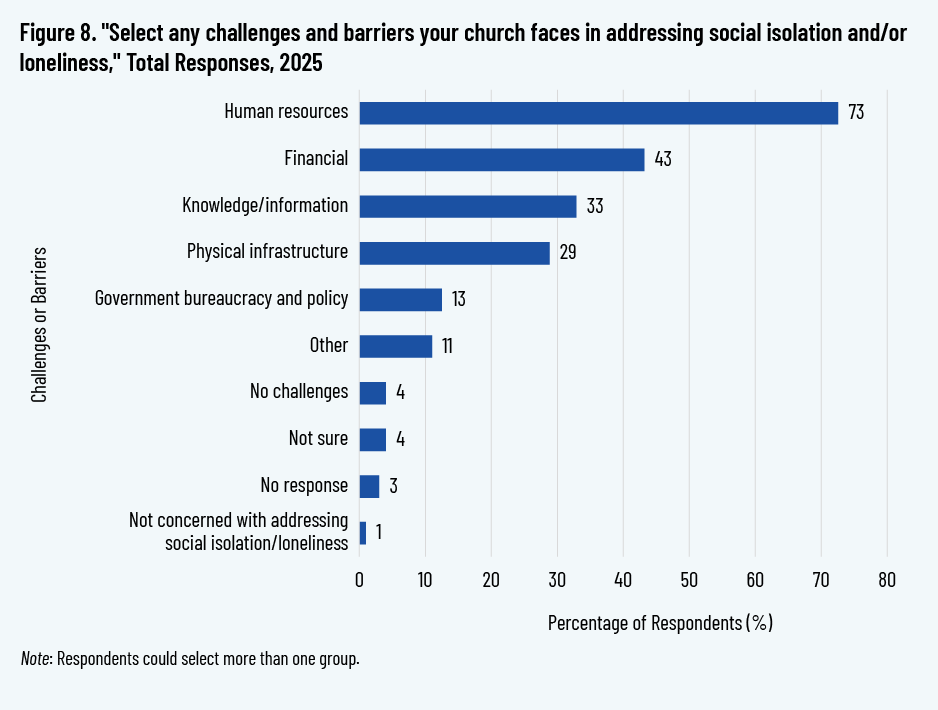
The challenge that was most frequently identified was lack of human resources (73 percent), followed more distantly by lack of financial resources (43 percent). Other responses are provided in figure 8. There was a relatively low number of responses indicating that their church did not face challenges in responding to social isolation and loneliness (4 percent, or n=16), was not concerned with this issue (1 percent, or n=4), or the respondent was not sure (4 percent, or n=15).
Responses across languages and denominations were fairly consistent, with a few exceptions discussed below. Differences can be seen depending on church size. A larger proportion of small churches reported a lack of human resources (76 percent), compared to 65 percent of respondents from large churches. The inverse is found regarding inadequate physical infrastructures, with 40 percent of large church respondents identifying this as a challenge, compared to 28 percent of respondents from small churches and 26 percent from medium-sized churches. Similarly, lack of knowledge or information was higher among large-church respondents (44 percent), compared to those from small (30 percent) and medium-sized churches (33 percent).
Regionally, a few interesting findings arose. Financial challenges were indicated less among British Columbia respondents (32 percent) than among respondents in other provinces, such as Ontario (42 percent), Atlantic and Prairie provinces (both at 43 percent), and Alberta (49 percent) and were highest among Quebec respondents (51 percent). Human resources challenges were reported by a majority of respondents in each region.
Physical infrastructure was reported to be a challenge more among respondents in Atlantic Canada and Quebec (both at 33 percent), Ontario (31 percent), Alberta (27 percent), and British Colombia (26 percent) than in the Prairies (16 percent). Likewise, government bureaucracy and policy challenges were identified less by respondents in the Prairies (8 percent), Ontario (11 percent), and British Colombia (12 percent) than by respondents in Quebec and Alberta (both 15 percent) and Atlantic Canada (17 percent).
Although responses in English and in French on this question were overall quite similar, there was a noticeable difference in the proportions who viewed government bureaucracy and policy as a challenge. Of French respondents, 21 percent identified it as a challenge, compared to 11 percent of English respondents. As for denominational categories, 25 percent of Catholics viewed government bureaucracy and policy as a challenge, compared to less than 10 percent of Evangelicals or of Mainline Protestants.
Personnel Challenges
Many respondents spoke of the limits of volunteers and church leaders, and of policy, regulations, and red tape associated with volunteering. The “busyness” and overextendedness of congregants was described as a major factor limiting volunteering: “It’s not for a lack of desire, but rather lack of time and energy!” Another respondent wrote, “We feel we have the information we need to help address isolation and loneliness, but, similar to our busy and over scheduled culture, we struggle to find volunteers.”
If the church had a small number of volunteers, burnout was also a problem. As one respondent wrote,
Our congregation has a small core group of volunteers who handle most of the day to day activities of the church, from planning/leading worship to property maintenance. Burnout from over-commitments is a real concern for our congregation and leaves less time for the social programs we want to focus on.
Aging was also a concern in relation to volunteer capacity, as indicated by one respondent who wrote that “people who were active volunteers [are] now having to slow down or needing services themselves.”
Some respondents also noted that the COVID-19 pandemic exacerbated the personnel challenges. Some congregants did not return to their church after the pandemic, or not to the same extent. Some programs had to be reinstated: “We had visitation teams prior to COVID and . . . now [we’ve had] to completely rebuild teams for seniors visitation as we do not have enough staff to do all the visits needed.”
The limitations of church leaders were also described, including the problem of vacant pastoral positions or too few priests, who must minister to many churches. Many Catholic respondents mentioned that the priest was responsible for more than one church—even as many as thirty churches in one case. The need for more church leaders was related to a lack of available priests or pastors, or to a lack of funds to hire additional staff.
“Red tape” affecting volunteer programs was also mentioned. The process of vulnerable sector checks was noted specifically. Although these checks are very important for protecting Canadians, particularly those in vulnerable situations, they increase the complexity and paperwork involved in taking on staff or volunteers. Respondents expressed a desire that these processes be simplified or made easier to navigate and understand.
Practical Challenges
Financial
Lack of financial resources was identified as a challenge by 43 percent of respondents, and many of them elaborated on the impact this has on donations and volunteer availability. As “the needs are increasing, the resources to address it are decreasing.”
Financial challenge was associated with church buildings, many of which are older, need updates and renovations, or carry significant mortgages. Funds allocated to maintaining basic infrastructure and paying down a mortgage cannot be spent on staff and programs. Respondents whose church did not own a building noted the cost of renting space. As one respondent noted, “We are currently a portable church that would love to have a ministry space in our neighbourhood, but have been priced out.”
Respondents frequently noted that grants were inaccessible or hard to identify or apply for. Easier-to-find information about available grants would be helpful, some respondents wrote. And while some respondents noted that they relied on no outside funding for their programs, others described how such funding enables them to offer services to the broader community and ensure that programs are free.
One respondent flagged that grants are often awarded for novel or new programs rather than for sustaining and expanding existing ones. “Most grants I have seen are to help a church create something brand new. We can more easily expand those [programs] that we are already involved in, even if it isn’t as exciting or innovative as something new.”
Facilities
Nearly one-third of respondents mentioned inadequate facilities. Having suitable facilities for the desired events and programs would require renting other space. Some of the desired projects, such as community kitchens or cafés, require specialized facilities to meet public health requirements.
Respondents with older buildings described the need to expand their spaces, since these buildings were not built for purposes other than worship but they operate large social programs out of the space nonetheless. Some facilities require changes to be more accessible to persons with disabilities: numerous respondents described a lack of full accessibility or a need for a lift to be installed. Aging buildings, as described earlier, may pose financial burdens—and may require significant renovations and upgrades to be used effectively. Respondents identified a need for financial support through match funding for renovations that create gathering spaces or make them more accessible.
Some respondents noted their physical location as a challenge, especially those in rural or remote communities. Linked with this were challenges with transportation, particularly in areas without a public transit system. Several respondents mentioned that coordinating transportation involves matters of insurance and liability. An urban location can present its own challenges, such as safety concerns due to crime or the presence of persons using drugs or who have addiction or mental illness.
Knowledge Gaps
Some respondents noted a challenge with identifying who is lonely or “where the needs are.” The pandemic heightened this challenge, particularly when leaders or volunteers were newer to the church and thus did not know which congregants were missing from services and lacked a relational history with them.
Respondents also spoke of a need for resources to help with outreach for specific groups, such as new immigrants. One wrote, “We’re often told how hard it is for newcomers, but we aren’t always sure how to ‘break-in’ in any larger way than we are and know who needs help.” Those at risk for isolation or loneliness may also not stay long within a particular community or neighbourhood. In this case, “they often don’t remain in our location so we may not know they are feeling isolated, or when we finally do, they soon move out of the area.”
A few responses indicated the challenge posed by those who are lonely but have difficulty admitting a need or accepting help, or who seem to “intentionally isolate themselves.” Several respondents noted that stigma, or a sense that it is weak to admit to being lonely, is a challenge they encounter with those affected.
Complexity of needs, such as of those with addictions or mental illness, was also raised as a difficulty. One respondent described the “emotional energy” and “stamina” that volunteers and church staff need when attempting to meet their needs. Respondents spoke of a lack of training in how to address such complex needs.
One respondent raised the challenge of a church’s religious identity, expressing concern that outreach could be interpreted as proselytization: “At one hand, we long to reach out to the isolated group of people within our community but, at the other hand, being a church could be perceived as converting them to Christianity. Which is not the case.”
Overall, additional training and resources for volunteers and staff was mentioned as a solution, including teaching personnel to identify those experiencing loneliness and isolation and reach out to at-risk groups. Training related to mental health supports—including how to connect with professional and community supports—was also identified as a possible resource.
Relationship with the State
Many respondents mentioned a sense of being undervalued or unrecognized for their church’s contributions to civil society, both by government and by the media and public. This concern was expressed more among French respondents but was also apparent within English responses.
A few French respondents stated that the religious nature of their church presented a challenge. The general distrust that other civil society actors have of religious institutions creates roadblocks in engaging partners and in general outreach among the public. Some articulated a desire for the media to recognize their positive contributions:
A parish does a lot to help poor, sick and isolated people, but because this involves faith in God, the secular state is very reserved and would sometimes even prefer to see us disappear. The state would then be deprived of considerable help from the Churches, which very often alleviate poverty and local emergencies. . .. The state uses us, but does not help us much. (Translation from French)
Some respondents noted the need for continued charitable status of churches, referencing a recommendation made by the federal Standing Committee on Finance that the “advancement of religion” be removed as a charitable purpose. 20 20 Standing Committee on Finance, Pre-Budget Consultations. More recently, a Quebec committee studying secularism (laïcité) recommended the same. Comité d’étude sur le respect des principes de la Loi sur la laïcité de l’État et sur les influences religieuses, Pour une laïcité québécoise encore plus cohérente. This recommendation was viewed very negatively: “It speaks to a deep ignorance of the impact of every church, large or small in almost every town in our country.” Respondents emphasized the significant financial implications that a loss of charitable status would entail. No longer being able to provide charitable tax receipts could dramatically affect the finances of churches and other religious charities. “Churches would recover and continue to do what they do,” in the words of one respondent, but the change would likely “force churches to cut programs.”
While other respondents did not frame the relationship with the state in a negative light, they did note challenges in navigating this relationship.
The problem isn’t inherently antagonism; the challenges are complexity and volunteer/staffing time to make sure we’ve checked all the right boxes. A third party in every conversation isn’t really a win, even if they intend some level of help. [. . .] The smaller churches in which I’ve served in the past could never navigate the things we work through here in the [. . .] suburbs.
Discussion and Recommendations
These survey data provide an exploratory account of Christian clergy and leaders’ concerns with isolation and loneliness within their congregation and in the surrounding community, and the programs, challenges, and potential solutions they offer. This is a significant foray into an understudied topic and provides important insight into the efforts of churches that see their duty of care as extending not only to their own congregants but also into the broader community, particularly to underserved or vulnerable persons.
The survey found that many churches are concerned about isolation and loneliness—and believe that these problems have worsened over the past five years. Respondents estimated that about one-fifth of their congregants are isolated or lonely, across all demographic groups. This finding is similar to that of the Angus Reid Institute–Cardus poll conducted in 2019, which found that 23 percent of Canadians were either somewhat or very lonely or isolated. 21 21 Angus Reid Institute, “A Portrait.”
Churches Are Highly Active in Responding to Isolation and Loneliness
Churches provide significant support and connection for their congregants through the primary purpose of the church, which is worship. As one respondent described, “The Sacred Mass itself would be the most important gathering event and remedy for loneliness, and disconnectedness. It fosters communion with God and others.” But, as indicated by the findings here, churches also offer many other programs and informal practices that keep congregants connected and that address the risk of isolation for those who are ill, homebound, or facing other challenging circumstances.
Furthermore, churches are deeply embedded in the broader community in a myriad of ways, such as by providing no-cost or low-cost use of their facilities to community groups, supporting community programs through volunteers and donations, and volunteering in long-term care, hospice, and retirement communities.
As described in a study by the Sheridan Centre for Elder Research, concerning how faith communities support immigrant seniors, “faith communities do not just fulfill religious/spiritual functions but they also address social and survival needs for [their] members.” 22 22 Banu et al., The Role of Faith Communities, 5. Faith communities more broadly were included in their study, in contrast to this study’s specific focus on Christian faith communities. That study, which focused specifically on the Halton and Peel Regions in southern Ontario, surveyed hundreds of immigrant seniors and revealed the significance of faith communities to those at higher risk of isolation and loneliness. Indeed, places of worship were most frequently reported by the survey respondents as important to them. 23 23 Banu et al., The Role of Faith Communities, 8.
And yet, there is a desire among faith community leaders to do more—if they knew where or how, and if they had the means or partners to do so.
Challenges to Addressing Isolation and Loneliness
Resources and training—or raising awareness of and access to existing resources and training—provided by denominational leaders and other community organizations could address the knowledge gaps and challenges that respondents described. Likewise, funding from outside sources could support expansion of churches’ efforts and facility renovations to support accessibility and wider use by both the church and the surrounding community.
The authors of the Sheridan Centre for Elder Research reported that partnerships between faith communities and other organizations and governments “drastically increases the reach of faith organizations” but also identified barriers to establishing such partnerships, including “lack of information, time, and resources.” These are similar to challenges that respondents described in our survey. The Sheridan Centre report recommended an increased openness among faith leaders to partner with community organizations, and that “community organization[s] need to broaden their understanding of faith groups to go beyond the traditional religious definitions.” The result of such partnerships, the authors said, “will be a lasting network of support that tackles social isolation and loneliness on a variety of levels.” 24 24 Banu et al., The Role of Faith Communities, 11–12, 14.
As discussed in more detail in the previous Cardus report, isolation and loneliness have negative health consequences, including higher morbidity and mortality risks. Further, their prevalence exacerbates existing social inequities, such as those experienced by persons with mental illness, chronic illness or disabilities, or living in poverty. Systematic literature reviews have pointed to “the growing evidence on the economic burden of loneliness and isolation, highlighting significant healthcare and productivity costs.” 25 25 Engel et al., “An Updated Systematic Literature Review,” 1061. In one Dutch study, loneliness was associated with increased mental healthcare spending and other health expenditures. 26 26 Meisters et al., “Does Loneliness Have a Cost?” Beyond increased healthcare costs, loneliness and isolation may have negative economic repercussions by depressing worker productivity and capacity. 27 27 Burlina and Rodríguez-Pose, “Alone and Lonely.”
Cardus’s Halo Project, which measures the socioeconomic benefit that religious congregations contribute to their local communities, has found that every dollar that a church spends produces three dollars of economic benefit to the community. This benefit includes the value of providing space for community groups and the many programs and services that support congregants and the broader community. 28 28 Wood Daly, “Why Religious Tax Exemptions Benefit All Canadians,” 9. And although the economic impact of churches’ activities that address isolation and loneliness were not investigated in this present study, the qualitative responses suggest a positive economic effect.
Recommendations
- Maintain the charitable status of churches.
Survey respondents expressed the concern that a loss of the tax exemptions and credits currently available to Canadian churches would result in reduced financial capacity to offer these socially valuable programs. 29 29 See also Wood Daly, “Why Religious Tax Exemptions Benefit All Canadians”; Sennyah and Liegmann, “Memo: FINA Committee’s Consultation for Fall Budget 2025.” Since many churches also make financial contributions to other community organizations, such a reduction would also have a cascading effect. - Simplify and clarify regulations and processes for volunteering.
Reviewing regulations relating to facility usage and providing greater clarity may assist churches that wish to offer programs such as soup kitchens, which alleviate isolation and loneliness in addition to hunger. If appropriate, streamlining some aspects of these regulations could encourage churches in such projects, so long as their goal of protecting public health is maintained. - Recognize and value the role of churches in addressing this public health challenge, and the other ways they support Canadians.
Governments and civil-society organizations should bring focused attention to isolation and loneliness in Canada, not only to study its prevalence and effects but also to gather evidence to better understand the important role played by civil society groups, including faith communities, in alleviating this public health crisis.
References
Amundson, Q. “Cardus Studies Faith Response to Loneliness.” Catholic Register, April 21, 2025. https://www.catholicregister.org/item/2057-cardus-studies-faith-response-to-loneliness.
Angus Reid Institute. “A Portrait of Social Isolation and Loneliness in Canada Today.” Polling. 2019. https://angusreid.org/social-isolation-loneliness-canada/.
Banu, R., S. Liladrie, and B. Noka. “The Role of Faith Communities in Improving Supports to Reduce Loneliness and Social Isolation in Immigrants 65+.” Sheridan Centre for Elder Research, 2019.
Bennett, A.P.W. “Still Christian(?): What Canadian Christians Actually Believe.” Cardus, 2024. https://www.cardus.ca/research/still-christian/.
Burlina, C., and A. Rodríguez-Pose. “Alone and Lonely. The Economic Cost of Solitude for Regions in Europe.” Environment and Planning A: Economy and Space 55, no. 8 (2023): 2067–87. https://doi.org/10.1177/0308518X231169286.
Catechism of the Catholic Church. Libreria Editrice Vaticana, 1993. https://www.vatican.va/content/catechism/en/part_two/section_two/chapter_one/article_3/i_the_eucharist_-_source_and_summit_of_ecclesial_life.html#$1KX.
DeJong VanHof, J. “Vulnerable Sector Check Costs Remain a Barrier for Volunteers.” Cardus, 2022. https://www.cardus.ca/research/vulnerable-sector-check-costs-remain-a-barrier-for-volunteers/.
Engel, L., M.F. Rizal, S. Clifford, et al. “An Updated Systematic Literature Review of the Economic Costs of Loneliness and Social Isolation and the Cost Effectiveness of Interventions.” PharmacoEconomics 43 (2025): 1047–63. https://doi.org/10.1007/s40273-025-01516-w.
Garland, R., J. Simmons, and J. Hadgraft. Right Up Your Street: How Faith-Based Organisations are Tackling Loneliness. FaithAction, 2019. https://communities1st.org.uk/sites/default/files/2022-07/fa-right-up-your-street.pdf.
Government of Quebec, Comité d’étude sur le respect des principes de la Loi sur la laïcité de l’État et sur les influences religieuses. Pour une laïcité québécoise encore plus cohérente: bilan et perspectives. 2025. https://cdn-contenu.quebec.ca/cdn-contenu/adm/org/secretariat-institution-democratiques/laicite/rapport-comite/rapport_laicite-bilan-perspectives-2025.pdf.
Meisters, R., D. Westra, P. Putrik, H. Bosma, D. Ruwaard, and M. Jansen. “Does Loneliness Have a Cost? A Population-Wide Study of the Association Between Loneliness and Healthcare Expenditure.” International Journal of Public Health 66 (February 2021): 581286. https://doi.org/10.3389/ijph.2021.581286.
Office of the Seniors’ Advocate Newfoundland and Labrador. Seniors’ Report 2024: Data Tables, Figures and Charts. 2024. https://www.seniorsadvocatenl.ca/pdfs/SeniorsReport2024_Data.pdf.
Sennyah, A. “Policy Brief: Absorbing Vulnerable Sector Check Fees to Reduce Barriers to Volunteering.” Cardus, 2022. https://www.cardus.ca/research/absorbing-vulnerable-sector-check-fees-to-reduce-barriers-to-volunteering/.
Sennyah, A., and D. Liegmann. “Memo: FINA Committee’s Consultation for Fall Budget 2025.” Cardus, 2025. https://www.cardus.ca/research/memo-fina-committees-consultation-for-fall-budget-2025/.
Standing Committee on Finance. Pre-Budget Consultations in Advance of the 2025 Budget. https://www.ourcommons.ca/Content/Committee/441/FINA/Reports/RP13466781/finarp21/finarp21-e.pdf.
Statistics Canada. Table 45-10-0048-01: Loneliness by Gender and Province. February 19, 2025. https://doi.org/10.25318/4510004801-eng.
Vachon, R., and M. Allatt. “Social Isolation, Loneliness, and Christian Communities.” Cardus, 2025. https://www.cardus.ca/research/social-isolation-loneliness-and-christian-communities/.
Van Thiel, S. Research Methods in Public Administration and Public Management: An Introduction. Routledge, 2014. https://doi.org/10.4324/9780203078525.
Wood Daly, M. “Why Religious Tax Exemptions Benefit All Canadians.” Cardus, 2024. https://www.cardus.ca/research/spirited-citizenship/reports/why-religious-tax-exemptions-benefit-all-canadians/.
Appendix: Survey Instrument
Q1. I agree to participate in the research study. I understand the purpose of this study and I am participating voluntarily. I understand that I can discontinue the survey at any time.
Yes
No
Q2. I grant permission for the data generated from this survey to be used in the researcher’s publications on this topic.
Yes
No
[Only those who respond to “yes” to Q1 and Q2 continue survey]
Q3. What is your first and last name?
Q4. What is your title? (e.g., Dr., Deacon, Most Reverend)
Q5. What role(s) do you play within your church? Select all that apply.
Pastor (i.e., lead pastor, parish priest, incumbent, senior minister)
Associate pastor (i.e., associate priest, associate minister)
Youth/children’s pastor
Elder
Deacon
Other (please specify): __________
Q6. Please provide the name(s) of your church(es) you are involved in. In this survey, we define church as a place of worship.
Q7. What province or territory is your church located in?
Q8. What municipality is your church located in?
Q9. What is the postal code of your church?
Q10. What best describes your church’s location?
Rural
Small town
Suburban
Urban
Q11. Which one of the following best describes your church or denomination?
Catholic (e.g., Roman Catholic or Eastern Catholic)
Mainline Protestant (e.g., Anglican, United, Lutheran, Presbyterian)
Evangelical Christian (e.g., Baptist, Pentecostal, Salvation Army)
Orthodox Christian (e.g., Russian, Greek, Ethiopian, Coptic)
Other denomination (please specify): ___________.
Q12. [If indicated “Mainline Protestant” or “Evangelical Christian” at Q11.] Which of the following best represents your denomination? (Please specify if yours is not on our alphabetical list.)
Adventist
Anglican (ACC or ANiC)
Associated Gospel Churches
Baptist (Fellowship, Convention)
Brethren in Christ
Church of the Nazarene
Christian & Missionary Alliance (CMA)
Evangelical Free Church
Free Methodist
Lutheran (ELCIC, LCC, etc.)
Mennonite
Pentecostal
Plymouth Brethren
Presbyterian (incl. PCC, PCA)
Reformed (incl. CRC, CRNA, Free, United, Canadian)
Salvation Army
United Church
Vineyard
Wesleyan Methodist
Non-Denominational
Don’t Know / Other (specify): __________
Q13. On average, how many people attend your Sunday worship service each week?
1–50
51–100
101–150
151–200
201–500
501–1,000
1,001–1,500
1,501+
Not sure
Q14. How many people are registered members of your church?
1–50
51–100
101–150
151–200
201–500
501–1,000
1,001–1,500
1,501+
Not sure
Not applicable
Q15. In this survey, church community is defined as those who attend or are members of your church or participate in your church’s offerings. Please estimate the percentage of your church community in the following groups:
15a.) Seniors (65+)
15b.) New to Canada (within the last 10 years)
15c.) Those who live alone (unmarried, divorced, widowed)
15d.) Those who live with socioeconomic vulnerabilities (e.g., low income)
15e.) Those who experience challenges with physical, intellectual, or developmental disabilities (e.g., vision loss, hearing loss, autism)
Social isolation refers to a lack of social networks and connections. Loneliness refers to the perception or feeling that one’s social connections are inadequate, both in quantity and/or in quality.
Q16. To what extent do you agree that “social isolation and/or loneliness is a challenge for your church community?”
Strongly disagree
Disagree
Neither agree nor disagree
Agree
Strongly agree
Not sure
Q17.What percentage of your church community do you believe may be socially isolated and/or lonely?
Q18. [If indicated “strongly agree” or “agree” at Q16.] Which groups in your church community are you most concerned about in terms of experiencing social isolation and loneliness? Select all that apply.
Seniors (65+)
New to Canada (within the last 10 years)
Those who live alone (never married, divorced, widowed)
Those who live with socioeconomic vulnerabilities (e.g., low income)
Those who experience challenges with physical, intellectual or developmental disabilities (e.g., vision loss, hearing loss, autism)
Not sure
Not applicable
Other (please specify): ____________
Q19. [If indicated “strongly agree” or “agree” at Q16.] In your opinion, has social isolation and loneliness in your church community increased or decreased over the last five years?
Greatly increased
Increased
No effect
Reduced
Greatly reduced
Not sure
Q20. Do you or your church offer any of the following? Select all that apply.
Services in multiple languages
Fitness/exercise programs and activities
Broadcasting services
Housing
Food programs (Food cupboard/meal deliveries, grocery deliveries)
Church socials, such as picnics, dances
Choir or music ministries
Meals after service
Community cafes
Craft groups
Coffee receptions after service
Greeters at services
Hospitality committees
Youth ministries
Family ministries
Discussion groups or small groups (e.g., Bible studies)
Faith formation programs (e.g., Alpha, RCIA)
Transportation services
Bringing communion to the sick/homebound
Pastoral visits (in person or virtual)
Counselling/spiritual direction
Senior ministries (e.g., senior social nights, home visits)
Organized volunteering with community services (e.g., homeless shelters, refugee resettlement, innercity ministries)
Not sure
Not applicable
Q21. Which of these programs do you think have been most effective in addressing social isolation and loneliness? Please select up to 3 programs.
Services in multiple languages
Fitness/exercise programs and activities
Broadcasting services
Housing
Food programs (Food cupboard/meal deliveries, grocery deliveries)
Church socials, such as picnics, dances, etc.
Choir or music ministries
Meals after service
Community cafes
Craft groups
Coffee receptions after service
Greeters at services
Hospitality committees
Youth ministries
Family ministries
Discussion groups or small groups (e.g., Bible studies)
Faith formation programs (e.g., Alpha, RCIA)
Transportation services
Bringing communion to the sick/homebound
Pastoral visits (in person or virtual)
Counselling/spiritual direction
Senior ministries (e.g., senior social nights, home visits)
Organized volunteering with community services (e.g., homeless shelters, refugee resettlement, innercity ministries)
Not sure
Not applicable
Q22. If applicable, please specify any other general programs not mentioned that your church offers which may contribute to building community and alleviating social isolation and loneliness, even if not directly. Please provide any further information as you’d like.
Q23. If applicable, please provide a list of any partnerships your church has with other organizations, parishes, or groups which may contribute to building community and alleviating social isolation and loneliness, even if not directly (e.g., meals on wheels, long-term retirement home visitation programs).
Q24. Please select any challenges and barriers your church faces in addressing social isolation and/or loneliness. Select all that apply.
Lack of financial resources
Lack of knowledge/information on how to address social isolation and loneliness
Lack of human resources (staff and volunteers)
Inadequate physical infrastructure to provide programs or resources
Government bureaucracy and policy
My church doesn’t face any challenges
My church is not concerned about addressing social isolation and/or loneliness
Not sure
Other (please specify): __________
Q25. If applicable, please describe further any challenges and barriers your church faces in addressing social isolation and/or loneliness.
Q26. If applicable, please describe possible resources, policies, or programs that your church would find helpful in addressing social isolation and/or loneliness and responding to the challenges or barriers you face.