
The most religious Americans tend be more patriotic and optimistic, survey finds
FOR IMMEDIATE RELEASE
19 November, 2025
More Americans than Canadians are happy to hear politicians and other leaders expressing their religious convictions, according to a recent survey. Over half (56 percent) of American respondents agree that “Americans who hold public positions should feel free to speak and act based on their religious beliefs.” Meanwhile, two-thirds of Canadians agree that religion and politics should be kept completely apart. Those findings come from a survey of 5,000 Americans and 5,000 Canadians by the Angus Reid Institute (ARI) in partnership with Cardus, a North American think tank.
Previous research has shown that the Americans are more religious than the populations of many other western countries, such as Canada. The ARI-Cardus data likewise found that 58 percent of Americans also agree that religion is “very important” in their day-to-day lives, compared to only 36 percent of Canadians who agree. Meanwhile, when assessed on ARI and Cardus’s Spectrum of Spirituality measurement, 37 percent of Americans identify as religiously committed compared to 16 percent of Canadians. Those who are religiously committed typically display higher rates of belief in God, behaviours like prayer and reading a sacred text, and regular attendance at religious services, among other factors.
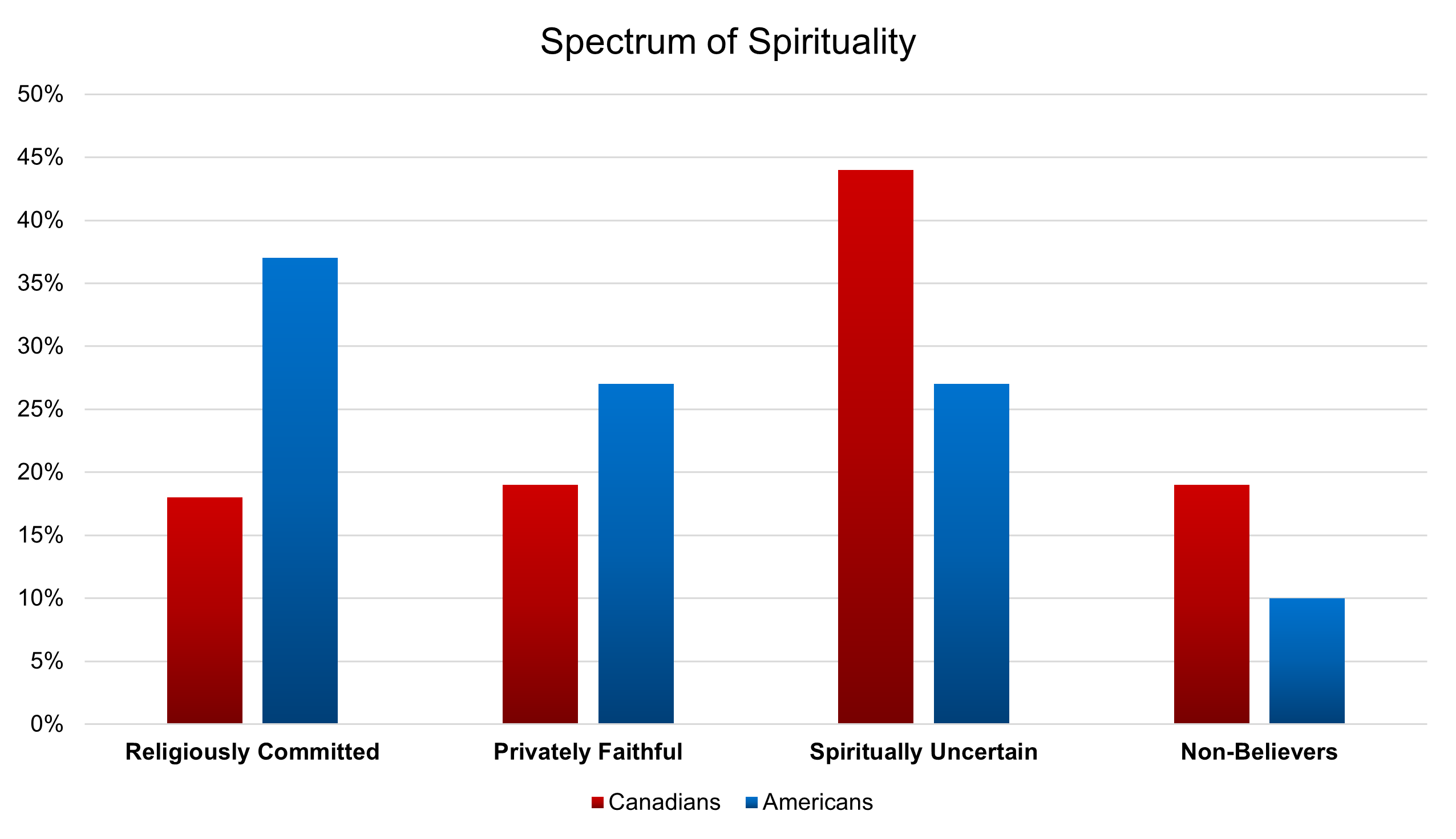
The privately faithful engage in some religious behaviours but are often skeptical of organized religion, the spiritually uncertain believe in a higher power and may sometimes think about a reality beyond the physical world, and non-believers completely reject religion.
Digging further into the ARI-Cardus data also confirms what previous research has shown: interest in religion is rebounding among younger generations in both the US and Canada.

“If the uptick in faith continues for younger Americans, the boldness and cultural acceptance of very public religion is likely to continue into the foreseeable future,” says Lynn Swaner, President, US at Cardus.
The survey data also suggest that religiously committed Americans are also the most patriotic and optimistic. More than 80 percent of religiously committed Americans agree they love their country and what it stands for (compared to 68 percent of Americans generally). Similarly, when it comes to whether they are optimistic about the future of their country, 62 percent of religiously committed Americans are optimistic (compared to 47 percent of Americans overall).
North of the US-Canada border, the tie between religion and patriotism or optimism is weaker. Seven in 10 religiously committed Canadians say they love their country and what it stands for, compared to 77 percent of Canadians generally. And only 43 percent of religiously committed Canadians are optimistic about their country, compared to 47 percent of Canadians generally.
“The American approach to religion seems to flow out of the cultural adoption of individualism and self-expression,” says Ray Pennings, Executive Vice President of Cardus. “That kind of approach is different than in Canada, where the emphasis is community-oriented and leads to more social action as an expression of faith.”
Despite the differences between the United States and Canada, both countries benefit from non-profit and social-service sectors that have a Christian legacy of compassion and care for the vulnerable. A Gallup study estimates that religion contributes $1.2 trillion to the US economy, while Cardus’s Halo Project in Canada has estimated the net socio-economic benefits from religious congregations at almost $12 billion annually.
In terms of an updated picture of religious affiliation in 2025, the survey finds that a majority of people in both countries identify as Christian. Specifically, 28 percent of Americans identify as Evangelical Protestant, 19 percent as Catholics, 11 percent as Mainline Protestants, two percent as another type of Christian, and eight percent as a follower of a non-Christian religion. In Canada, 28 percent checked Catholic, 14 percent Mainline Protestant, eight percent Evangelical, two percent another type of Christian, and 11 percent a non-Christian faith.
Religion for the Common Good: Canada and the United States in 2025 is freely available on the Cardus website.
-30-
MEDIA INQUIRIES
Daniel Proussalidis
Cardus – Director of Media & Public Relations
613-241-4500 x508
media@cardus.ca
Cardus – Imagination toward a thriving society
Cardus is a non-partisan think tank dedicated to clarifying and strengthening, through research and dialogue, the ways in which society’s institutions can work together for the common good.