

Table of Contents
Table of Contents
Key Points
- Subsidiarity is a principle of social organization by which authority in decision-making, problem-solving, and action is assigned to the lowest level competent to exercise it.
- It emphasizes the role of the civil-society institutions that exist between the individual and the state.
- It promotes solidarity and genuine relationships of care among people, leading to better social and economic outcomes.
- An example of subsidiarity in action can be seen in Canada’s refugee resettlement system. Canada accepts government-assisted refugees and privately sponsored refugees. Privately sponsored refugees are supported by organizations such as churches and diaspora communities, and by groups of individuals.
- Privately sponsored refugees have better economic outcomes than do government-assisted refugees, especially in the short run when they are actively supported in integrating in Canada.
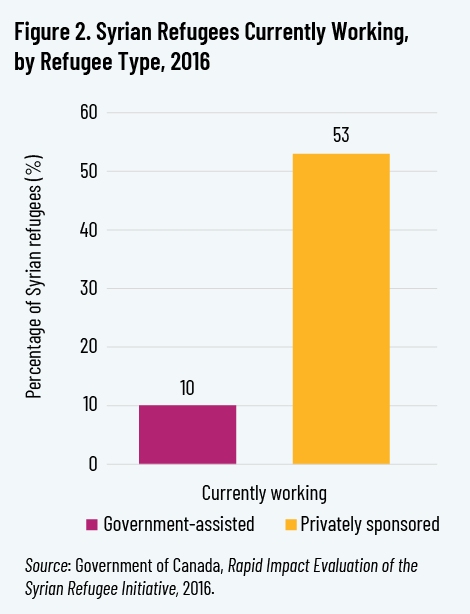
- More than half of surveyed Syrian privately sponsored refugees in 2016 found employment within a year of arrival, compared to less than 10 percent of surveyed Syrian government-assisted refugees.
- Sixty-three percent of Syrian privately sponsored refugees in 2016 were referred to employment services, compared to 27 percent of government-assisted refugees.
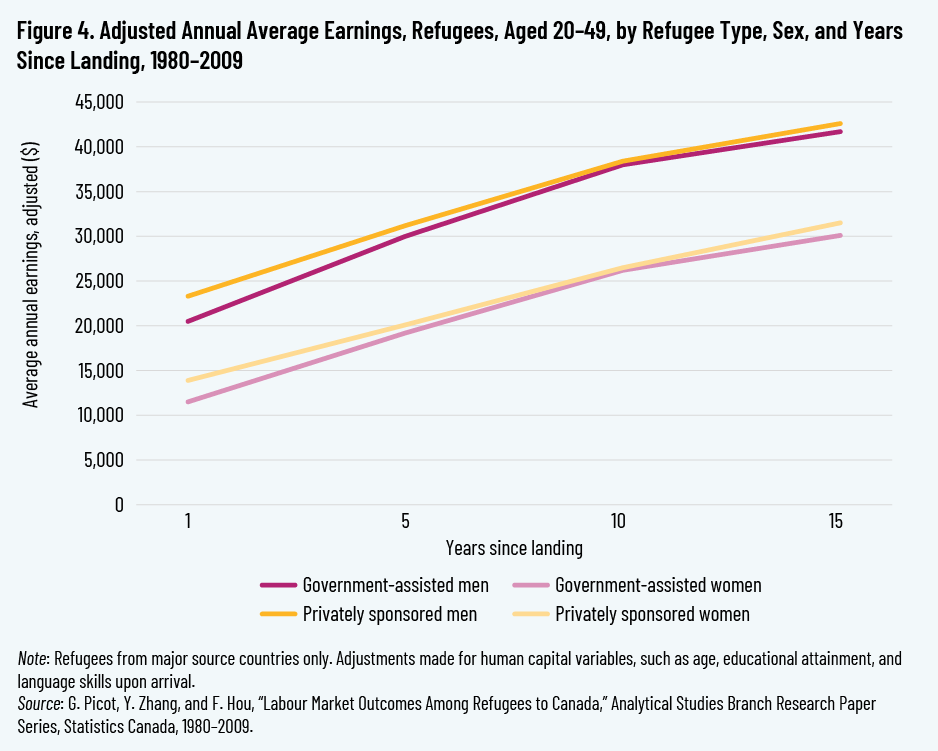
- As for refugees more generally, men who are privately sponsored have incomes that are 14 percent higher than those who are government-assisted, on average, after one year in Canada. For women, the gap is over 20 percent. For both sexes, the gap narrowed in subsequent years, but after ten years it was still higher for the privately sponsored.
- The principle of subsidiarity is a plausible explanation of the differences in outcome of the two types of refugees. Privately sponsored refugees:
- receive more personalized support,
- have access to greater social capital, and
- benefit from a welcoming community and genuine friendships.
- Governments should apply a subsidiarity lens to other questions of public policy, to consider the role of civil society in solving problems and delivering services. The paper concludes with guidance for policy-makers on developing a subsidiarity lens.
Introduction
The foundation of many political and policy disputes is the question of who does what—or, put differently, who has jurisdiction over, or care for, what. The question is rarely whether this or that action should be done at all, but rather in whose jurisdiction this action falls: whether government should do it or some other institution of civil society; and, if government, which level of government.
Subsidiarity is a principle of social organization that helps to answer these questions. It states that authority in decision-making, problem-solving, and action should be assigned to the lowest level competent to exercise it. Lower-order authorities are usually closer to a given situation, and their closeness generally provides them better information and a greater sense of care for the people involved.
Canada has a real-world case that illustrates the beneficial effects of subsidiarity. Canada’s refugee resettlement system was the first in the world to incorporate private sponsorship of refugees alongside government-assisted sponsorship. An extensive body of research has analyzed decades’ worth of data on the differences between the two groups, showing that the former tend to have stronger economic outcomes. Notably, the reasons that researchers have proposed for explaining these differences suggest that the principle of subsidiarity is a key factor, with at least one Canadian public policy expert pointing to it explicitly. 1 1 Speer, “Lost in the Aggregate.” Complete citations are provided for all sources at the end of this report.
This report seeks to draw out this fact. Following a brief overview of the principle of subsidiarity, the paper surveys the literature on the economic outcomes of privately sponsored refugees and government-assisted refugees and considers how an understanding of subsidiarity sheds light on the reasons for the disparity in these outcomes. The paper concludes with recommendations for how a subsidiarity lens can be applied to other areas of public policy.
The Principle of Subsidiarity
The word “subsidiarity” finds its origin in the Catholic social tradition. The concept appears fully articulated for the first time in the 1931 encyclical Quadragesimo Anno by Pope Pius XI, although the idea can be found in the thought of Pope Leo XIII in Rerum Novarum of 1891. Its origins can be traced even further back, to the seventeenth-century political thought of Calvinist philosopher Johannes Althusius, 2 2 Althusius, Politica Methodice Digesta. and it is implicit in the works of Aristotle and St. Thomas Aquinas. 3 3 Finnis, “Subsidiarity’s Roots and History.” It is also often compared to the theory of sphere sovereignty in the thought of Dutch philosopher and politician Abraham Kuyper. 4 4 Weinberger, “The Relationship Between Sphere Sovereignty and Subsidiarity.”
Pius XI introduces the principle as follows:
Just as it is gravely wrong to take from individuals what they can accomplish by their own initiative and industry and give it to the community, so also it is an injustice and at the same time a grave evil and disturbance of right order to assign to a greater and higher association what lesser and subordinate organizations can do. For every social activity ought of its very nature to furnish help to the members of the body social, and never destroy and absorb them. 5 5 Pius XI, Quadragesimo Anno.
Since this inaugural definition, subsidiarity has become an important principle of governance in determining which entities are best equipped to address issues and solve problems. It prescribes that decision-making and action should be undertaken by the level of authority that is closest to the issue at hand. In general, this means that higher-order authorities should defer decisions and actions to lower-order authorities, unless the latter are incapable of dealing with it. 6 6 Pius XI, Quadragesimo Anno, 79.
Subsidiarity, Government, and Civil Society
The division of powers in a federal system of government is an example of subsidiarity in practice. In the Canadian constitution, for example, provincial governments are generally responsible for issues such as health care and education, while the federal government is responsible for countrywide issues, such as monetary policy and military defence. 7 7 See Government of Canada, Constitution Act, 1867, sections 91 to 93. Municipal governments are generally responsible for those issues that are even more local in nature, such as road maintenance and garbage collection. 8 8 Canadian municipalities, as creatures of provincial governments, are delegated power through provincial legislation. In Ontario, for example, the powers of the municipalities are outlined primarily in the Municipal Act, 2001 and the City of Toronto Act, 2006. See Government of Ontario, Municipal Act, 2001, and Government of Ontario, City of Toronto Act, 2006. The European Union is explicitly organized on the principle of subsidiarity. The Treaty Establishing the European Community states that the EU “shall take action, in accordance with the principle of subsidiarity, only if and in so far as the objectives of the proposed action cannot be sufficiently achieved by the Member States and can therefore, by reason of the scale or effects of the proposed action, be better achieved by the Community.” 9 9 Treaty Establishing the European Community, Article 5. 10 10 Whether the European Union lives up to this ideal of subsidiarity has been the subject of much debate within the European Community, leading most famously to the “Brexit” withdrawal of the United Kingdom. This highlights the fact that adopting a principle is very different from applying it. Discerning where to draw the limits of authority is a delicate question, one that this paper engages below in the section on advice for policy-makers.
But subsidiarity has applications far beyond the relations among levels of government. It applies equally to the relations between governments and civil society and within civil society itself. In fact, the articulation of the principle of subsidiarity in Quadragesimo Anno does not deal primarily with the division of powers between governments but with the role of civil-society institutions, especially labour unions, in defending the rights and responsibilities of workers.
Pius XI’s reference to “members of the body social” evokes a vivid image of a rich social fabric that makes up civil society. In this view, society is a complex fabric with interwoven connections that manifest in relationships and, importantly, in institutions such as the family, service organizations, schools, corporations, labour unions, religious communities, and so many more. 11 11 Pontifical Council for Justice and Peace, Compendium of the Social Doctrine, 185. This is not an individualistic view of autonomous individuals pursuing self-interest within legal constraints imposed by the state. Rather, it is one that recognizes the importance of all the intermediary institutions between the individual and the state, each with its own role and set of responsibilities, each contributing in its own way to the richness of society.
Subsidiarity recognizes this complexity and provides guidance for assigning responsibilities to different social organizations. Under this principle, problems that concern an individual are, wherever possible, best handled by the individual themselves. Problems that pertain to a family are generally best resolved within the family itself, rather than by appeal, for example, to the courts. A crisis in a community is best handled within that community, perhaps by a service organization that is close to the crisis at hand. And governments are best left to handle those issues that cannot be handled by any lower authority.
Yet it would be a mistake to interpret subsidiarity as erecting rigid walls between institutions or between different levels of society. In fact, the social fabric envisioned by subsidiarity entails a bountiful set of interconnections among individuals and institutions. Far from cutting institutions off from each other, there can be recourse to higher-order authorities when lower-order authorities fail to resolve an issue. But this recourse should take the form of cooperation and help. The root of the word “subsidiarity” is subsidium, a Latin word meaning “assistance,” so the relationships among institutions must be defined by cooperation. 12 12 Pontifical Council for Justice and Peace, Compendium of the Social Doctrine, 186.
Subsidiarity and Solidarity: Two Principles of Care
Subsidiarity is sometimes misunderstood as a principle primarily concerned with which entity is best positioned to efficiently deliver some service or which entity has the best information about some issue. Efficiency and information are certainly benefits of subsidiarity. The wonderful complexity of society makes it impossible for an entity far removed from it to grasp the intricacies of each strand of the social fabric. Individuals and organizations closest to an issue will naturally have better information about the problem, as well as about the unique persons and communities involved. 13 13 Hayek, “The Use of Knowledge in Society.”
But information and efficiency are far from the most fundamental benefits of subsidiarity. Consider Pius XI’s language in introducing the principle. The phraseology of “gravely wrong” and “grave evil” is not the language one associates with a technocratic principle of organizational efficiency. It suggests instead a moral seriousness that goes beyond concerns about information and efficiency in service delivery.
To understand this, we have to understand the connection between subsidiarity and its twin principle: solidarity. The principle of solidarity recognizes the unity of all human persons and affirms the social and interdependent nature of human beings. 14 14 Pontifical Council for Justice and Peace, Compendium of the Social Doctrine, 192. Solidarity is expressed in the care and responsibility that we all have for each other. 15 15 Pontifical Council for Justice and Peace, Compendium of the Social Doctrine, 193. But genuine care depends, in turn, on subsidiarity, because this principle requires that action be taken at the level that is as close as possible to the bonds between individual persons. In general, care is a person-to-person phenomenon: It presupposes a human person who is “doing the caring” and another human person who is “receiving the care.” While it is possible to speak of an institution or a system as providing care (think of “health care” or “child care”), at the end of the day, it is a person (a nurse or an educator, for example) who is providing the care. This is especially true of the most fundamental understanding of the word “care,” which is taking a genuine and active interest in another person’s well-being. No abstract entity, no institution, can care in this sense. Only a human person can do so.
At the same time, care often takes place within and with the support of an institution. The care that a parent provides to a child or that kin provide to an ailing relative takes place within the institution of the family. The care that a nurse provides to a patient takes place within a hospital. Institutions help in these caring activities by providing resources that would be inaccessible otherwise. These institutions are a natural and good feature of the rich social fabric that subsidiarity presumes.
Yet there is a danger that institutions, especially as they grow, will become overly bureaucratic and lose their character of care. Recall Pius XI’s warning that “it is gravely wrong to take from individuals what they can accomplish by their own initiative and industry and give it to the community.” The principle of subsidiarity reminds us that care is ultimately shown by individual persons toward other persons. That is why it is crucial to emphasize the “industry and initiative” of individuals working for the common good. It is they who express care and ultimately manifest solidarity.
Moreover, we generally express a greater degree of care for those closest to us. It is natural, for example, for parents to care more deeply about their children than they do about others. We may have a greater sense of care for people in our friend groups, in our workplaces, and in our neighbourhoods, simply because we know them and interact with them. This does not negate the care that we may have for people whom we have never met, such as those in other parts of the world who may be victims of war or starvation. Nor does it diminish our responsibility to human persons all over the world. But these are phenomena of a more abstracted sort and are generally less intense than the care we have for those whom we know personally.
Subsidiarity harnesses this anthropological truth and puts it at the service of solidarity. Care can be a powerful motivator, particularly when it is for those closest to us.
Subsidiarity can therefore be seen as the principle that seeks the balance between, on the one hand, prioritizing action and care at the individual level and, on the other, establishing order within institutions to better enable care and solidarity. By pushing decision-making as close to individuals and local institutions as possible, subsidiarity enables individuals to care for each other and so express this solidarity. It protects against higher-order institutions that could interfere in these relationships and crush the possibility of genuine solidarity. In this way, subsidiarity and solidarity can never truly be separated. 16 16 Donati, “What Does ‘Subsidiarity’ Mean?”
Canada’s refugee resettlement system is a concrete example of how subsidiarity enables care and solidarity. The next section outlines how that system’s subsidiarity approach harnesses the care of those closest to the refugees themselves to achieve better economic outcomes upon their arrival to our country.
Government-Assisted Refugees and Privately Sponsored Refugees
Canada resettles tens of thousands of refugees each year. 17 17 Resettled refugees, who apply for and received refugee status from outside the country, are separate from asylum seekers, also known as refugee claimants, who apply for refugee status from within Canada or at the border. Asylum seekers are not discussed in this paper. Refugees are granted permanent residence in Canada owing to a “well-founded fear of persecution based on race, religion, political opinion, nationality, or membership in a particular social group” or because they have been affected by civil war or armed conflict or otherwise had their human rights violated on an ongoing basis. 18 18 Immigration, Refugees and Citizenship Canada, How to Be Resettled in Canada as a Refugee. In 2024, there were 76,685 refugees and protected persons admitted to Canada. 19 19 Immigration, Refugees and Citizenship Canada, 2025 Annual Report to Parliament on Immigration. Protected persons are a different category from refugees, as they seek asylum from within the country or at the border, whereas refugees seek refuge from outside the country’s borders.
There are two main streams of resettled refugees: 20 20 A third stream, Blended Visa Office-Referred refugees, accounts for less than 1 percent of refugees and receives only minimal attention in this paper. See Immigration, Refugees and Citizenship Canada, Blended Visa Office-Referred Program: Who Can Apply to Sponsor a Refugee; Immigration, Refugees and Citizenship Canada, Partners in Refugee Resettlement: Blended Visa Office-Referred Program.
- Government-assisted refugees are referred by the United Nations High Commissioner for Refugees or another referral organization and supported by the Government of Canada or the Government of Quebec for a period of up to one year. 21 21 Immigration, Refugees and Citizenship Canada, Government-Assisted Refugees Program. The province of Quebec has unique powers over immigration among the Canadian provinces and thus has its own programs to support resettled refugees. The remainder of this paper will address the federal program, unless specifically stated otherwise. These refugees receive help from the Resettlement Assistance Program, which provides financial assistance, housing, assistance with adaptation to life in Canada, and other services, as well as from the Settlement Program, which provides language training, translation services, employment-related assistance, and other services. Although the support is financed entirely by public funds, the government relies on non-governmental organizations to deliver that support. At the time of this research, there were thirty-nine organizations listed as Resettlement Assistance Program service provider organizations, mostly immigrant services groups in local communities around the country. 22 22 Immigration, Refugees and Citizenship Canada, Find Help to Adjust as a Refugee in Canada; Immigration, Refugees and Citizenship Canada, Get Government Assistance—Refugees.
- Privately sponsored refugees are supported by civil-society groups for a designated sponsorship period, usually of one year. Most support is financed by the private sponsors themselves and includes housing, food, transportation, clothing, social integration, and emotional needs. 23 23 Immigration, Refugees and Citizenship Canada, Private Sponsorship of Refugees Program— Information for Refugees. This describes the federal government’s program for private sponsorship of refugees. The Government of Quebec has a broadly similar program. There are three categories of civil-society groups that may sponsor a refugee:
- Sponsorship Agreement Holders have a formal agreement with the federal government to resettle refugees. They are mostly religiously affiliated groups, such as dioceses and parishes or their equivalents, and cultural groups, such as diaspora community organizations. They typically have greater capacity to resettle a larger number of refugees than groups of five (see below). At the time of this research, there were 139 Sponsorship Agreement Holders across Canada. 24 24 Immigration, Refugees and Citizenship Canada, Private Sponsorship of Refugees Program; Immigration, Refugees and Citizenship Canada, Sponsorship Agreement; Immigration, Refugees and Citizenship Canada, Sponsorship Agreement Holders. The total number of entries can be seen by selecting one of the provinces in the drop-down menu box.
- Groups of five are groups of a minimum of five individual Canadians who band together to sponsor one or more refugees. They have the same general responsibilities as any private sponsor and must reside in the community in which the refugee intends to reside. 25 25 Immigration, Refugees and Citizenship Canada, Groups of Five: Who Can Apply.
- Community sponsors are corporations, associations, or organizations that take on the responsibilities of a private sponsor. They may choose to co-sponsor with an individual or another community sponsor, but, like groups of five, they must be present in the community in which the refugee is expected to settle. 26 26 Immigration, Refugees and Citizenship Canada, Community Sponsors: Who Can Apply.
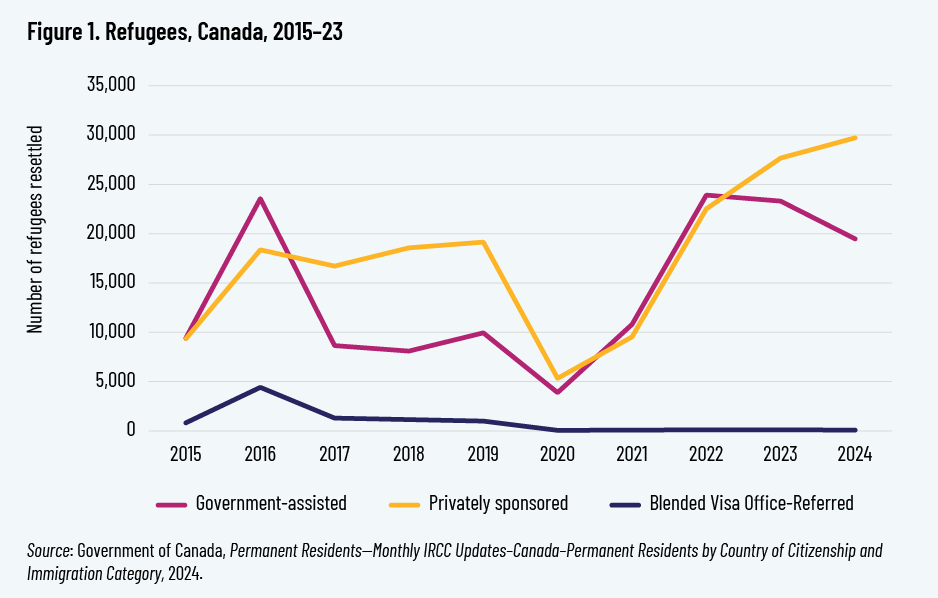
In terms of numbers, the government and civil society each play significant roles in resettling refugees. In 2024, there were 19,485 government-assisted refugees resettled to Canada (40 percent of refugees) and 29,715 privately sponsored refugees (60 percent). 27 27 Immigration, Refugees and Citizenship Canada, 2025 Annual Report to Parliament on Immigration The number of refugees who are privately sponsored each year typically matches or exceeds the number of those who are government-assisted. In fact, the number of privately sponsored refugees resettled between 2017 and 2019 was more than double the number of the government-assisted who were resettled during the same time frame, before most resettlement was paused during the COVID-19 pandemic. In recent years, the number of privately sponsored refugees has been increasing while the number of government-assisted refugees has been decreasing.
Privately Sponsored Refugees Have Better Economic Outcomes
A large body of research has found that privately sponsored refugees tend to have better economic outcomes than government-assisted ones, in both the short term and the long term. 28 28 Although this paper focuses on the difference in economic outcomes between the two groups, the divergence extends beyond economic integration to social integration as well. For example, a study of Syrian refugees’ physical and mental health showed that the privately sponsored reported better health on average than the government-assisted and were more likely to report that their healthcare needs were met. See Oda et al., “Differences in Self-Reported Health.”
One contribution to this literature was a 2016 evaluation by the federal government of its initiative to accept 25,000 Syrian refugees between November 2015 and February 2016. 29 29 Immigration, Refugees and Citizenship Canada, Rapid Impact Evaluation. This initiative was a significant contributor to the rapid rise in refugee resettlements in 2016. The government’s survey, which gathered data between June and September of 2016, found that more than half of those in the privately sponsored group had successfully found employment, compared to less than 10 percent of those in the government-assisted group, during the first few months of their arrival in Canada.
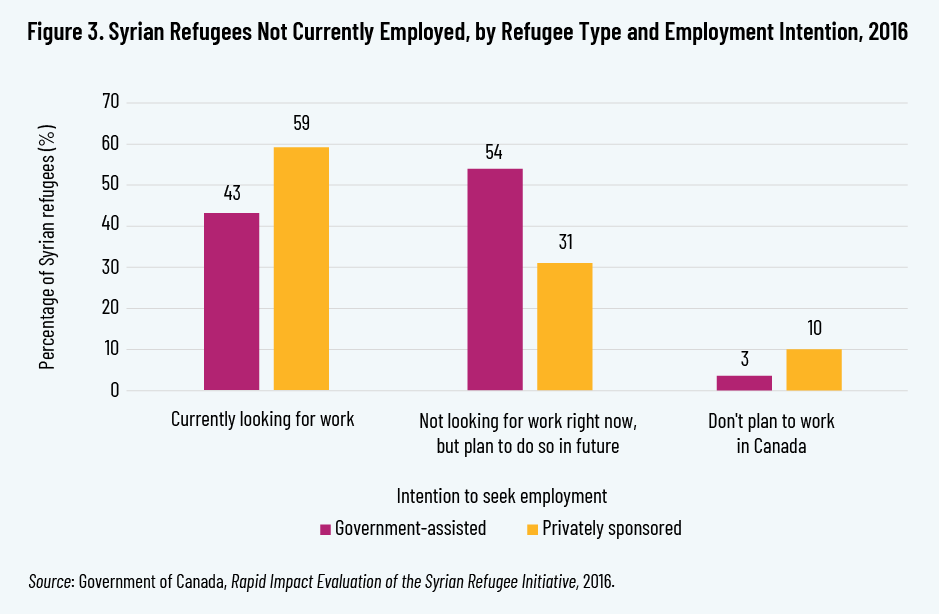
Privately sponsored refugees who were not working were also more likely to state that they were actively looking for work, whereas over half of government-assisted refugees not working said they planned to look for work only in the future. A possible explanation for this disparity may be that the former were more likely to have been directed to employment services (63 percent, versus 27 percent for the latter). Moreover, in focus groups conducted as part of the survey, government-assisted refugees reported that service provider organizations associated with the Resettlement Assistance Program failed to provide them with enough information about applying for jobs.
The government’s evaluation brought to light important divergences in the experiences of the two groups, but it also had some limitations. For example, the paper focused exclusively on the experience of Syrian refugees, and it was necessarily focused on their short-term outcomes since most of them had landed less than twelve months before the report’s publication in December 2016. As such, it did not consider the long term, nor any refugees who were not part of the Syrian refugee initiative.
Moreover, it is difficult to conclude from the report whether the differences in economic outcomes are attributable to the type of sponsorship or instead to different background characteristics, as some scholars have posited. 30 30 Hynie et al., “What Role Does Type of Sponsorship Play?” As the government’s own evaluation indicates, Syrian privately sponsored refugees tended to arrive in Canada more educated and more familiar with one of Canada’s official languages than were those who were government-assisted. 31 31 Immigration, Refugees and Citizenship Canada, Rapid Impact Evaluation. In fact, the evaluation showed that most of the survey respondents, especially those in the government-assisted group, who were not looking for work said that the main reason for postponing their job search was that they were busy taking lessons to learn English or French.
As for refugees more generally, researchers have pointed to background differences as a possible explanation for the divergence in outcomes between the two groups. One study based on 2016 Census data showed that the employment and income gaps between the two groups were more pronounced for male refugees who had arrived in Canada in the five years prior to the census. For those who had arrived earlier, the gaps still existed, but they were much narrower. 32 32 Jedwab, “GARs vs. PSRs.” The study observed, however, that privately sponsored refugees who had arrived in the previous five years were almost twice as likely to hold a university credential than were refugees in the other group. It also pointed to differences in the two groups’ visible-minority status—government-assisted refugees were more likely to be visible minorities—though it leaves unstated how visible-minority status may affect employment or income outcomes.
Nevertheless, several other studies have found that the differences in economic outcomes between the two groups persist even when controlling for background characteristics. 33 33 Hynie et al., “What Role Does Type of Sponsorship Play?”; Hyndman, Payne, and Jimenez, “Private Refugee Sponsorship in Canada.” Statistics Canada has also looked extensively at these issues in two notable research papers. One of these examined the average annual earnings of various categories of refugees, including by the program through which they were admitted to Canada, and adjusted them to control for several variables of human capital, such as a refugee’s age, educational attainment, and language skills upon arrival. 34 34 Picot et al., “Labour Market Outcomes Among Refugees to Canada.” This analysis found that, even when controlling for these variables, privately sponsored refugees tended to outperform their government-assisted counterparts on economic outcomes in the short run, and that the gap was still present, although much smaller, at year ten. One year after arrival in Canada, men in the first group had adjusted average annual earnings of $23,300, versus $20,500 for men in the second group, a gap of nearly 14 percent, while women in the first group had $13,900, versus $11,500 for women in the second group, a gap of over 20 percent. These gaps narrowed to $400 and $300, respectively, after ten years in Canada.
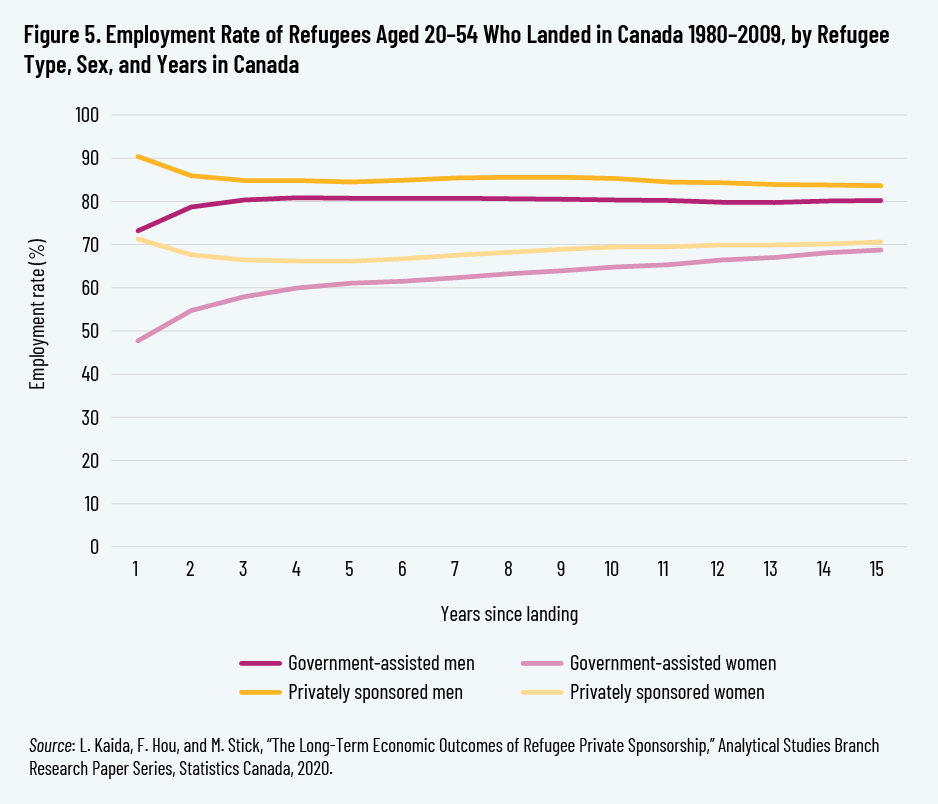
The second Statistics Canada report used multivariate analysis to control for other factors, including education, language skills, and country of origin. 35 35 Kaida, Hou, and Stick, “The Long-Term Economic Outcomes.” This analysis measured the probability that a refugee would be earning employment income in each year of residency, up to fifteen years after landing in Canada. As with the other studies described above, it found a wide gap in the privately sponsored group’s favour in a refugee’s first year in Canada: The gap was about 24 percentage points for men and about 17 percentage points for women. However, this report found that, while the long-term gap between the two groups narrowed to about two or three percentage points, it remained statistically significant. Although the gap could still be explained by some unobserved variables, the results suggest that there is an economic advantage to being a privately sponsored refugee over a government-assisted one, including in the long run.
Interestingly, this paper also found that the employment rate of privately sponsored refugees in the first year in Canada (just over 90 percent for men and 71 percent for women) dropped in the few years after that (to about 86 percent and 68 percent, respectively), after which it remained fairly stable or climbed back up slightly. This is noteworthy because private sponsors are on the hook for assistance only for the first twelve months after a refugee’s arrival. This may explain why the employment rate declines in those refugees’ second year in Canada. By contrast, while government-assisted refugees started with much lower employment rates (under 75 percent for men and under 50 percent for women), these rates rose in the second year and then remained stable or rose again in each subsequent year, although they never rose higher than the employment rates of the privately sponsored. This may suggest that, while the immediate initial boost available to those in the privately sponsored group waned somewhat, it nonetheless had a positive long-term impact on the likelihood of a refugee to be employed.
Some scholars have nevertheless pointed out that, beyond the measured background characteristics outlined above, there may yet be some unobserved background characteristics related to refugee experience that could explain the remaining difference in economic outcomes between the two groups. These scholars note that government-assisted refugees are referred to the Government of Canada from the UN based on their level of vulnerability. 36 36 Immigration, Refugees and Citizenship Canada, Evaluation of the Refugee Resettlement Program. By contrast, privately sponsored refugees are identified through various other channels, such as refugee agencies, friends, relatives, or members of their communities. 37 37 Immigration, Refugees and Citizenship Canada, Private Sponsorship of Refugees Program. Although the privately sponsored applicants must still pass eligibility requirements for refugee status, they are not necessarily prioritized according to vulnerability in the way the government-assisted are. This means that government-assisted refugees may be more vulnerable on average than the privately sponsored refugees and may have more difficulty integrating as a result.
Moreover, the experiences of government-assisted refugees in refugee camps and the length of time that they are displaced may have a negative impact on the ease with which they integrate into the Canadian workforce. 38 38 Kaida, Hou, and Stick, “Long-Term Economic Outcomes.” One survey found that Syrian government-assisted refugees spent nearly twice as much time on average in displacement camps compared to the privately sponsored, for example. 39 39 Hynie et al., “What Role Does Type of Sponsorship Play?” Their vulnerability and the amount of time they spend in refugee camps before coming to Canada could also explain why they self-report having lower physical and mental health than refugees in the other group. 40 40 Oda et al., “Differences in Self-Reported Health.”
With these qualifications noted, the combined analysis of the studies outlined above leads to a few reasonable conclusions:
- Privately sponsored refugees have better economic outcomes than government-assisted ones.
- The gap in economic outcomes is widest in the years shortly after arrival in Canada. While it narrows in later years, it remains statistically significant.
- The gap in economic outcomes between the two groups is not due solely to differences in observed background characteristics. The gap persists even when controlling for differences in educational attainment, language skills, and other factors.
Reasons for the Gap in Outcomes
Several reasons have been suggested to explain the two groups’ differences in economic outcomes, beyond educational attainment, language skills, country of origin, and other observed background characteristics. These include the following:
- Personalized assistance. Perhaps the most commonly proposed reason for the gap between the two groups is that private sponsors are often in a better position than public servants or settlement agencies to provide tailored support. 41 41 Wilkinson and Garcea, “The Economic Integration of Refugees.” Moreover, government and agency employees may be constrained by the rules and regulations of their employers, whereas private sponsors can more easily increase the intensity of their support according to need. 42 42 Ali, Zendo, and Somers, “Structures and Strategies.” It has also been suggested that the greater flexibility of private sponsorship allows those refugees who need it to lean on their sponsors to compensate for lower human capital. Support for this explanation may be found in the data that show that the gap between the two groups is especially wide for those with lower education levels. 43 43 Kaida, Hou, and Stick, “Long-Term Economic Outcomes.”
- Access to social capital. Private sponsors are generally well-educated, well-established, and well-off, giving them relatively wide social networks and high social capital that they can lend to the refugees they sponsor. 44 44 Macklin et al., “A Preliminary Investigation into Private Refugee Sponsors”; Ali, Zendo, and Somers, “Structures and Strategies.” The staff members of settlement agencies, on the other hand, tend to have more limited social networks and lower social capital. 45 45 Ali, Zendo, and Somers, “Structures and Strategies.” This presents an advantage to privately sponsored refugees in integrating socially into their new country, which could then have consequences for their economic success as well.
- A welcoming community and genuine friendships. Many privately sponsored refugees come to Canada with a built-in community. For example, those who are sponsored by a church may find it easier to resettle when they are attached to a congregation. Similarly, those who are sponsored by a diaspora organization may find resources through the ethnic community of which they are a part. In that vein, some researchers have suggested that privately sponsored refugees may find that they are welcomed more fully into the local community. 46 46 Kaida, Hou, and Stick, “Long-Term Economic Outcomes.” Survey data show that Syrian refugees who were privately sponsored had more friends and family from the Syrian community in Canada than refugees in the other group, and that Syrian refugees often cited “co-ethnic friends” as a source of finding jobs. 47 47 Hynie et al., “What Role Does Type of Sponsorship Play?,” 46. One research study even noted a difference in how the two groups labelled those who helped them resettle: The government-assisted tended to describe settlement workers as “friendly” but not as “friends,” whereas the privately sponsored described their sponsors as like “family.” 48 48 Ali, Zendo, and Somers, “Structures and Strategies,” 483. Survey responses of private sponsors are replete with the language of “family,” “friendship,” and even “love.” 49 49 Macklin et al., “The Kinship Between Refugee and Family Sponsorship,” 6–7. This phenomenon speaks to the closeness felt between these refugees and their sponsors. Together, these factors highlight the importance of non-economic institutions and social relationships to a refugee’s successful integration into the economy.
- Greater need to enter the labour market quickly. Some have argued that privately sponsored refugees are actually less well supported during their first year and therefore are pushed into the labour market earlier than government-assisted refugees “out of necessity.” 50 50 Hyndman, “Probing Canadian Integration with Refugees: Whose Responsibility and at What Scale?” Centre for Refugee Studies, York University, 14th National Metropolis Conference, 2012, quoted in Jedwab, “GARs vs. PSRs.” Government-assisted refugees, according to this view, are more supported during their first year and therefore don’t need employment as quickly. This argument could challenge the one made above, that privately sponsored refugees benefit from better support because it is more personalized. However, surveys show mixed responses on this: One survey found that, while there were “overtones of parentalism” in sponsors’ perspectives on refugees’ employment, nevertheless some private sponsors said that they had to persuade the refugees they sponsored to prioritize language classes over taking the first job available to them. 51 51 Macklin et al., “The Kinship Between Refugee and Family Sponsorship,” 19. At the same time, there may be factors that disincentivize government-assisted refugees from entering the labour market, such as policies that claw back government benefits as employment income rises. 52 52 Wilkinson and Garcea, “The Economic Integration of Refugees.”
All of these reasons are plausible, and it is possible for all of them to be true. 53 53 For a discussion of how multiple factors affect refugee resettlement and how these factors cannot be understood in isolation from each other, see the discussion in Janzen, Taylor, and Gokiert, “Life Beyond Refuge.” Even the reasons that seem to be in tension—that private sponsors provide a more tailored experience, and that privately sponsored refugees get pushed into the labour market earlier out of necessity—may both be true. Although the latter point could be interpreted to mean that privately sponsored refugees don’t receive as much support as government-assisted refugees, it could equally mean that private sponsors just place a greater degree of importance on support for finding employment and therefore encourage the sponsored refugees in that direction.
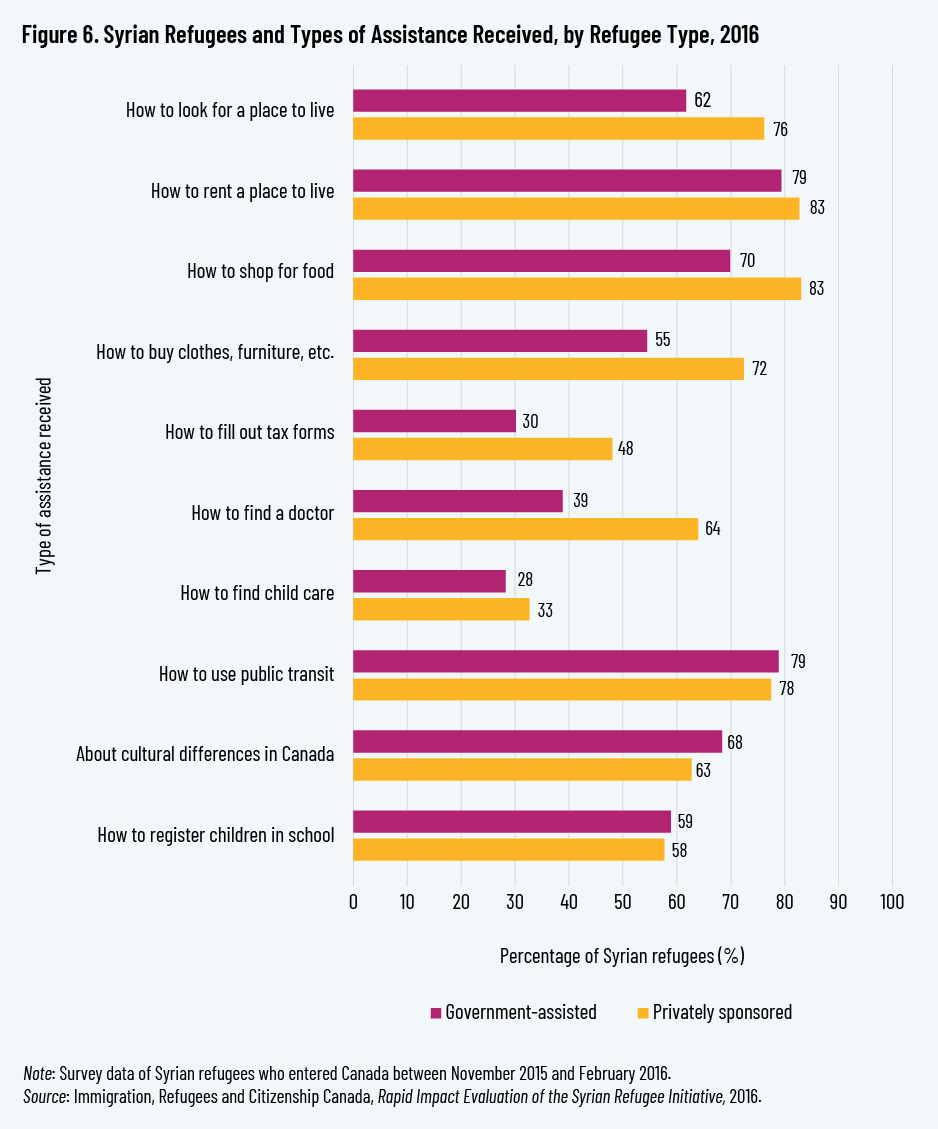
As mentioned above, the personalized assistance that privately sponsored refugees receive is often suggested as a key reason for the differences in economic outcomes. There is good reason to take this suggestion seriously, as there is evidence that privately sponsored refugees receive better care than government-assisted refugees, overall. For example, in the 2016 review of the Syrian refugee resettlement effort, privately sponsored refugees reported receiving more resettlement assistance and were more likely to indicate that their immediate needs were met than were refugees in the other group. Of ten types of assistance, privately sponsored refugees were more likely to report receiving help on seven: finding a place to live; renting; shopping for food; shopping for other things; filling out tax forms; obtaining medical care; and obtaining child care. And the gaps were not small: In the most extreme case, 64 percent of privately sponsored refugees reported receiving assistance finding a doctor, versus 39 percent of government-assisted refugees. For the three types of assistance for which government-assisted refugees reported receiving more help than privately sponsored refugees—how to use public transportation, learning about cultural differences, and registering for school—the differences between the two groups were relatively small, averaging less than three percentage points. On the other seven categories, for which privately sponsored refugees reported more help, the gap averaged almost fourteen percentage points. 54 54 Immigration, Refugees and Citizenship Canada, Rapid Impact Evaluation.
It would be simplistic to say that private sponsorship is wholly better than government assistance at helping refugees integrate into the Canadian economy. The privately sponsored program involves government at some level. At the very least, all refugees must be accepted by the Government of Canada, such that no privately sponsored program would even be possible without some government process. Privately sponsored refugees who have exceptional needs may be eligible for financial assistance under the Resettlement Assistance Program. 55 55 Immigration, Refugees and Citizenship Canada, Grants and Contributions in Support of Resettlement Assistance Program. Health care is available to privately sponsored refugees through the Interim Federal Health Program, 56 56 Immigration, Refugees and Citizenship Canada, Temporary Health Care Coverage. and all refugees can access the federal government’s Settlement Program, which provides services such as language training. 57 57 Immigration, Refugees and Citizenship Canada, Find Help to Adjust.
Yet the trend is clear: Privately sponsored refugees tend to receive better care than government-assisted refugees. Other surveys show similar results. An evaluation conducted by the government found that privately sponsored refugees were more likely to say that services were provided in a manner that was timely (95 percent) and accessible (96 percent) than were government-assisted refugees (85 percent and 86 percent, respectively). This is not to denigrate the assistance provided by government, since more than eight out of ten refugees spoke well of it; but the private sponsors appear to do even better. 58 58 Immigration, Refugees and Citizenship Canada, Evaluation of the Resettlement Programs (GAR, PSR, BVOR and RAP).
The Advantages of Subsidiarity in Refugee Resettlement
The possible reasons outlined above to explain why privately sponsored refugees tend to perform better than government-assisted refugees point to subsidiarity as a fundamental explanation underlying them. The survey data showing that privately sponsored refugees are more likely than government-assisted refugees to indicate that their immediate needs are met are evidence that those closest to the refugees themselves are providing more support, as are the data showing that privately sponsored refugees receive more timely and accessible support.
The principle of subsidiarity can also explain the conclusions of scholars that privately sponsored refugees receive more personalized assistance. Those who are closest to the refugees themselves not only have better information about their needs but are also likely to have stronger motivation to care for them. The private sponsorship model is particularly tied to motivation, since private organizations or groups of five must freely choose to participate in it. Individual citizens who choose to sponsor a refugee do not act out of obligation to an international treaty, as a government does. Rather, they act out of their caring disposition and the free exercise of their will.
Of course, as stated above, the differences between the two streams, and those who support each of them, are not black and white. It would be a mistake, for example, to think that government-assisted refugees receive support only from distant officials in Ottawa. In fact, the federal government contracts many of the integration services to local agencies that interface directly with the refugees. The care that government-assisted refugees receive from public servants or the employees of these agencies remains important. Nevertheless, it is important to acknowledge the structural differences between the private and public programs and the nuances in these structures that motivate the participants in each system. The data analyzed in the previous section of this paper bear out the differences. When we understand the principle of subsidiarity as enabling the creation and preservation of the social bonds that give rise to care, then we can see more clearly the connection between the data and the different structures of these two programs.
Moreover, the argument above—that privately sponsored refugees are often integrated into their new country by a more welcoming community—underscores a crucial aspect of subsidiarity. When privately sponsored refugees arrive in Canada, it is usually not just a group of five helping them. Nor is it usually a single refugee agency. Rather, they enter with the support of a community. Whether that is a diaspora community or a church community that supports the refugee agency, or it is a community of people who come along with the group of five, it is a community that is invested in the integration of that person or that family into their new home.
Such integration does not necessarily happen for refugees in the government-assisted group, since community is not typically a characteristic of government agency but is knitted together naturally by the social bonds of those who choose to associate with each other. In other words, subsidiarity enables solidarity. When higher-level authorities displace the ability of lower-level entities to create community, the social bonds that motivate people to care for their neighbours are weakened.
Survey data of sponsors are particularly interesting in this respect. As noted above, private sponsors often use the language of “family,” “friendship,” and “love” to describe the relationships that they form with those they sponsor. But equally notably, the researchers pointed out that “no respondent likened him or herself to a settlement worker or cast their relationship in terms of service provider/client.” 59 59 Macklin et al., “The Kinship Between Refugee and Family Sponsorship,” 6–7. The relationship between privately sponsored refugees and their sponsors can therefore be seen, by the sponsors at least, as fundamentally different, of a different order, than the relationship between government-assisted refugees and government.
The authors of this survey describe the difference in this way:
Settlement workers may be assigned to many government-assisted refugees and must serve them equally and without preferential treatment. They are public actors subject to public norms of neutrality. Refugee sponsors are avowedly partial. They feel a unique commitment to advance the welfare of the specific family they sponsor—or, as many sponsors say, “our” family. This, too, echoes the particularity of kinship relations. 60 60 Macklin et al., “The Kinship Between Refugee and Family Sponsorship,” 6.
This “particularity” is the anthropological truth that human beings, while they can and do care about humanity as a whole or individual people in distant lands, tend to care more about those with whom they have a real connection. The authors of the study go on:
There is a certain paradox in this: some refugee sponsors may be motivated to welcome the “stranger” by a humanitarian ethos that regards human beings as equal in their suffering, and equally entitled to aid in relief of suffering. Yet refugee sponsorship trades on the formation of thick bonds that connect specific sponsors to specific refugees, despite the aleatory circumstances of the initial match that brought them together; sponsors are thus expected to care more about the welfare of the family they sponsor than about other refugees. 61 61 Macklin et al., “The Kinship Between Refugee and Family Sponsorship,” 6.
These “thick bonds” are possible precisely because of the particularity of the relationships between refugees and their sponsors. Subsidiarity allows for the growth of these thick bonds, simply by giving them room to develop.
Canada will always need a government-assisted refugee stream, but government should do all it can to celebrate the distinctively Canadian option of private sponsorship and should encourage civil-society participation in it. The research findings outlined in this paper tell a clear story: The thick bonds formed between refugees and sponsors lead to relations of care, more personalized assistance, and stronger community to welcome the newcomers—all of which help to produce better economic outcomes for the refugee. Private sponsorship is preferable, all other things being equal. Canada’s refugee resettlement system is just one example of how the principle of subsidiarity can be embedded in social policy and produce benefits for all Canadians.
Applying a Subsidiarity Lens to Other Areas of Public Policy
This example of the advantages of the subsidiarity principle can inform other questions of public policy. Although no two areas of policy are precisely the same, principles such as subsidiarity can be understood and applied in various contexts.
There are many instances in Canadian public policy where the principle of subsidiarity is not functioning effectively. Canada is a federal state, in which subsidiarity is constitutionally embedded in the division of powers between the federal and provincial governments. Yet examples of federal intrusion in areas of provincial jurisdiction abound. The introduction of a national child care system is one of the clearest examples, but the federal government’s attempts to create a national pharmacare and a national dental care system are also indications of this. Moreover, this encroachment into provincial jurisdiction has arguably led to an atrophying of the federal government’s capacity to deal with issues of truly national importance, such as national defence and interprovincial trade barriers.
It is equally important to ensure that the principle of subsidiarity function effectively in the relationship between government and civil society. The nature of civil society, though, is that it requires citizens to be engaged in it. While governments can incentivize citizens’ participation in civil society, they cannot accomplish it through policy or decree. But governments can start by “doing no harm.” In some cases, the best that governments can do is to limit their activity in a given sphere, in order to allow more room for citizen-led civil-society organizations. This is where the principle of subsidiarity is so crucial, because it guides governments, civil society, and individual persons to discern the appropriate sphere of action for each.
That said, the principle of subsidiarity is fairly general and, while it provides guidance for action, the proper boundaries of action between levels of government, civil-society organizations, and individual persons are often difficult to discern. Determining what level of authority is sufficiently close to the problem or issue, while also being sufficiently large to deal with it effectively, is a matter of practical judgment, and each situation will call for a slightly different application of the principle.
Therefore, policy-makers at all levels of government must be attentive to the principle of subsidiarity when they are considering a policy solution to a given social problem. They should actively restrain themselves from directly engaging an issue when a lower order of government, or civil society, is better placed to handle it. Governments have a tendency to assume control, in part so that political actors can be seen to be responding to an issue. This tendency is understandable, but it must be resisted, since it can lead to a greater centralization than is warranted. Explicitly including subsidiarity in the decision-making process can help to counteract this inclination.
As an aid to doing so, policy-makers may ask themselves the following questions when considering a problem or issue. Together, these questions represent a guide to a subsidiarity mentality. They are framed in terms of government action versus civil-society action, but they can also be used when considering which level of government—federal, provincial, or municipal—should act.
Questions of Proximity
- Could a solution to the issue be delivered by an organization or person that is closer to it than government?
This is the core question that must be asked when using a subsidiarity lens. According to the principle, if a program or solution can be delivered effectively by a level of authority closer to the problem, then it should be. What are the organizations or persons closer to the problem able to do? The following questions, particularly those about capacity, will help to answer this question.
- If one part of the solution should be delivered by government, are there other parts that should be delivered by an organization or person that is closer to the problem?
Most social and economic issues are complex and require different kinds of interventions, of which some are best made by central government authorities and others by lower authorities and civil society. In refugee policy, for example, resettlement targets and security screening may be done best by the national government, whereas integration and service delivery may be done best by civil society. Attention to the various aspects of an issue will help to determine how to distribute responsibility.
Questions of Efficiency
- What efficiencies would be gained if the government delivered this service or program?
Although subsidiarity is not primarily about efficiency, arguments about centralization and decentralization inevitably deal with this factor. Policy-makers should be attentive to the efficiency gains that can be achieved by larger collective action. These gains could justify action by a higher-level authority if they are large enough, but the decision should be made only after considering the following two questions.
- What efficiencies would be gained if civil society delivered it?
As noted earlier, lower-level authorities have more information than higher-level authorities about an on-the-ground problem, and they may be nimbler in dealing with it. This can lead to different efficiencies from those contemplated in the previous question.
- What social bonds would be weakened or lost if government delivered it, which would otherwise have been created or strengthened?
Gains in efficiency should be weighed against other advantages that would be forgone by elevating the delivery to a higher level of authority. Chief among these are the social bonds that are formed when citizens help each other out of their own free will. These bonds are the breeding ground of the true, genuine care that can arise only at the personal level. Policy-makers must take care not to crowd them out in an excessive desire for greater efficiency.
Questions of Capacity
- Does civil society have sufficient capacity to deliver the solution? If not, does it have potential capacity? Could this problem or issue catalyze additional capacity if civil society were given the opportunity to act?
Engaging the principle of subsidiarity requires determining the capacity of civil society or individual persons to deliver a solution. If a non-governmental organization is capable of delivering it, then it should be left to do so. If it cannot, then this may justify action by a higher authority.
Or it may not. The real measure is the potential capacity of civil society, not necessarily its current capacity. Delegating responsibility to civil society nurtures social bonds. The care that emerges can cultivate an increased capacity for dealing with an issue. The Syrian refugee crisis is a case in point. Private sponsorship in 2015–16 increased when the government decided to resettle a large number of refugees quickly. This represented a large increase in civil-society capacity, and this capacity was sustained for many years, until the COVID-19 pandemic severely limited cross-border movement.
- What assistance can government provide to civil society to help achieve this capacity?
Policy-makers should ask themselves whether civil society needs any assistance that is in the government’s capacity to give in order for civil-society organizations to deliver programs and solutions effectively. The word “subsidiarity” comes from the Latin word subsidium, meaning “help.” The proper attitude of higher-level authorities, therefore, is not to absorb the activities that are proper to civil society but rather to provide the necessary assistance to them, including the space to operate freely.
- Is there sufficient capacity within government to deliver this service or program?
This is a key question in two respects. First, in determining which sphere of society is best equipped to deal with an issue, policy-makers must ask which one has the existing capacity to do so. Second, they must ensure that no sphere is so overloaded with responsibilities that it neglects its core functions. Thus, a proper distribution of responsibilities is essential. Concerns about Canada’s “state capacity” make this question all the more important in ensuring that not too many responsibilities are uploaded to senior levels of government. 62 62 S. Speer, “Incapacitated.”
That said, even if there is sufficient state capacity to deliver a service or program, government action may not be justified. Other considerations, such as the impact on social bonds, need to be weighed alongside this question.
These questions attempt to draw out what using a subsidiarity lens looks like in practice. They are a guide to policy-makers in determining the proper roles for government and for civil society. Practical judgment is necessary in answering any of these questions. That judgment requires policy-makers to have a strong appreciation for different spheres of society and the capacity that each can offer. By orienting themselves to this principle, they will restrain themselves in areas where others are more capable of acting, reserve themselves for areas in which they are best positioned to act, and assist where they can offer genuine help.
References
Ali, M.A., S. Zendo, and S. Somers. “Structures and Strategies for Social Integration: Privately Sponsored and Government Assisted Refugees.” Journal of Immigrant and Refugee Studies 20, no. 4 (2022). https://doi.org/10.1080/15562948.2021.1938332.
Althusius, J. Politica Methodice Digesta, Atque Exemplis Sacris et Profanis Illustrata, trans. Frederick S. Carney, 1964. https://www.constitution.org/2-Authors/alth/alth.htm.
Donati, P. “What Does ‘Subsidiarity’ Mean? The Relational Perspective.” Journal of Markets & Morality 12, no. 2 (2009): 211–43. https://www.marketsandmorality.com/article/139587-what-does-subsidiarity-mean-the-relational-perspective.
Finnis, J. “Subsidiarity’s Roots and History: Some Observations.” American Journal of Jurisprudence 61 (2016). https://scholarship.law.nd.edu/cgi/viewcontent.cgi?article=2269&context=law_faculty_scholarship.
Government of Canada. Constitution Act, 1867. Sections 91–93. https://laws-lois.justice.gc.ca/eng/const/page-1.html.
Government of Canada. Permanent Residents—Monthly IRCC Updates–Canada–Permanent Residents by Country of Citizenship and Immigration Category. 2024. https://open.canada.ca/data/en/dataset/f7e5498e-0ad8-4417-85c9-9b8aff9b9eda/resource/0f1e6cce-a2e3-4ded-92ca-47d3c7e55128.
Government of Ontario. City of Toronto Act, 2006. https://www.ontario.ca/laws/statute/06c11.
Government of Ontario. Municipal Act, 2001. https://www.ontario.ca/laws/statute/01m25.
Hayek, F.A. “The Use of Knowledge in Society.” American Economic Review 35, no. 4 (1945): 519–30. https://german.yale.edu/sites/default/files/hayek_-_the_use_of_knowledge_in_society.pdf.
Hyndman, J., W. Payne, and S. Jimenez. “Private Refugee Sponsorship in Canada.” Forced Migration Review 54 (2017). https://www.fmreview.org/resettlement/hyndman-payne-jimenez/.
Hynie, M., S. McGrath, J. Bridekirk et al. “What Role Does Type of Sponsorship Play in Early Integration Outcomes? Syrian Refugees Resettled in Six Canadian Cities.” Refuge 25, no. 2 (2019): 36–52. https://www.erudit.org/en/journals/refuge/2019-v35-n2-refuge04887/1064818ar/.
Immigration, Refugees and Citizenship Canada. 2025 Annual Report to Parliament on Immigration. 2025. https://www.canada.ca/en/immigration-refugees-citizenship/corporate/publications-manuals/annual-report-parliament-immigration-2025.html.
Immigration, Refugees and Citizenship Canada. Blended Visa Office-Referred Program: Who Can Apply to Sponsor a Refugee. 2024. https://www.canada.ca/en/immigration-refugees-citizenship/services/refugees/sponsor-refugee/private-sponsorship-program/blended-visa-office-program/eligibility.html.
Immigration, Refugees and Citizenship Canada. Community Sponsors: Who Can Apply. 2025. https://www.canada.ca/en/immigration-refugees-citizenship/services/refugees/sponsor-refugee/private-sponsorship-program/community-sponsors/eligibility.html.
Immigration, Refugees and Citizenship Canada. Evaluation of the Refugee Resettlement Program. 2024. https://www.canada.ca/en/immigration-refugees-citizenship/corporate/reports-statistics/evaluations/evaluation-of-the-refugee-resettlement-program.html.
Immigration, Refugees and Citizenship Canada. Evaluation of the Resettlement Programs (GAR, PSR, BVOR and RAP). 2016. https://www.canada.ca/en/immigration-refugees-citizenship/corporate/reports-statistics/evaluations/resettlement-programs.html#toc5-8.
Immigration, Refugees and Citizenship Canada. Find Help to Adjust as a Refugee in Canada. 2025. https://www.canada.ca/en/immigration-refugees-citizenship/services/refugees/help-within-canada/government-assisted-refugee-program/providers.html.
Immigration, Refugees and Citizenship Canada. Get Government Assistance—Refugees. 2025. https://www.canada.ca/en/immigration-refugees-citizenship/services/refugees/help-within-canada/government-assisted-refugee-program.html.
Immigration, Refugees and Citizenship Canada. Government-Assisted Refugees Program. 2025. https://www.canada.ca/en/immigration-refugees-citizenship/services/refugees/resettle-refugee/government-assisted-refugee-program.html.
Immigration, Refugees and Citizenship Canada. Grants and Contributions in Support of Resettlement Assistance Program. 2024. https://www.canada.ca/en/immigration-refugees-citizenship/corporate/transparency/program-terms-conditions/resettlement-assistance-program.html.
Immigration, Refugees and Citizenship Canada. Groups of Five: Who Can Apply. 2025. https://www.canada.ca/en/immigration-refugees-citizenship/services/refugees/sponsor-refugee/private-sponsorship-program/groups-five/eligibility.html.
Immigration, Refugees and Citizenship Canada. How to Be Resettled in Canada as a Refugee. 2025. https://www.canada.ca/en/immigration-refugees-citizenship/services/refugees/resettle-refugee/eligibility.html.
Immigration, Refugees and Citizenship Canada. Partners in Refugee Resettlement: Blended Visa Office-Referred Program. 2024. https://www.canada.ca/en/immigration-refugees-citizenship/services/refugees/sponsor-refugee/private-sponsorship-program/blended-visa-office-program.html.
Immigration, Refugees and Citizenship Canada. Private Sponsorship of Refugees Program. 2025. https://www.canada.ca/en/immigration-refugees-citizenship/corporate/publications-manuals/guide-private-sponsorship-refugees-program/section-2.html.
Immigration, Refugees and Citizenship Canada, Private Sponsorship of Refugees Program—Information for Refugees. 2025. https://www.canada.ca/en/immigration-refugees-citizenship/services/refugees/sponsor-refugee/private-sponsorship-program/refugees-information.html.
Immigration, Refugees and Citizenship Canada. Rapid Impact Evaluation of the Syrian Refugee Initiative. 2016. https://www.canada.ca/en/immigration-refugees-citizenship/corporate/reports-statistics/evaluations/rapid-impact-evaluation-syrian-refugee-initiative.html.
Immigration, Refugees and Citizenship Canada. Sponsorship Agreement. 2023. https://www.canada.ca/content/dam/ircc/documents/pdf/english/services/refugees/sah-agreement-modifications-en.pdf.
Immigration, Refugees and Citizenship Canada. Sponsorship Agreement Holders: Find a Sponsorship Agreement Holder. 2025. https://www.canada.ca/en/immigration-refugees-citizenship/services/refugees/sponsor-refugee/private-sponsorship-program/agreement-holders/holders-list.html.
Immigration, Refugees and Citizenship Canada. Temporary Health Care Coverage: Who Is Eligible and For How Long. 2025. https://www.canada.ca/en/immigration-refugees-citizenship/services/refugees/help-within-canada/health-care/interim-federal-health-program/eligibility.html.
Janzen, R., M. Taylor, and R. Gokiert. “Life Beyond Refuge: A System Theory of Change for Supporting Refugee Newcomers.” Refuge 38, no. 2 (2022): 1–21. https://doi.org/10.25071/1920-7336.40892.
Jedwab, J. “GARs vs. PSRs: Explaining Differences in Outcomes for Recent Refugees to Canada.” Canadian Diversity 15, no. 2 (2018). https://acsmetropolisca-wpuploads.s3.ca-central-1.amazonaws.com/wp-content/uploads/2024/07/05115224/Jack-Jedwab-CanadianDiversity-Vol15-No2-2018.pdf.
Kaida, L., F. Hou, and M. Stick. “The Long-Term Economic Outcomes of Refugee Private Sponsorship.” Analytical Studies Branch Research Paper Series. Statistics Canada, 2020. https://www150.statcan.gc.ca/n1/pub/11f0019m/11f0019m2019021-eng.htm.
Macklin, A., K. Barber, L. Goldring, J. Hyndman, A. Korteweg, S. Labman, and J. Zyfi. “A Preliminary Investigation into Private Refugee Sponsors.” Canadian Ethnic Studies 50, no. 2 (2018): 35–58. https://jhyndman.info.yorku.ca/files/2018/11/CES-Macklin-et-all-FINAL-2018.pdf.
Macklin, A., L. Goldring, J. Hyndman, A. Korteweg, K. Barber, and J. Zyfi. “The Kinship Between Refugee and Family Sponsorship.” Working Paper No. 2020/4, 2020, 6–7. https://www.torontomu.ca/content/dam/centre-for-immigration-and-settlement/tmcis/publications/workingpapers/2020_4_Macklin_Audrey_et_al._The_Kinship_between_Refugee_and_Family_Sponsorship.pdf.
Oda, A., M. Hynie, A. Tuck, B. Agic, B. Roche, and K. McKenzie. “Differences in Self-Reported Health and Unmet Health Needs Between Government Assisted and Privately Sponsored Syrian Refugees: A Cross-Sectional Survey.” Journal of Immigrant and Minority Health 21 (2019). https://doi.org/10.1007/s10903-018-0780-z.
Picot, G., Y. Zhang, and F. Hou. “Labour Market Outcomes Among Refugees to Canada.” Analytical Studies Branch Research Paper Series, Statistics Canada, 2019. https://www150.statcan.gc.ca/n1/pub/11f0019m/11f0019m2019007-eng.htm.
Pius XI. Quadragesimo Anno. Libreria Editrice Vaticana, 1931. https://www.vatican.va/content/pius-xi/en/encyclicals/documents/hf_p-xi_enc_19310515_quadragesimo-anno.html.
Pontifical Council for Justice and Peace. Compendium of the Social Doctrine of the Church. Canadian Conference of Catholic Bishops, 2005.
Speer, S. “Incapacitated: Why Canada Has a State Capacity Problem—and How to Fix It.” Public Policy Forum, 2024. https://ppforum.ca/publications/canada-state-capacity-problem/.
Speer, S. “Lost in the Aggregate.” Review of The Rule of Nobody: Saving America from Dead Laws and Broken Government, by Philip K. Howard. Comment, February 2, 2017. https://comment.org/lost-in-the-aggregate/.
Treaty Establishing the European Community. Article 5, 2002. https://eur-lex.europa.eu/legal-content/EN/TXT/?uri=CELEX:12002E/TXT.
Weinberger, L.D. “The Relationship Between Sphere Sovereignty and Subsidiarity,” in M. Evans and A. Zimmerman (eds.), Global Perspectives on Subsidiarity, Ius Gentium: Comparatives Perspectives on Law and Justice 37, 2014. https://doi.org/10.1007/978-94-017-8810-6_4.
Wilkinson, L., and J. Garcea. “The Economic Integration of Refugees in Canada: A Mixed Record?” Migration Policy Institute, 2017. https://reliefweb.int/report/canada/economic-integration-refugees-canada-mixed-record.