

Key Points
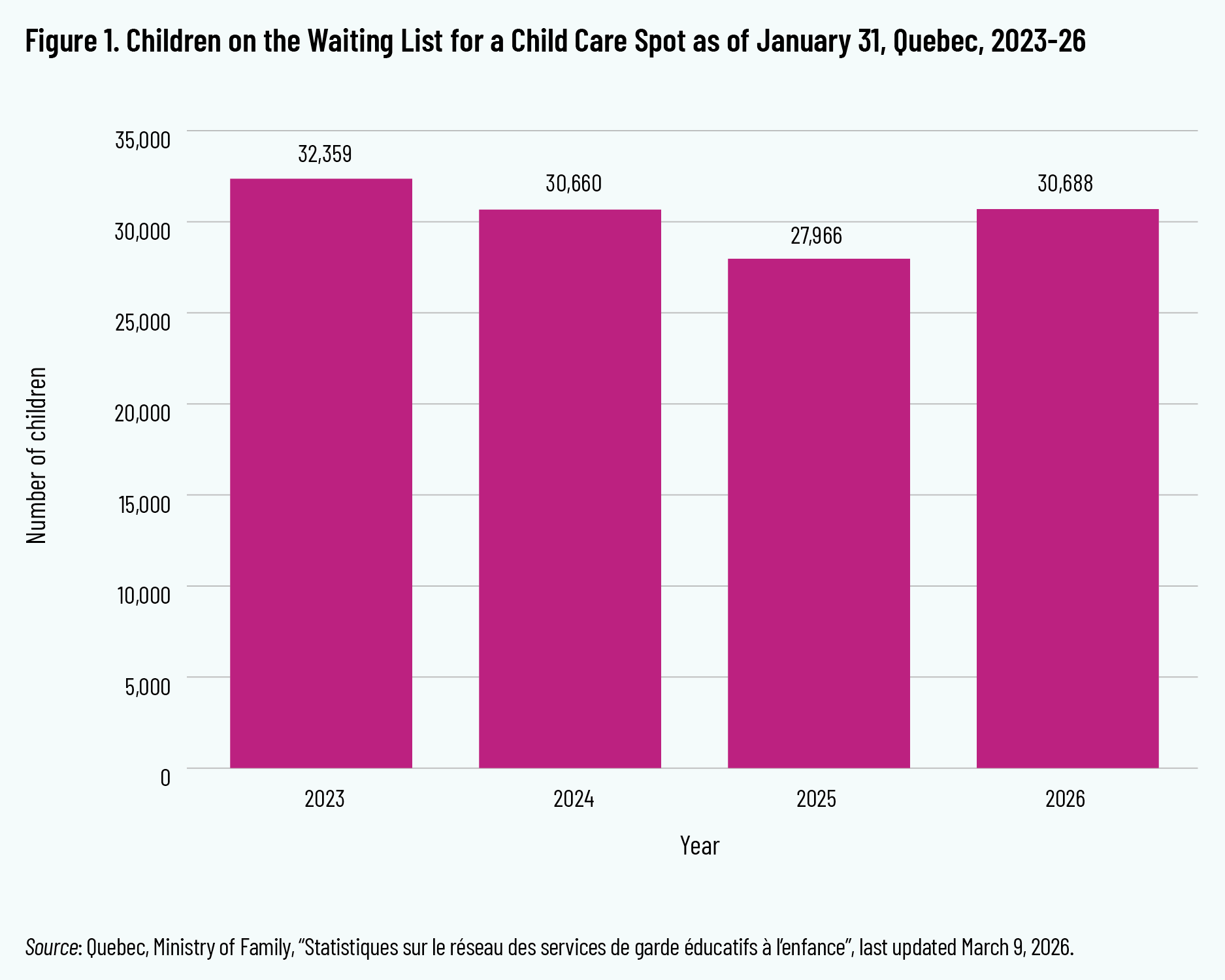
- The federal government’s Canada-Wide Early Learning and Child Care (CWELCC) program upholds the Quebec child care system as a model for the rest of the country. Yet, even after nearly thirty years, Quebec’s child care system has failed to deliver on its promises. It has never been able to meet the demand generated by its low fees, and more than thirty thousand children are currently on a waiting list.
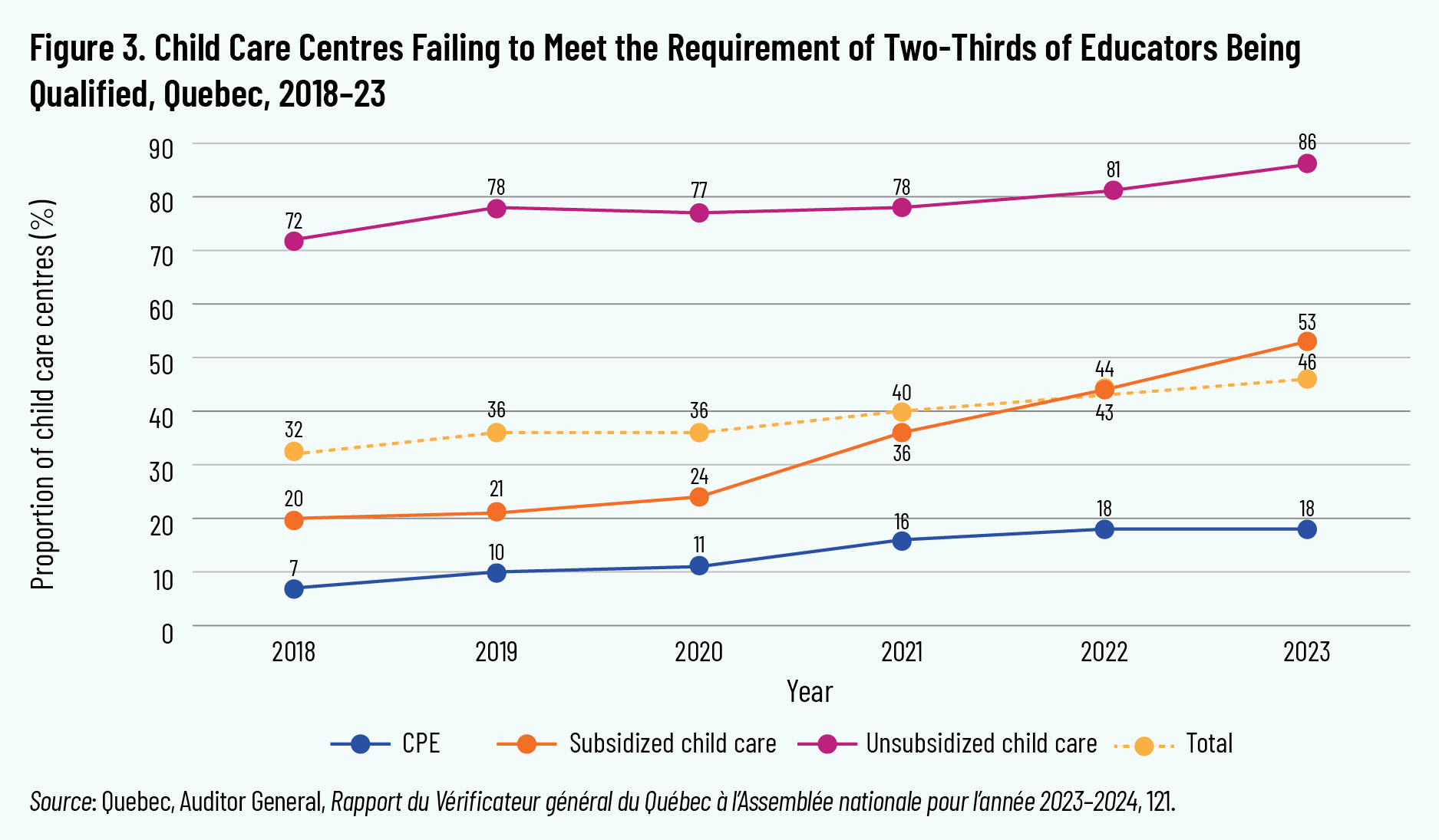
- The need to create a large number of spots is at odds with the Quebec government’s own quality standards. The percentage of child care centres reporting their proportion of qualified educators as less than two in three is on the rise, reaching 46 percent as of 2023.
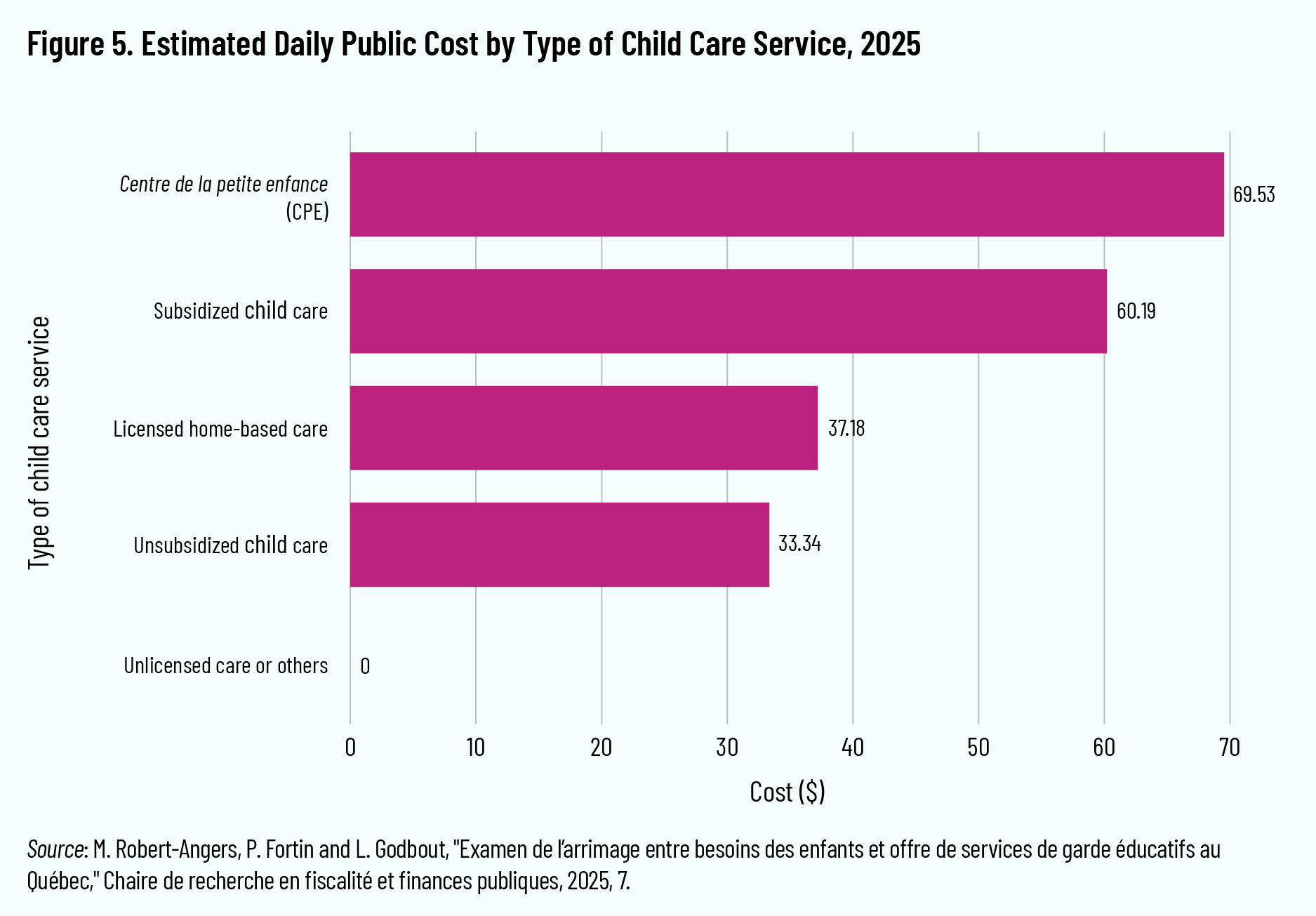
- In the Quebec system, government funding is inequitable from one child to another: It ranges from approximately $33 per day for the tax credit for non-subsidized child care centres to $70 per day for a spot in a government-subsidized centre (CPE). A parent whose child does not attend any licensed child care facility receives no financial support.
- By tying its funding to attendance at a licensed facility, Quebec’s current model subsidizes work by reducing its cost, but does not support time spent with family. Yet surveys show that Quebec parents would like to work less in order to spend more time with their children.
- Our polling reveals that only 50 percent of Quebecers believe that the current system, where funding primarily goes to child care providers, is preferable to a system where funding goes to parents, thereby offering them freedom of choice. The other half of Quebecers would prefer this second option.
- Many of the problems within the Quebec model have been replicated across the country with the CWELCC program, because it also funds child care providers directly instead of parents, thus leaving many families behind. A truly comprehensive child care system should instead take into account the full range of parental choices and, if it provides direct funding to certain providers, also offer direct support to parents, as is the case in Finland.
Introduction
Since its creation in 1997, Quebec’s network of low-cost child care centres has attracted the interest of policymakers across North America and is held up as a model for achieving a universal and accessible child care system. When the federal government announced its Canada-Wide Early Learning and Child Care Program (CWELCC, or “$10-a-day child care”) in 2021, it explicitly stated that it was drawing inspiration from the “model that already exists in Quebec” to design its own program. 1 1 Canada, Governor General, "A Stronger and More Resilient Canada." Complete citations are provided for all sources at the end of this report. New York City’s new democratic socialist mayor, Zohran Mamdani, has also pledged to take cues from Quebec to create a universal child care network. 2 2 North, “New York Mayor-Elect Zohran Mamdani.”
However, Quebec’s child care system is far from perfect, for two main reasons: It is neither universal nor equitable. The low up-front cost of public child care has driven up demand to such an extent that it has never been met; the system has never had enough capacity to serve all those who wish to use it. Furthermore, the government funds the various child care options (CPEs, 3 3 A CPE (centre de la petite enfance) is a government-subsidized early education centre. subsidized child care centres, home-based care, and tax credits for unsubsidized child care) at different levels, resulting in significant disparities in the amount parents receive.
These two problems stem from the fact that the current system primarily funds child care facilities rather than families directly. This has adverse effects, such as increasing the actual cost of child care spots for taxpayers, but also direct consequences for families, particularly those who do not secure a spot in a child care centre and consequently receive no support from the government.
This research report aims to shed light on these persistent blind spots in Quebec’s family policy, through summarizing research by Quebec academics and government data. Many of the problems inherent in the Quebec model have been replicated at the federal level, since the CWELCC program is based on it. To build a more equitable system, where no family is left behind due to their care preferences, exclusively funding child care providers is not a viable strategy. Finland, which gives parents the right to choose between a financial benefit and a child care spot, offers a model that is more respectful of diverse preferences.
A System That Was Never Universal
Despite the government’s stated intention, Quebec’s child care system has never truly been universal, since it is unable to offer a spot to all parents who ask for one. As Professor Sophie Mathieu of the University of Sherbrooke explains, “Quebec’s child-care system has always been a victim of its own success: it has never succeeded in providing universal access to child care services.” 4 4 Mathieu, “Four Lessons.” Indeed, nearly thirty years after its creation, the network still fails to meet demand, despite a relatively steady increase in the number of spots since 1998. 5 5 Robert-Angers, Fortin, and Godbout, “Examen de l’arrimage,” 4. Figure 1 shows that approximately thirty thousand children are on the government waiting list for child care spots in Quebec.
This creates real challenges for families, particularly during the transition period between the end of parental leave and the child’s entry into child care or school, when tens of thousands of parents are either unable to find a spot or do not wish to do so, and thus receive no financial support from the government for their child care needs. This gap represents a significant blind spot in Quebec’s family policy. 6 6 Dinan and Mathieu, “Le Québec, paradis des familles . . . vraiment?”
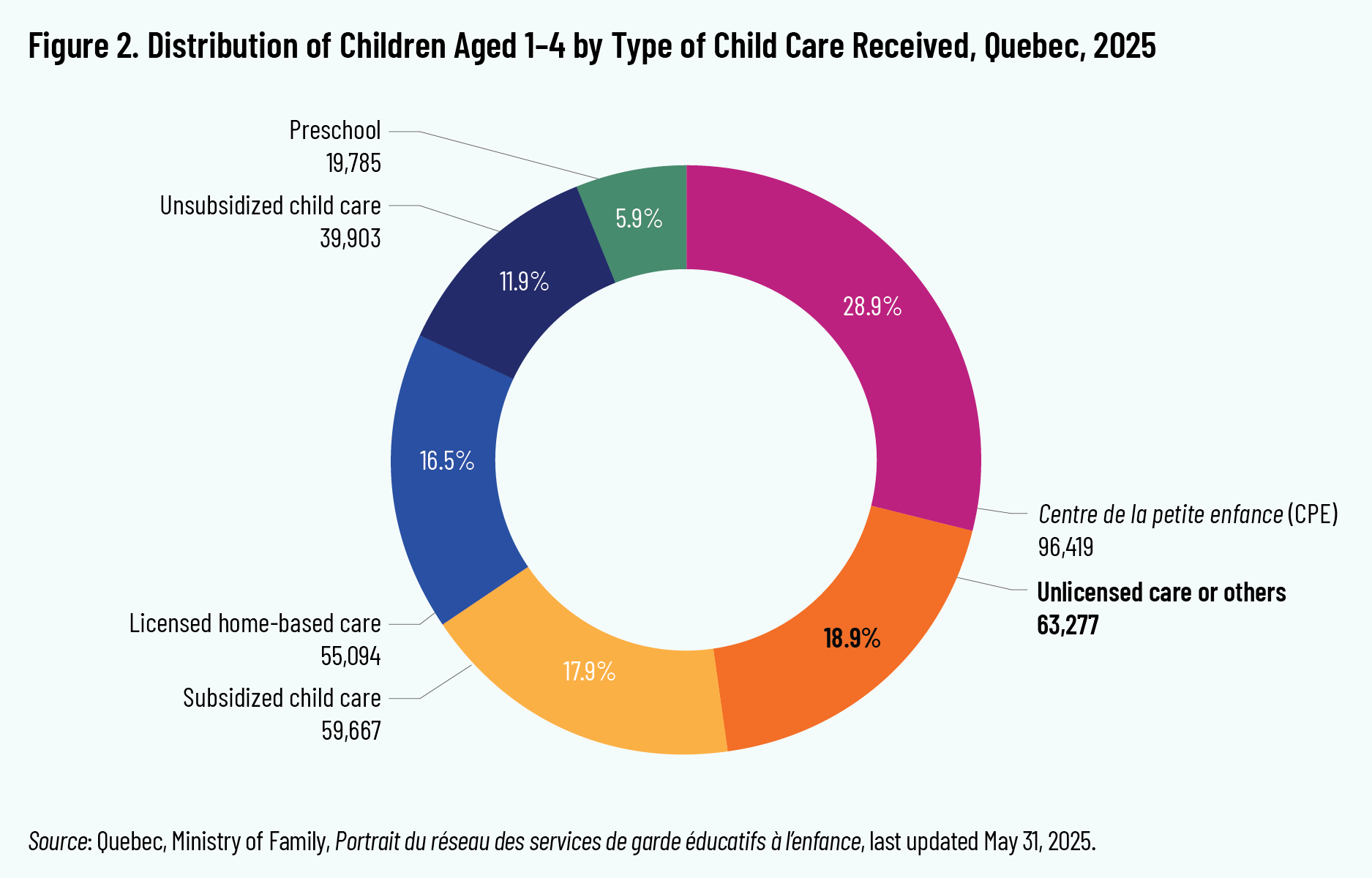
According to the latest data from the Quebec Ministry of Family, approximately 80 percent of children aged 1–4 in Quebec have a spot in a licensed educational child care service (SGEE) or in preschool. In other words, one-fifth of children aged one and older (18.9 percent) do not attend such a program, either by choice or due to a lack of available spots. Furthermore, the current child care network in Quebec is highly fragmented, with several types of child care facilities coexisting (see figure 2). Only 28.9 percent of children aged 1–4 attend a CPE, which is just over one-third of those in child care. Thus, two-thirds of those with a spot in an SGEE are not in a CPE.
Furthermore, for several years there has been a tension between the desire to increase the number of spots and the quality of the spots created. As Michael Robert-Angers, Pierre Fortin, and Luc Godbout point out, “The average quality of child care services in Quebec leaves much to be desired: while many facilities, particularly CPEs, offer adequate service quality, conversely, in a large number of them the quality is inadequate.” 7 7 Robert-Angers, Fortin, and Godbout, “Examen de l’arrimage,” 25; our translation.
The Quebec Ministry of Family measures quality across several dimensions, such as the layout of the facilities and the equipment, the children’s experiences, and the interactions between the educational staff and the children and their parents. 8 8 Quebec, Ministry of Family, “Qualité éducative dans les services de garde.” The training of educators is also one of the criteria most frequently used by the Quebec government to assess the quality of services. 9 9 It should be noted that there is no real consensus on the criteria that should be used to objectively measure the quality of a child care service. Cardus will soon publish a study on the issue of quality in child care services. Prior to the pandemic, government regulation required that two out of every three educators be qualified (ECE certification), which was lowered during the health emergency to recruit more staff, then gradually raised to one in two (50 percent) in March 2023, and then returned to two-thirds in April 2027. 10 10 Quebec Auditor General, Rapport du Vérificateur général, 120. Thus, to increase the number of spots, the proportion of child care centres where fewer than two out of every three educators have received recognized training rose significantly across the system, reaching 46 percent of the total as of 2023, as demonstrated by the Quebec Auditor General (figure 3).
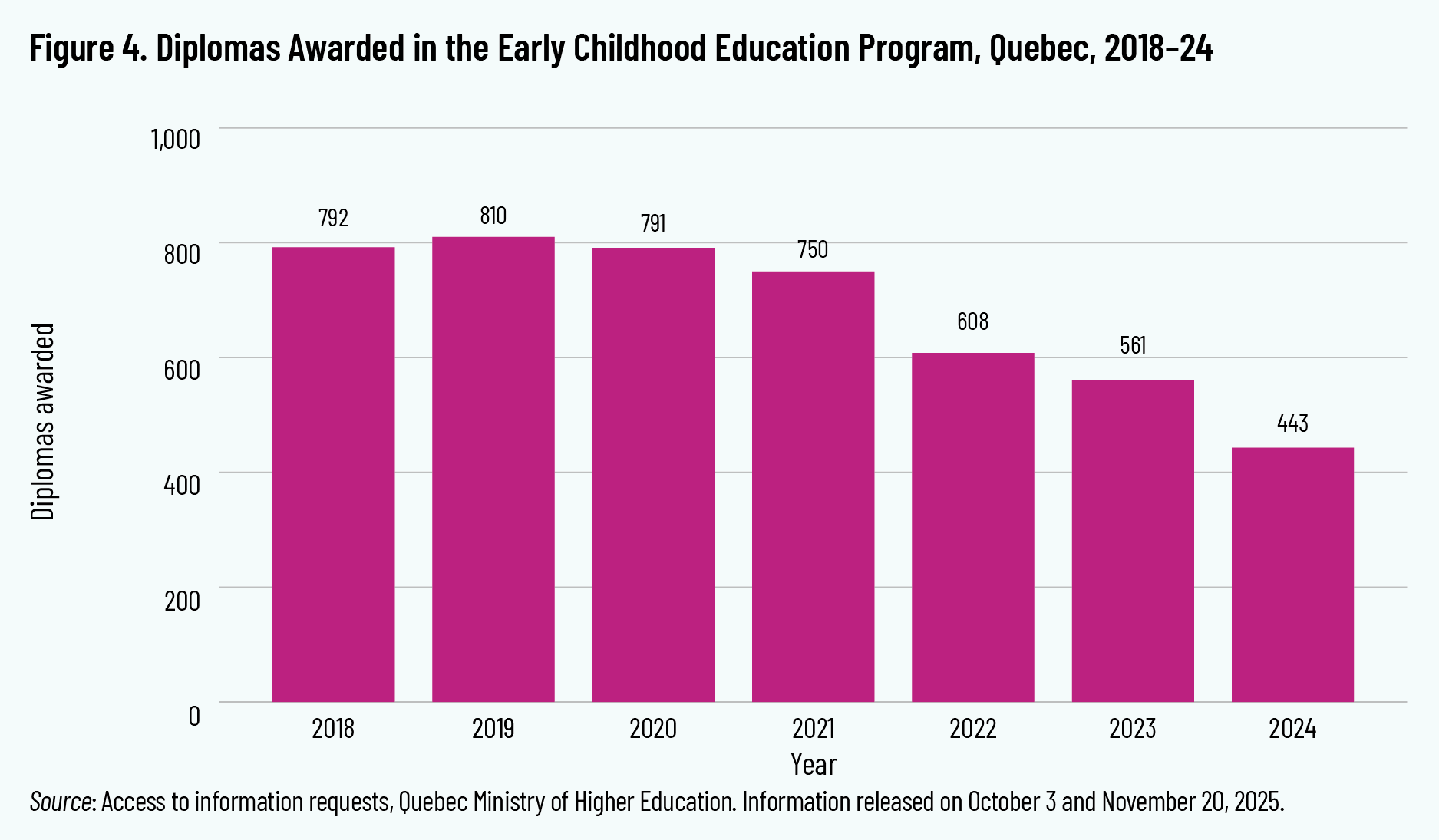
Despite numerous incentives, including scholarships for each completed semester, Quebec is graduating fewer and fewer early childhood educators, as shown in figure 4. 11 11 Mathieu, “How to Create Early Childhood Spaces.” This program has a low graduation rate, of only one in three, and several thousand educators have left their jobs in recent years due to dissatisfaction with salary levels and working conditions. 12 12 Gerbet, “Les étudiantes désertent la formation d’éducatrice à la petite enfance.”
Thus, even though the government has stated its intention to move toward a universal system where all children would have a spot—to the point of enshrining in law that “every child has the right to receive high-quality, personalized educational child care services from birth until admission to preschool or elementary school” 13 13 Loi sur les services de garde éducatifs à l’enfance, art. 2; our translation. —it seems unlikely that this goal will be achieved without compromising quality standards. In recent years, the failure rate in quality assessments of child care services has risen significantly: “Nearly 30% of facilities . . . whose educational quality was assessed by the Ministry of Family Affairs failed the assessment,” according to the Auditor General of Quebec. 14 14 Quebec, Auditor General, Rapport du Vérificateur général, 107; our translation. This is not without consequences, as “several studies have found that inadequate child care services are associated with negative effects on children’s development.” 15 15 Robert-Angers, Fortin, and Godbout, “Examen de l’arrimage,” 25; our translation. Even if it were possible to meet the government’s standards across the entire network, such uniformity would not necessarily reflect what parents want, as they have varied child care preferences.
Unequal Funding from One Child to Another
An equitable family policy should follow the principle of “funding neutrality,” meaning it should respect parents’ choices regarding the child care options they prefer, without favouring one at the expense of others. Whether a child care service is public or private, in a family setting or at a centre, or even at home with a nanny or a family member, all these options are legitimate and correspond to needs and desires that vary from one child and one family to another. 16 16 Cardus Family, “A Positive Vision for Child Care Policy Across Canada,” 8–9. It is indeed profoundly unfair to fund child care differently based on the type of service children attend or their ability to secure a spot. Yet this is precisely what is happening in Quebec.
Professors Sophie Mathieu and Diane-Gabrielle Tremblay state it clearly: “Not all families are equal in the support they receive from the state,” and “not all children seem to have the same ‘value’” in the eyes of the Quebec government, depending entirely on the type of child care service they attend. 17 17 Mathieu and Tremblay, “The Evolution and the Transformation,” 6–8; our translation. Robert-Angers, Fortin, and Godbout estimated the extent of this inequity based on the Quebec government’s 2025–2026 budget appropriations. As shown in figure 5, the gap is extremely important. The government subsidizes CPEs at a rate of $69.53 per child per day, which is roughly twice as much as a subsidized home-based child care centre or a non-subsidized child care centre eligible for the tax credit for child care expenses. Over a full year of 260 days of care, this represents a considerable gap (see figure 6). In fact, a parent whose child attends a non-subsidized child care centre covered by the tax credit receives approximately $10,000 less in government support than a parent whose child is in a CPE.
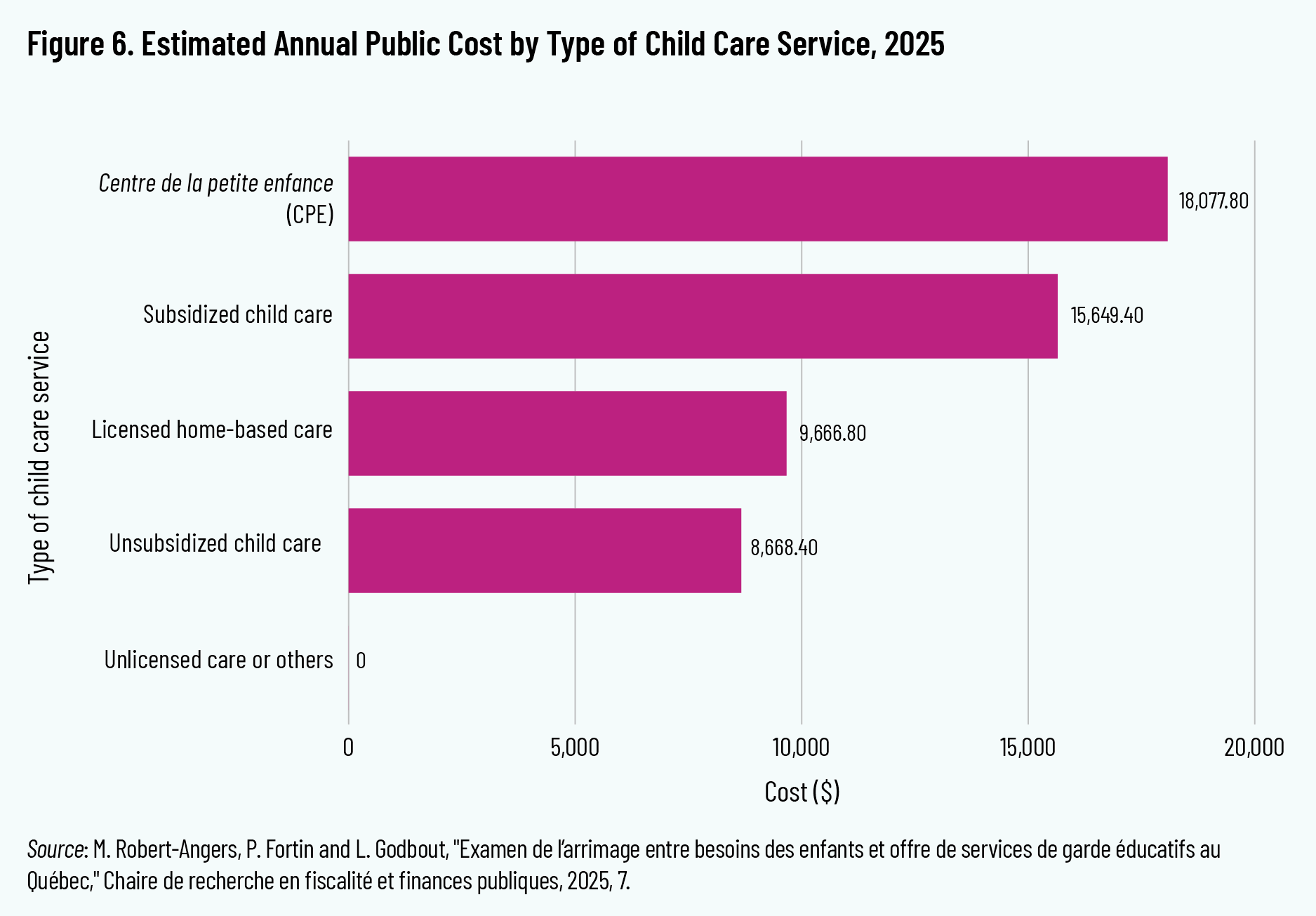
This is a major inequity, which is also not correlated with the actual cost of child care: “Some parents bear a higher net cost of child care for a service whose actual cost is lower, and vice versa.” 18 18 Robert-Angers, Fortin, and Godbout, “Examen de l’arrimage,” 11; our translation.
For example, a parent might pay $9.65 per day for a spot in a CPE, which actually costs nearly $80 per child per day when parental and public contributions are added together, while another parent ends up paying more, even after tax credits, at a private child care centre where the actual cost is $50 per child per day. This funding inequity partly explains why there are more qualified educators in CPEs: Since they receive a subsidy that far exceeds that of other child care options, they can afford to offer higher salaries, whereas unsubsidized child care centres would have to pass this increase on to parents. 19 19 Robert-Angers, Fortin, and Godbout, “Examen de l’arrimage,” 12.
The most significant inequity, however, concerns children who do not attend a licensed child care facility, because they are on a waiting list, use another form of care, or are cared for by a parent or family member: They receive no financial support. This means that nearly one in five children aged 1–4 20 20 We exclude children under the age of one from this measure because their parents most often benefit from the Quebec Parental Insurance Plan. receives no financial support from the government for the care they receive, as this care is not provided in a licensed child care facility or is provided at home. As Mathieu and Tremblay explain:
In Quebec, a parent who cares for their child at home is not eligible for the child care tax credit; for caregiving work to be assigned a monetary value partially covered by the government, it must be performed outside the home in a licensed child care facility. The social reproduction work of these parents is therefore performed for free and without any recognition. 21 21 Mathieu and Tremblay, “The Evolution and the Transformation,” 8; our translation.
This “invisible work,” performed primarily by women, 22 22 Standing Committee on the Status of Women, Women’s Unpaid Work in Canada. goes unpaid because it takes place in the domestic sphere rather than in the market. Moreover, this lack of recognition disproportionately affects children from disadvantaged backgrounds, as they are proportionally less likely to attend a child care facility than children from affluent families. 23 23 Laurin et al., “La fréquentation d’un service éducatif préscolaire,” 18. Indeed, the Institut de la statistique du Québec’s Enquête québécoise sur l’accessibilité et l’utilisation des services de garde 2021 indicates that children whose parents have upper-middle or high incomes are overrepresented in CPEs, as are those whose parents hold a university degree, as shown in figures 7 and 8. 24 24 Institut de la statistique du Québec, Enquête québécoise, 110.
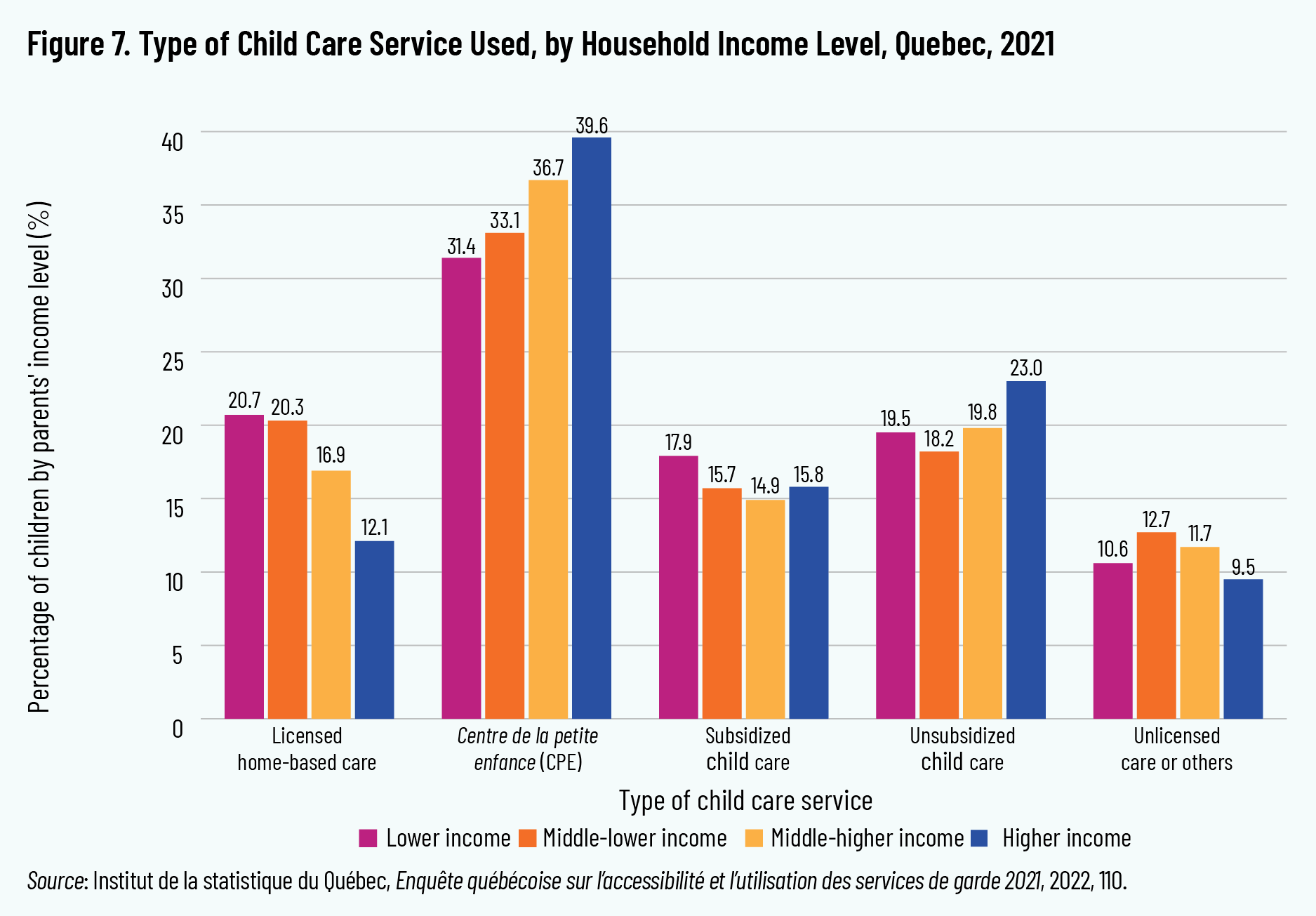
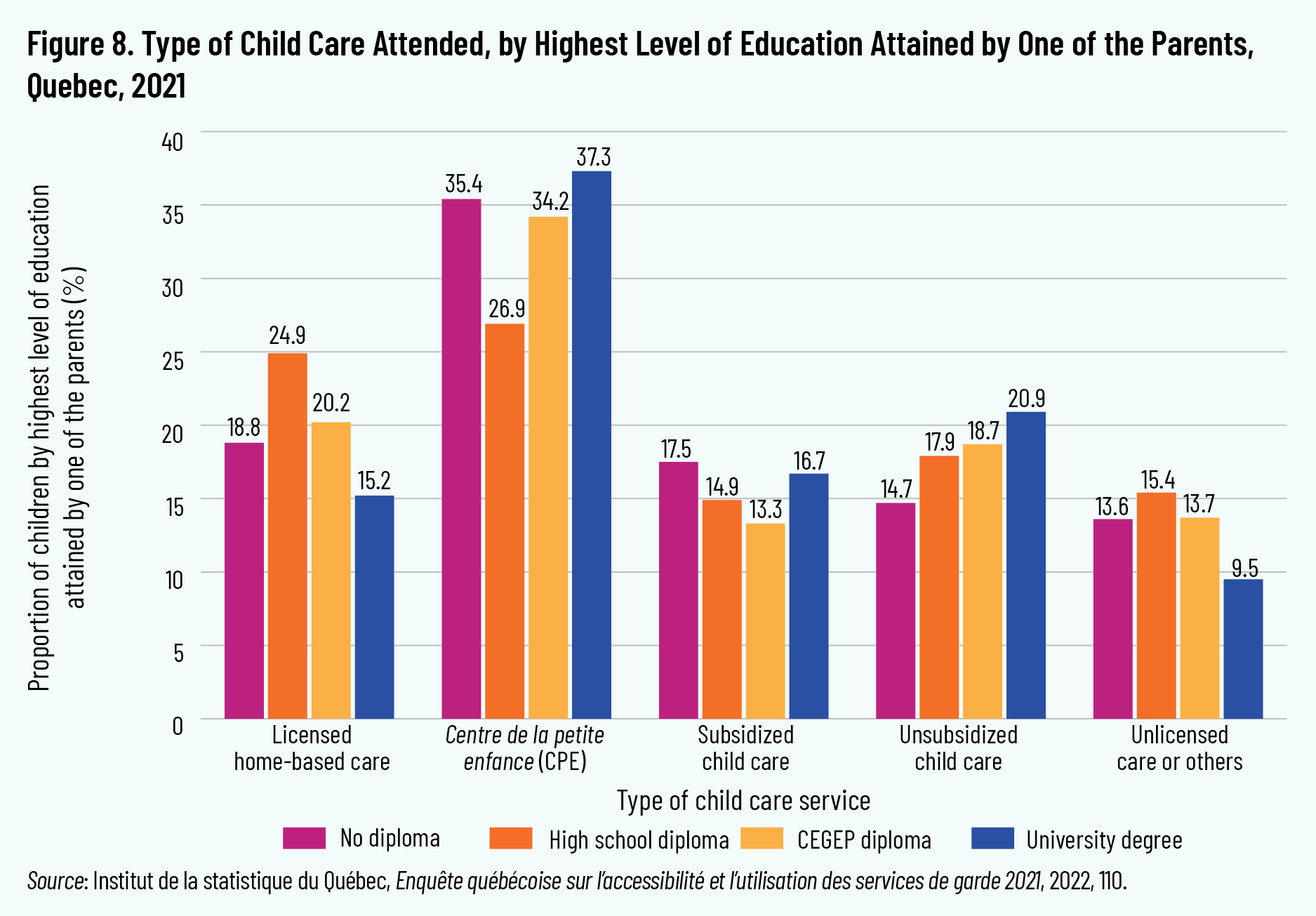
This situation is not unique to Quebec, however: In most OECD countries, children from lower-income families use child care services less frequently than children from wealthier families. 25 25 OECD, “PF3.2: Enrollment in Childcare and Pre-School,” 3. This finding makes sense given that reduced child care rates effectively serve as a subsidy for work, designed to lower its cost and make it more affordable. 26 26 Fortin, Godbout, and St-Cerny, “L’impact des services de garde,” 2. A flat-rate system like Quebec’s is more advantageous for high-income households than for low-income ones, as this rate represents a smaller portion of their income. This is why economist Jean-Yves Duclos, who later became Canada’s Minister of Families, stated that “the system of direct subsidies to CPEs benefits the wealthiest families the most.” 27 27 Duclos, “À qui profitent les services de garde à sept dollars?”; our translation.
The current system is therefore deeply inequitable because it does not fund all child care options equally and leaves out certain families who do not use government-licensed child care options. This differential support exacerbates inequalities among households by subsidizing CPEs, which are used more by affluent households, and providing less support for those attended by families with modest incomes.
Parents Want to Spend More Time with Their Children
The Quebec child care system is often presented as a work-life balance policy, a way to achieve equilibrium between professional and family responsibilities. However, since it does not treat all families equally, this is not entirely true.
As Mathieu and Tremblay point out, Quebec’s 1997 family policy “is part of a trend that prioritizes economic activity” and constitutes “a policy linked to labour market participation, rather than a policy designed to compensate for the provision of care.” 28 28 Mathieu and Tremblay, “The Evolution and the Transformation,” 5, 10; our translation. Since funding is paid directly to child care centres rather than to parents, and since parents whose children do not attend a licensed child care facility receive no support, it constitutes a subsidy aimed at lowering the cost of labour, and thus encouraging work, rather than a policy supporting families, regardless of the choices they freely decide to make. As Cardus senior fellow Andrea Mrozek notes, child care should not primarily be an economic policy, and when it is seen as such by governments, “the quality of child care often lands as a distant second, third, or even non-existent concern.” 29 29 Mrozek, “What Mayor Mamdani Should Learn.”
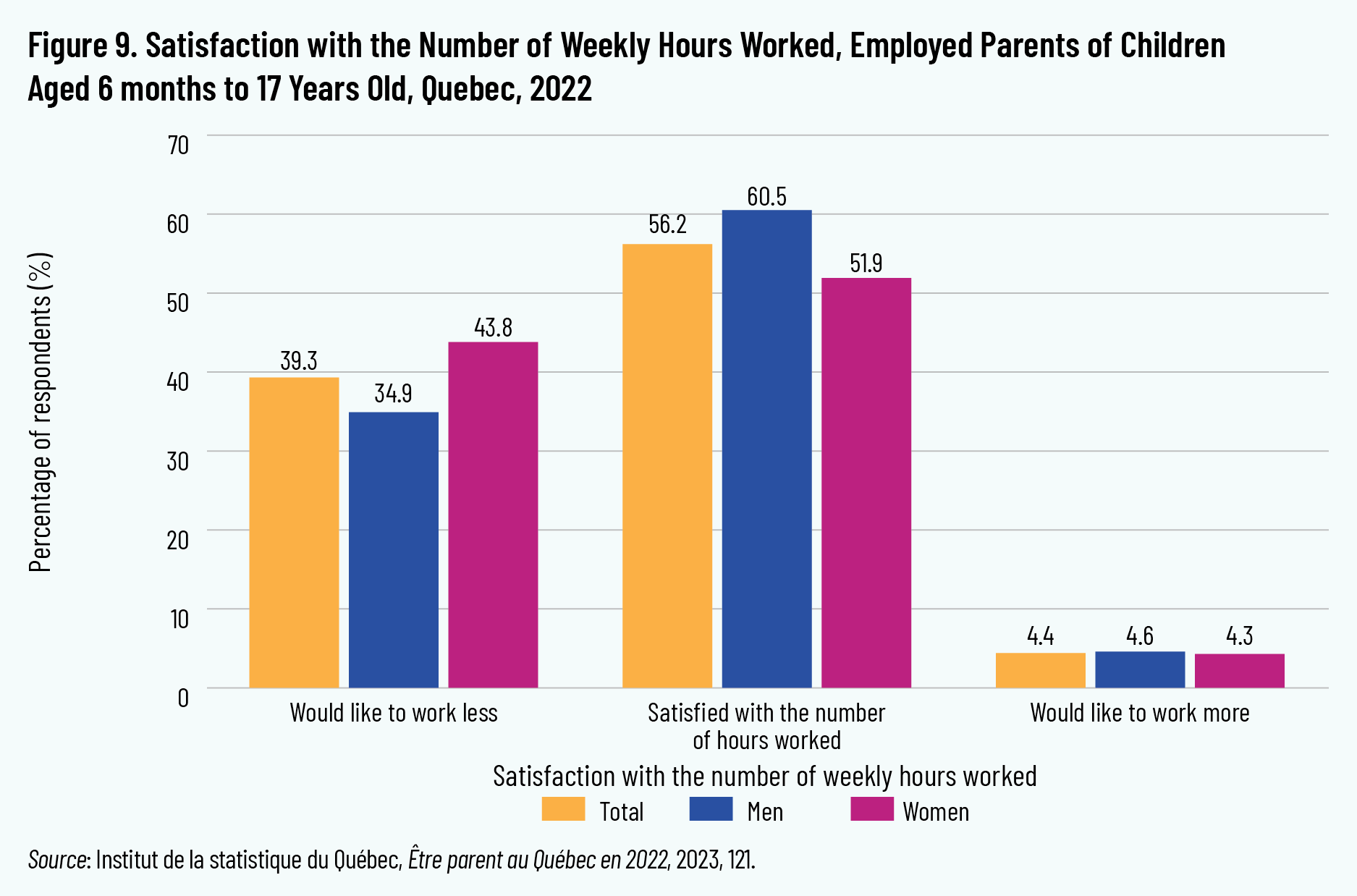
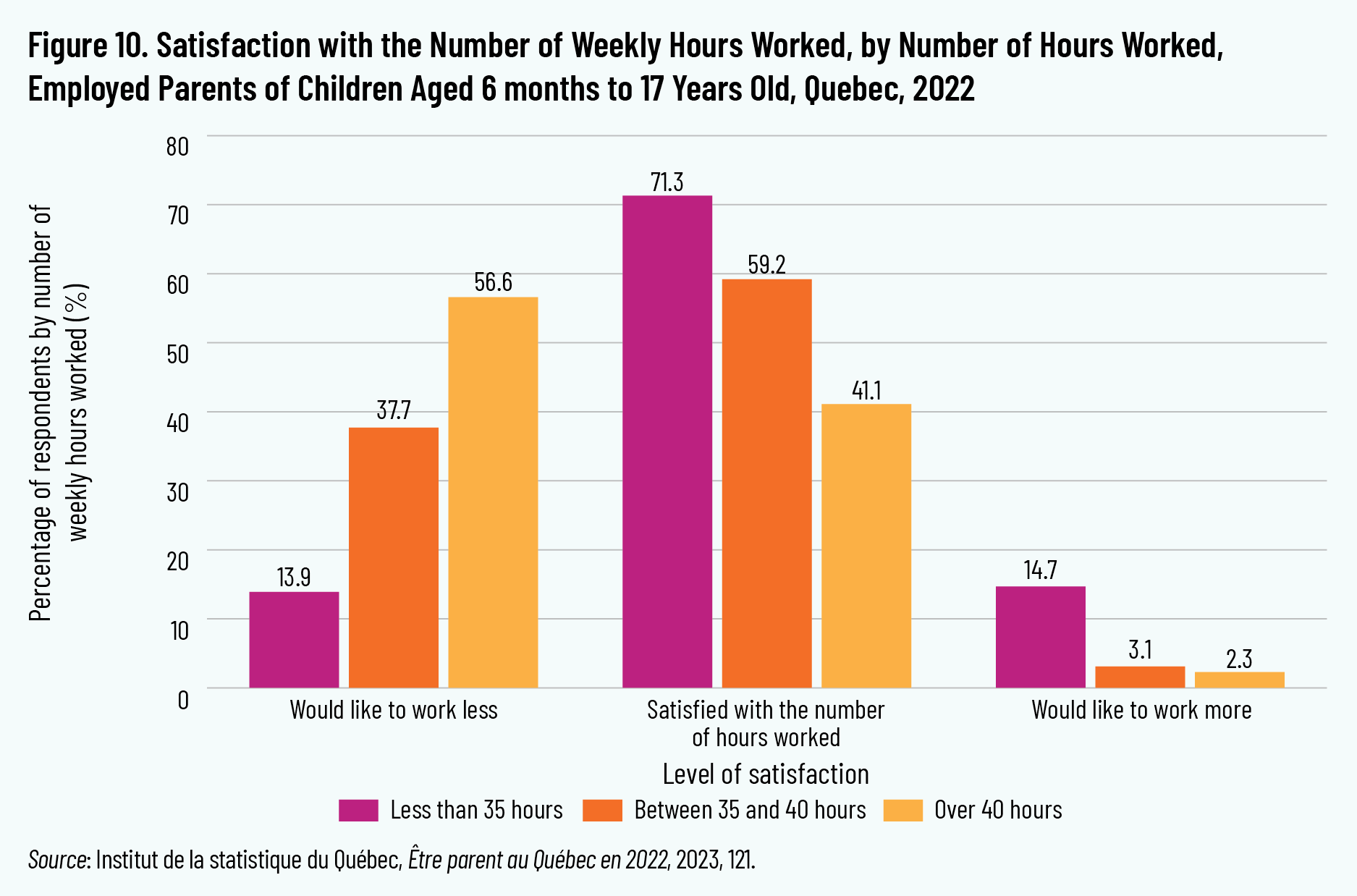
Even though the policy serves to keep parents of young children on the labour market, a survey conducted by the Institut de la statistique du Québec among parents of minor children shows that approximately 40 percent of them would actually like to work fewer hours. 30 30 Institut de la statistique du Québec, Être parent au Québec en 2022, 121. As shown in figure 9, the desire to reduce working hours is more prevalent among women (43.8 percent) than among men (34.9 percent). Figure 10 also shows that the more a parent works, the more likely they are to want to work fewer hours to spend time with their family. Thus, parents who work fewer than thirty-five hours per week are by far the most satisfied (71.3 percent) with their work hours, while a clear majority (56.6 percent) of those who work forty hours or more would like to spend less time at work.
Similarly, the Concilivi initiative of the Réseau pour un Québec Famille reveals in a survey that the most popular work-life balance measures among parents are better financial compensation for time off and a reduction in working hours, to spend more time with their families. 31 31 Concilivi, “Sondage,” 26. The current system, however, leans in the opposite direction, as it actually encourages parents to increase their working hours. The more days a child spends per year in licensed child care, the greater the subsidy, direct or indirect, received by the parents. Conversely, the subsidy is reduced the more time a parent spends with their children rather than at work, which increases the opportunity cost of working less rather than mitigating that cost, which would promote real work-life balance.
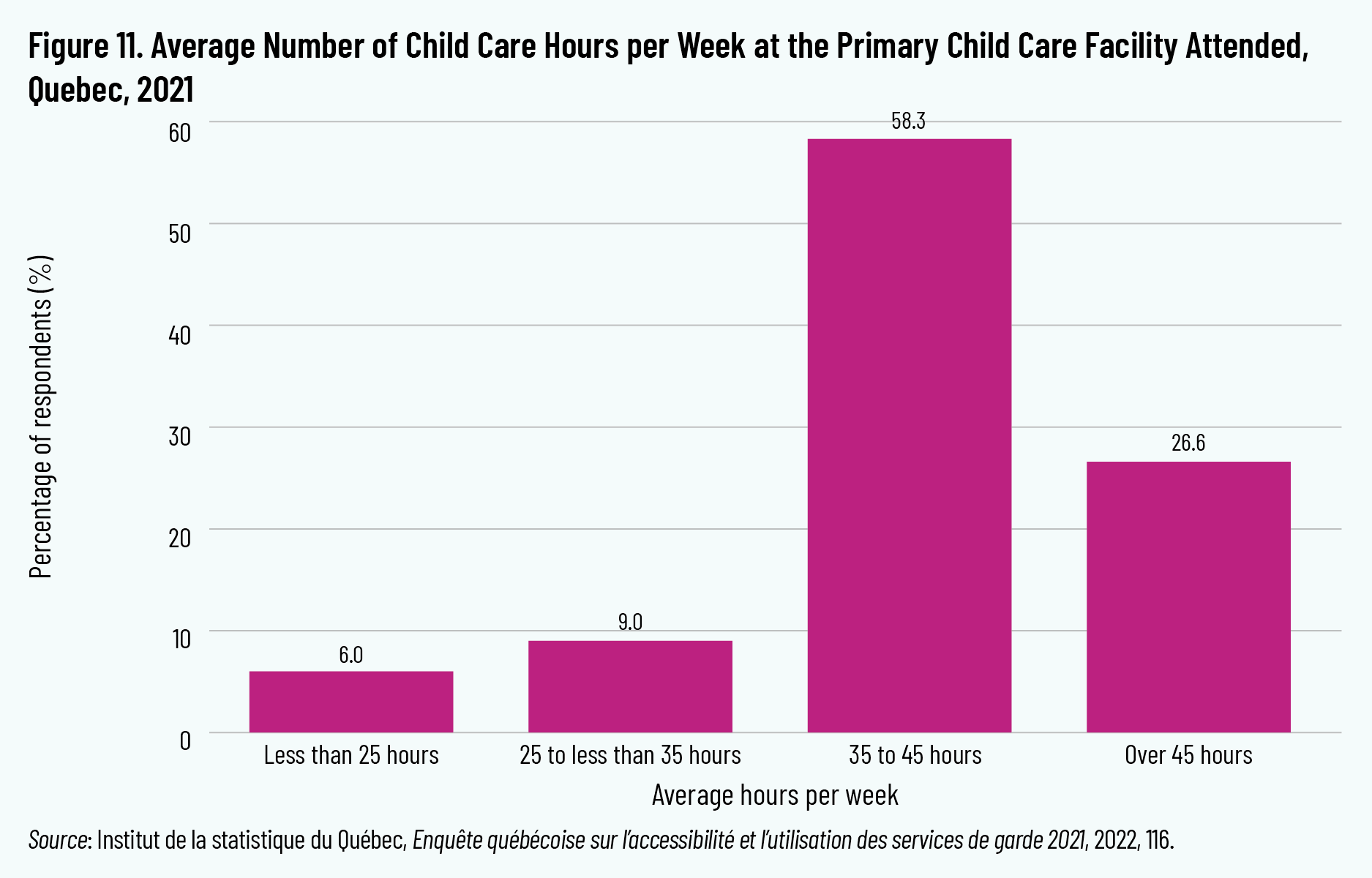
The result of this policy is therefore a high labour force participation rate, certainly, but also very long hours of child care attendance. Thus, nearly 85 percent of preschool-aged children attending child care attend for more than thirty-five hours per week, and more than a quarter (26.6 percent) attend for more than forty-five hours per week. 32 32 Institut de la statistique du Québec, Enquête québécoise, 116. These figures are of concern to the Observatoire québécois des tout-petits, which notes that spending more than thirty-five hours per week in child care can harm the development of social skills and emotional maturity. When the average exceeds forty-five hours of child care per week, it can have negative effects on socio-emotional skills, such as feelings of insecurity, behavioral problems, and increased aggressivity. 33 33 Observatoire québécois des tout-petits, Dans quels environnements grandissent les tout-petits au Québec?, 128. See also Belsky, “Universal Preschool.”
These findings should therefore be viewed in the context of studies that demonstrate the positive effects of attending child care on children from disadvantaged backgrounds, particularly when the child care is of high quality. 34 34 Bigras, Lemire, and Tremblay, “Le développement cognitif des enfants”; Belsky et al., The Origins of You. These potential negative effects stem from a system that funds only attendance itself, thereby incentivizing increased attendance, rather than equitably funding the various options available to parents, even as opinion polls show that parents would prefer to work fewer hours in order to balance their professional and family responsibilities.
Sending Money to Families Instead of Child Care Providers
The biggest shortcomings of Quebec’s child care system—namely, its lack of universality and the unequal funding provided for each child—are the result of the decision to fund child care centres themselves rather than parents. This focus on institutionalized child care amounts to a failure “to recognize that all parents are using care of some kind” 35 35 Mrozek, “What Mayor Mamdani Should Learn.” and to support them accordingly. This means that families who do not wish to, or who are unable to, secure a spot in a licensed child care centre are left behind by the system.
Furthermore, the money paid to child care facilities does not always ease the financial burden on families and often tends to increase the cost. 36 36 Stone, “Why a Child Allowance Is Preferable to Subsidized Child Care.” As Clavet and Duclos explain, “Those who use child care services funded directly by the government have little information about the (actual) cost of these services,” which leads to “overuse of these services and a natural upward pressure on their cost.” 37 37 Clavet and Duclos, “Réformer le financement des services de garde,” 9–10; our translation. Few families whose children attend a CPE know that the government contributes nearly $70 per child per day in addition to the flat rate of $9.65 they pay out of pocket. Those whose children are in subsidized home-based care also do not know that government support is nearly half that received by children in CPEs. This lack of information allows public support to be highly inequitable among families and costs to rise in a hidden manner, without users directly seeing the impact.
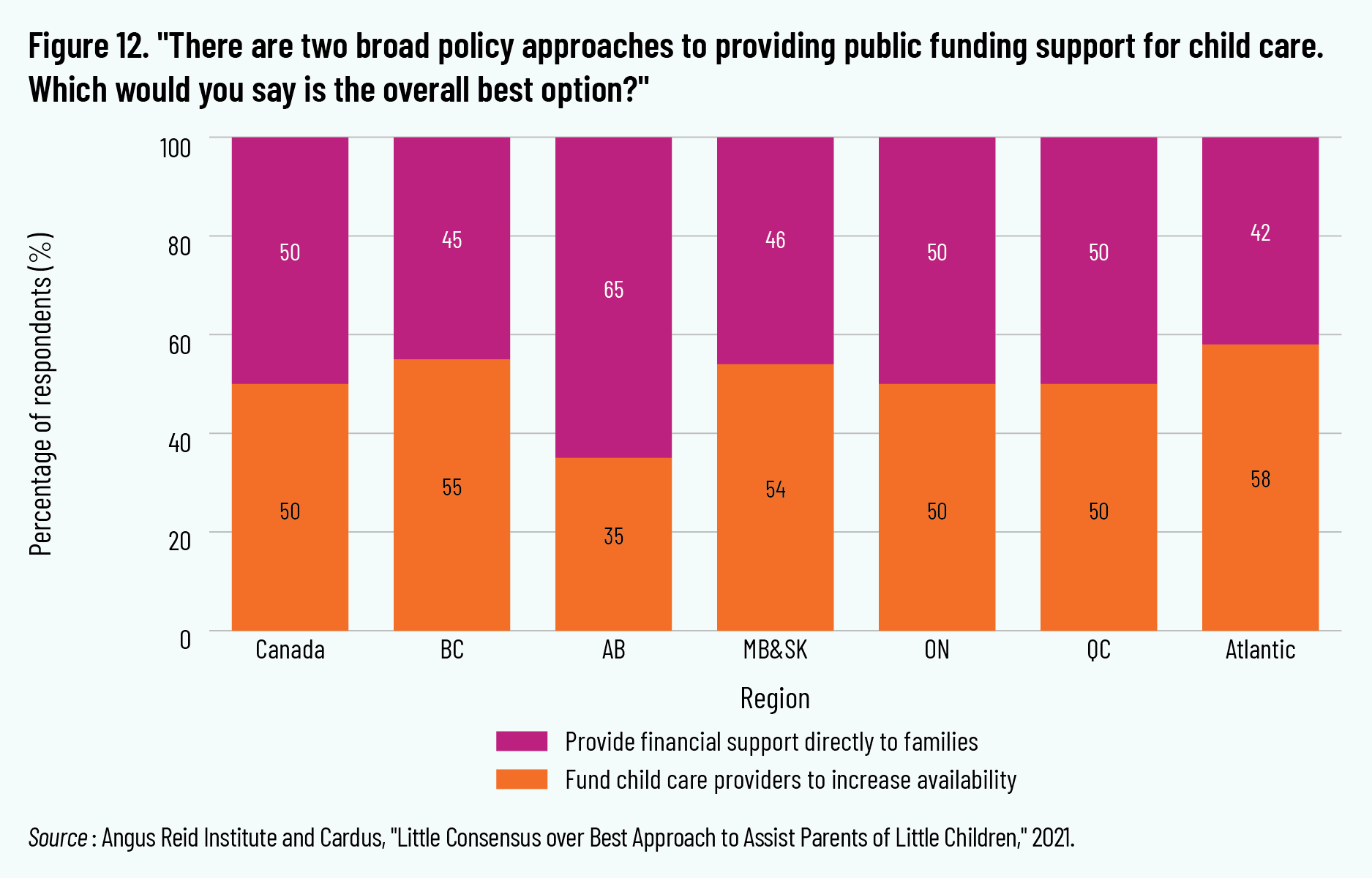
Directly funding child care facilities is not, however, the only way to support families of young children with their child care needs. Another option would be to fund parents directly through an allowance, then let them choose the type of care they prefer. Although this approach is not currently in place in Quebec, a 2021 Angus Reid Institute survey conducted in partnership with Cardus shows that half of Quebecers prefer it to direct funding of child care centres. 38 38 Angus Reid Institute, “Child Care in Canada.” There is therefore strong support in Quebec for a shift in philosophy, which would help resolve persistent problems that have existed since the creation of the CPE network.
The last Quebec election campaign also demonstrated that both sides of the political spectrum recognize the limitations of the current system. Québec Solidaire proposed an “emergency benefit” of $870 per month for parents of infants who no longer have access to the Quebec Parental Insurance Plan but cannot secure a child care spot. The left-wing party points out that tens of thousands of families “are forced to forgo an income because the government fails to provide them with a child care spot,” and that they receive no financial assistance due to the current funding structure. 39 39 Québec Solidaire, “Québec solidaire propose une prestation”; our translation. This new option would effectively address, at least partially, the issue of universality by ensuring no family is left behind.
The Conservative Party of Quebec, for its part, proposed providing a $200 taxable voucher per week per eligible child to cover child care costs, provided that one of the two parents works full-time, with a proportional voucher for those in part-time employment. This voucher was intended to eventually replace direct funding of child care facilities. The party proposed that the government fund families directly so child care providers can set their own rates, and parents can choose the child care option that best suits them. 40 40 Conservative Party of Quebec, Liberté 22, 62.
These two proposals share the common goal of directly addressing the issues of equity and universality in the Quebec model by promoting a direct transfer to families. They implicitly acknowledge that the current model has an overly narrow definition of what constitutes care, and thus leaves families behind. To move toward a more equitable model within a social-democratic framework similar to Quebec’s, the Finnish model can also serve as inspiration, given the flexibility it offers parents. It is also widely recognized as one of the best education and child care systems in the world, with high standards and outcomes. 41 41 Colagrossi, “10 Reasons Why Finland’s Education System Is the Best”; Jiménez, “Early Education’s Top Model.”
Finland, a Model of Flexibility for Parents
Finland, like Quebec, has a network of subsidized, low-cost child care services. This network is managed by cities and costs parents between €0 and €311 ($407.60) 42 42 Exchange rate of 1.60 EUR to 1 CAD, calculated as of April 28, 2026. per month, depending on their income. Allowances and vouchers are also available for parents who prefer to send their children to private child care facilities. 43 43 European Education and Culture Executive Agency, “Finland.”
Unlike Quebec, Finland does not only subsidize institutional child care. 44 44 Himmelstrand, “Made in Finland.” Its support for preschool-aged children does not discriminate based on the type of care chosen; rather, it offers great flexibility for parents who do not wish to send their child under the age of three to a child care centre, or who wish to work part-time while their child is young. This is made possible by two allowances, the Child Home Care Allowance and the Flexible Care Allowance. 45 45 Kela, “Child Home Care Allowance”; Kela, “Flexible Care Allowance.”
The Child Home Care Allowance is available to parents of children under the age of three who are no longer on parental leave and whose child does not attend a licensed child care facility. It consists of a basic benefit of €377.68 per month, with a supplement of €113.07 for each additional child under the age of three, and a supplement of up to €202.12 per month, depending on family size and income. It therefore amounts to up to €579.80 ($929.03) per month for one child and €692.87 ($1,110.20) for two children who do not attend a child care facility. This allowance is available even if both parents work, provided they use a type of child care other than a subsidized child care centre or a private child care centre.
The Flexible Child Care Allowance, on the other hand, is intended for parents who reduce their working hours to spend time with their children under the age of three. It offers two tiers: one at €269.34 ($431.57) per month for parents who reduce their work schedule to 60 percent of their usual hours or less, and one at €179.49 ($287.60) for parents who work 80 percent of their usual hours or less, which is the equivalent of three or four workdays. This allowance therefore enables working parents whose children attend child care to spend more time with their children, while reducing the opportunity cost of family time.
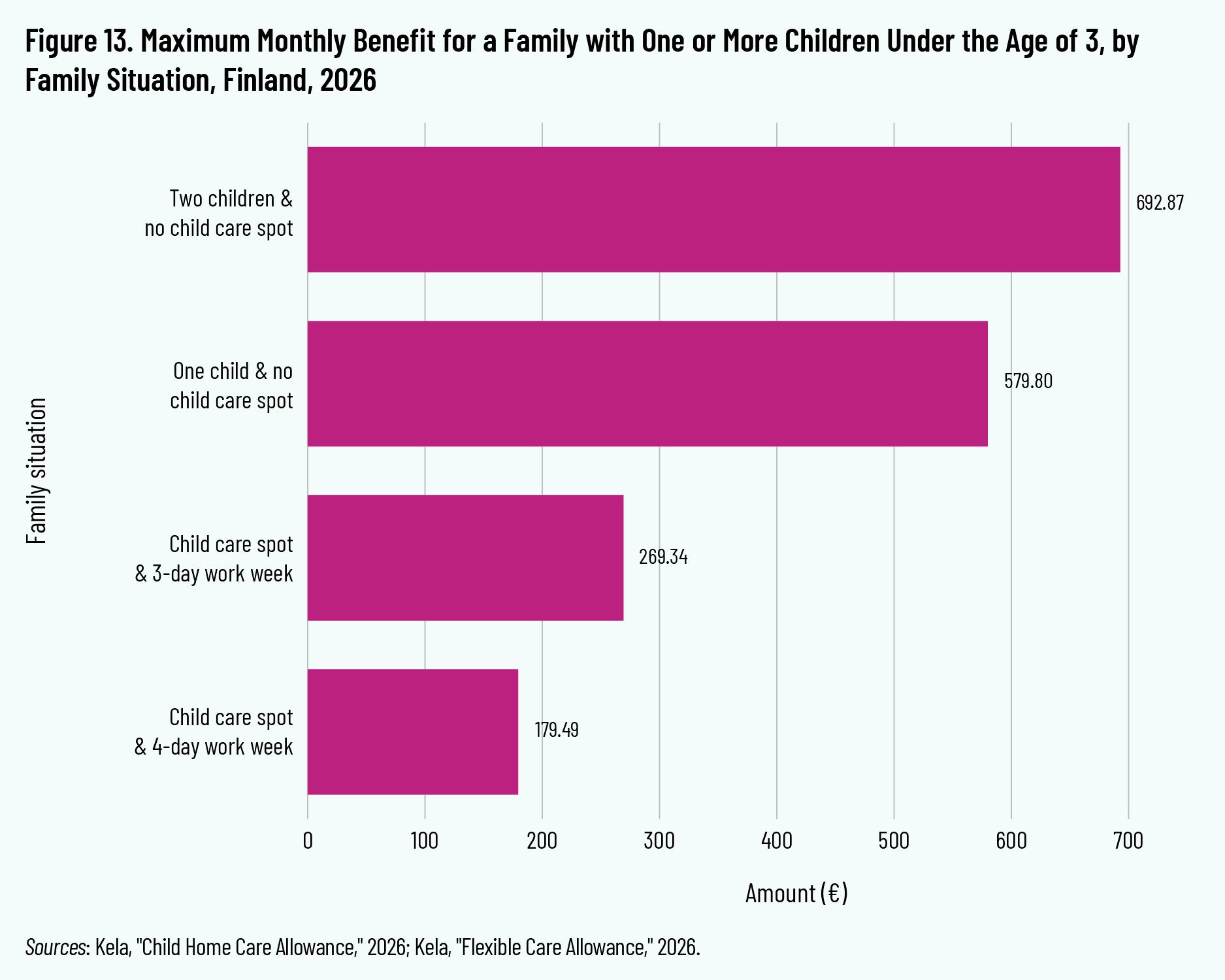
As shown in figure 13, the Finnish model offers far greater flexibility than the Quebec model of financial support for child care, as it accommodates multiple scenarios based on parents’ preferences. In Quebec, the parents of the 30,600 children on the waiting list for a child care spot receive no government financial support, just like those who prefer to use another type of child care. Similarly, a parent who decides to work four days a week to care for their child one day would receive no financial support. Finland therefore offers an appealing avenue for making the Quebec system more universal and equitable, ensuring that no family is left behind, regardless of their child care choices.
Conclusion
Nearly thirty years after its creation, Quebec’s network of low-cost child care centres continues to grapple with persistent issues of universality and equity. The system has never been able to provide a spot for all parents who want one for their child, and more than thirty thousand children are currently on a waiting list. Furthermore, the various types of child care services receive government financial support that varies widely, ranging from approximately $33 per day for a non-subsidized child care centre to nearly $70 per day for a CPE. Parents who cannot secure a spot or who choose to arrange for child care through other means cannot rely on public support.
Several issues arising from this model were replicated on a national scale with the implementation of the Canada-Wide Early Learning and Child Care Program. As in Quebec, the costs charged to parents have decreased, but the benefits have been distributed unevenly to middle- and upper-income families in many provinces. 46 46 Mitchell, “Ten-Dollar Delay,” 8. These reduced costs have also boosted demand and led to longer waiting lists. 47 47 Mitchell, “Ten-Dollar Delay,” 9. In Ontario, the drive to increase the number of educators has also reduced the proportion of certified early childhood educators, possibly impacting quality. 48 48 Mitchell, “Ten-Dollar Delay,” 11. Canadian provinces, too, are subject to a system that funds only the choices of a select few, based on an overly narrow definition of child care, and leaves other families with young children to their own devices. A truly comprehensive child care system should instead take into account the full range of parental choices and, if it provides direct funding to certain providers, also offer direct support to parents, as is the case in Finland.
References
Angus Reid Institute, “Child Care in Canada: Little Consensus over Best Approach to Assist Parents of Little Children,” March 2, 2021, https://angusreid.org/child-care-in-canada/.
Belsky, J. “Universal Preschool: Be Careful What You Wish For?” Institute for Family Studies, 2015. https://ifstudies.org/blog/universal-preschool-be-careful-what-you-wish-for.
Belsky, J., A. Caspi, T.E. Moffitt and R. Poulton. The Origins of You: How Childhood Shapes Later Life. Harvard University Press, 2020.
Bigras, N., J. Lemire, and M. Tremblay. “Le développement cognitif des enfants qui fréquentent les services de garde,” in Petite enfance, services de garde éducatifs et développement des enfants: État des connaissances, ed. N. Bigras et L. Lemay (Presses de l’Université du Québec, 2012), 21–68.
Canada, Governor General. A Stronger and More Resilient Canada. Speech from the Throne to open the Second Session of the Forty-Third Parliament of Canada. 2021. https://www.canada.ca/en/privy-council/campaigns/speech-throne/2020/stronger-resilient-canada.html.
Canada, House of Commons, Standing Committee on the Status of Women. Women’s Unpaid Work in Canada: Report of the Standing Committee on the Status of Women. 2021. https://publications.gc.ca/collections/collection_2021/parl/xc71-1/XC71-1-1-432-8-eng.pdf.
Cardus. “A Positive Vision for Child Care Policy Across Canada.” Cardus, 2019. https://www.cardus.ca/research/positive-vision-for-child-care-policy-across-canada/.
Clavet, N.-J., and J.-Y. Duclos. “Réformer le financement des services de garde des enfants au Québec: oui, mais comment?” C.D. Howe Institute, 2012. https://cdhowe.org/publication/réformer-le-financement-des-services-de-garde-des-enfants-au-québec-oui-mais-comment/.
Colagrossi, M. “10 Reasons Why Finland’s Education System Is the Best.” Big Think, September 9, 2018. https://bigthink.com/the-present/finland-education-system-2/.
Concilivi. “Sondage auprès des travailleur(-euse)s du Québec. Édition 2025.” Réseau pour un Québec Famille, 2025. https://www.concilivi.com/fr/statistiques-cft/2025-sondage-employes.
Conservative Party of Quebec. Liberté 22: Plateforme du Parti conservateur du Québec 2022. 2022. https://assets.nationbuilder.com/pcq/pages/5328/attachments/original/1660581693/FR_PLATERFOME_PCQ_2022_web.pdf?1660581693.
Dinan, S., and S. Mathieu. “Le Québec, paradis des familles . . . vraiment?” Options Politiques, March 31, 2025. https://policyoptions.irpp.org/fr/2025/03/quebec-paradis-familles/.
Duclos, J.-Y. “À qui profitent les services de garde à sept dollars?” Association des économistes du Québec, 2011. https://economistesquebecois.com/a-qui-profitent-les-services-de-garde-a-sept-dollars-2/.
European Education and Culture Executive Agency. “Finland: Early Childhood Education and Care.” Eurydice, last updated September 30, 2024. https://eurydice.eacea.ec.europa.eu/eurypedia/finland/access.
Fortin, P., L. Godbout and S. St-Cerny. “L’impact des services de garde à contribution réduite du Québec sur le taux d’activité féminin, le revenu intérieur et les budgets gouvernementaux.” Revue Interventions économiques 47 (2013). https://doi.org/10.4000/interventionseconomiques.1858.
Gerbet, T. “Les étudiantes désertent la formation d’éducatrice à la petite enfance.” Radio-Canada, November 26, 2024. https://ici.radio-canada.ca/nouvelle/2116065/formation-educatrice-enfance-cegep-etudiant-abandon.
Himmelstrand, J. “Made in Finland: Childcare Help for All Families.” Institute of Marriage and Family Canada, 2015. https://www.imfcanada.org/sites/default/files/eReview_Sep%2030.pdf.
Institut de la statistique du Québec. Enquête québécoise sur l’accessibilité et l’utilisation des services de garde 2021. 2022. https://statistique.quebec.ca/fr/document/enquete-quebecoise-accessibilite-utilisation-services-garde-2021.
Institut de la statistique du Québec. Être parent au Québec en 2022. Un portrait à partir de l’Enquête québécoise sur la parentalité 2022. 2023. https://statistique.quebec.ca/fr/fichier/etre-parent-quebec-2022.pdf.
Jiménez, M. “Early Education’s Top Model: Finland.” Globe and Mail, June 16, 2009. https://www.theglobeandmail.com/life/early-educations-top-model-finland/article4212334/.
Kela. “Child Home Care Allowance.” Last modified May 19, 2026. https://www.kela.fi/child-home-care-allowance.
Kela. “Flexible Care Allowance.” Last modified April 10, 2026. https://www.kela.fi/flexible-care-allowance.
Laurin, I., D. Guay, M. Fournier, N. Bigras, et al. “La fréquentation d’un service éducatif préscolaire : un facteur de protection pour le développement des enfants de familles à faible revenu?” Revue canadienne de santé publique 106, no. 7 (2015). https://archipel.uqam.ca/11722/1/Laurin%20et%20al_santé%20publique_2015.pdf.
Loi sur les services de garde éducatifs à l’enfance, RLRQ, ch. S-4.1.1. https://www.legisquebec.gouv.qc.ca/fr/document/lc/S-4.1.1.
Mathieu, S. “How to Create Early Childhood Spaces: Lessons from Quebec.” Policy Options, May 15, 2023. https://policyoptions.irpp.org/2023/05/early-childhood-spaces-quebec-lessons/.
Mathieu, S. “Four Lessons from Quebec’s Early Child Care Model.” Policy Options, May 4, 2021. https://policyoptions.irpp.org/2021/05/four-lessons-from-quebecs-early-child-care-model/.
Mathieu, S., and D.-G. Tremblay. “The Evolution and the Transformation of Québec’s Family Policy since 1997.” Enfances, Familles, Générations, 35 (2020). https://doi.org/10.7202/1077682ar.
Mitchell, P.J. “Ten-Dollar Delay: How Canada’s Child Care Program Locked Provinces In and Left Most Families Out.” Cardus, 2026. https://www.cardus.ca/research/family/reports/ten-dollar-delay/.
Mrozek, A. “What Mayor Mamdani Should Learn from Child Care in Canada.” Institute for Family Studies, 2026. https://ifstudies.org/blog/what-mayor-mamdani-should-learn-from-child-care-in-canada.
North, H. “New York Mayor-Elect Zohran Mamdani Takes a Page from Quebec on Child Care Pledge.” Montreal Gazette, November 5, 2025. https://montrealgazette.com/news/zohran-mamdani-child-care-quebec/.
Observatoire québécois des tout-petits. Dans quels environnements grandissent les tout-petits au Québec? Portrait 2024. Fondation Lucie et André Chagnon, 2024. https://tout-petits.org/publications/portraits/portrait-environnements-2024/.
Organisation for Economic Co-operation and Development (OECD). “PF3.2: Enrolment in Childcare and Pre-School.” OECD Family Database, updated February 2026. https://webfs.oecd.org/els-com/Family_Database/PF3_2_Enrolment_childcare_preschool.pdf.
Quebec, Auditor General. Rapport du Vérificateur général du Québec à l’Assemblée nationale pour l’année 2023–2024, mai 2024. Vérificateur général du Québec, 2024. https://www.vgq.qc.ca/Fichiers/Publications/rapport-annuel/208/VGQ_mai2024_web-complet_2908.pdf.
Quebec, Ministry of Family. Portrait du réseau des services de garde éducatifs à l’enfance. Last updated May 31, 2025. https://cdn-contenu.quebec.ca/cdn-contenu/adm/min/famille/publications-adm/Service_de_garde/napperon-explicatif-SGEE.pdf.
Quebec, Ministry of Family. “Qualité éducative dans les services de garde.” Last updated April 27, 2026. https://www.quebec.ca/famille-et-soutien-aux-personnes/enfance/garderies-et-services-de-garde/reseau/responsabilites/qualite-educative.
Québec, Ministry of Family. “Statistiques sur le réseau des services de garde éducatifs à l’enfance.” Last updated March 9, 2026. https://www.quebec.ca/gouvernement/politiques-orientations/plan-action-reseau-services-garde/statistiques#c254846.
Québec Solidaire. “Québec solidaire propose une prestation d’urgence pour les parents de poupons.” March 16, 2022. https://quebecsolidaire.net/nouvelle/quebec-solidaire-propose-une-prestation-durgence-pour-les-parents-de-poupons.
Robert-Angers, M., P. Fortin, and L. Godbout. “Examen de l’arrimage entre besoins des enfants et offre de services de garde éducatifs au Québec.” Chaire de recherche en fiscalité et finances publiques, 2025. https://cffp.recherche.usherbrooke.ca/examen-de-larrimage-entre-besoins-des-enfants-et-offre-de-services-de-garde-educatifs-au-quebec/.
Stone, L. “Why a Child Allowance Is Preferable to Subsidized Child Care.” Institute for Family Studies, 2020. https://ifstudies.org/blog/why-a-child-allowance-is-preferable-to-subsidized-child-care.