

Table of Contents
Table of Contents
Key Points
- Across Canada, more than 470,000 students attend a wide variety of independent schools, which offer diverse educational programs and experiences for Canadian families and do so amid very different constitutional and legislative arrangements in each province.
- To sustain excellence and legitimacy within these different contexts, independent schools frequently seek out membership in independent school associations. These associations are an essential component of robust civil society engagement within a context of educational pluralism.
- Educational pluralism refers to systems of education in which the government funds and regulates schools but does not necessarily operate them. It places a high priority on civil society engagement in the structures and delivery of education, and is realized in any given education system through the availability of educational options, broad access to them, and accountability to the public for them.
- As voluntary institutions, independent school associations fill a unique and vital role in assisting schools toward best practices in pedagogy or fidelity to faith commitments, but also in complying with applicable local regulation. School associations may therefore be an essential component of the accountability pillar within educational pluralism.
- This paper offers a current overview of the work and role of independent school associations in Canada through website analysis and, through interviews with leaders of key provincial school associations, it explores the ways in which these associations actively contribute to public accountability of independent schools and act as mediating institutions between government and the school sector.
- School associations play a critically important role in enhancing the visibility, quality, and accountability of independent education, and through these roles, make significant contributions to democracy and civil society. Holding schools accountable for what they say they stand for is itself a democratic service in its commitment toward better education.
- In provinces where there is financial and regulatory support for independent education, key associations have developed over time that play a unique role in mediating the relationship of independent schools to government. Their ongoing work serves to build and maintain public trust in independent schooling.
“In democratic countries, the knowledge of how to form associations is the mother of all knowledge since the success of all the others depends on it.”—Alexis de Tocqueville 1 1 Tocqueville, Democracy in America, 600. Complete citations are provided for all sources at the end of this report.
Introduction
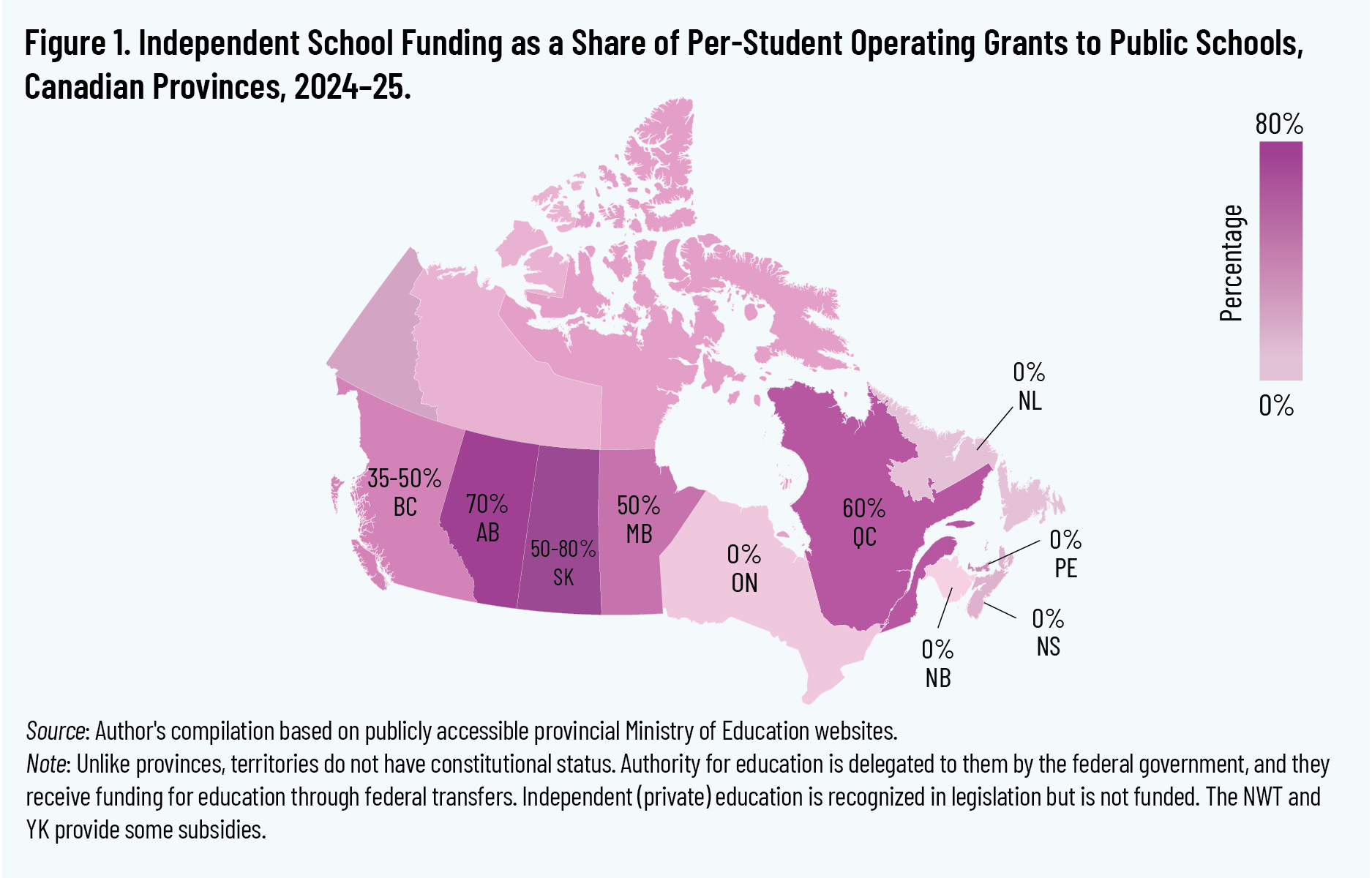
Across Canada, there are more than 470,000 students attending independent schools. 2 2 Statistics Canada, Table 37-10-0109-01. These schools offer robust and diverse educational programs and experiences for a growing number of Canadian families. Despite operating within different regulatory environments in each province, independent schools have managed to sustain a vital role in the country’s educational ecosystem. In large part, this is due to constitutional and legislative arrangements that provide some degree of public funding to independent schools in the form of operating grants, in all provinces except Ontario and the Atlantic provinces (figure 1). While independent school enrolment has been increasing at a faster rate than district school enrolment in every large province in recent years, the proportion of students enrolled outside the district systems remains quite low overall. British Columbia and Quebec have the highest number of students enrolled in independent schools as a percentage of all students in the province, at 13.7 percent and 10.5 percent respectively (figure 2).

Accommodation for linguistic and religious minorities is fundamental to Canada’s history and identity; provisions for French, English, Catholic, and Protestant education are expressions of this. The diversity of today’s educational landscape, however, extends far beyond constitutional arrangements. A wide variety of independent schools exist across the country. 3 3 See, for example, previous work describing this diversity in two previous Cardus papers: Hunt, DeJong VanHof, and Los, “Naturally Diverse,” and Hunt and DeJong VanHof, “Exploring Alberta’s Independent School Landscape.” How do these schools build and sustain excellence and legitimacy within these different environments? Occasionally, independent schools and their provincially certified educators may have access to government resources offered by district schools, such as curricular resources or professional development training. However, this requires strong partnerships with district schools, and it is more likely the case that these resources are not accessible, or that independent schools desire offerings that align with their pedagogical or religious orientation. The role of school associations in the provision of high-quality independent education is critically important to these desires. Because it is unsustainable in the long term for independent schools to operate as isolated institutions, they frequently seek out membership within school associations, which are an essential component of robust civil society engagement within a context of educational pluralism.
Educational pluralism refers to systems of education in which the government funds and regulates schools but does not necessarily operate them. 4 4 Berner, Pluralism and American Public Education, 3. It places a high priority on civil society engagement in the structures and delivery of education. Educational pluralism is realized when three pillars are present in an education system: availability of educational options, accessibility to them, and accountability for educational outcomes to families, communities, and government. 5 5 DeJong VanHof, “The Three Pillars of Educational Pluralism.” As voluntary institutions, independent school associations fill a unique and vital role both in assisting schools toward best practices in pedagogy or fidelity to faith commitments and in complying with applicable local regulation. These associations may therefore be an essential component of the accountability pillar within educational pluralism. Consequently, the ways in which these associations serve independent schools, both in relation to the types of services they provide and in relation to their advocacy and engagement with government policy, should be better understood.
There are many kinds of associations, reflecting the variety of the schools and their interests. They provide an infrastructure for these schools, offering a wide range of services, collaborative networks, and, importantly, advocacy for their members.
Schools may affiliate through membership, association, or accreditation processes. 6 6 For ease of reference, we will refer to the schools that independent school associations represent as “members” or “member schools” throughout this paper. Schools may hold membership in more than one association, depending on their geographic or institutional characteristics. For example, some national associations have provincial derivatives, and schools hold membership in both, while others hold membership in separate provincial and national associations that have different purposes—one to assist with government relations and the other to support the school’s pedagogical or religious orientation. School associations may function democratically, taking their direction from member schools, or they may function in a similar manner to large district school boards, issuing recommendations and providing resources.
There is very little academic literature or study on independent school associations and how they support their member schools. To the best of our knowledge, the only prior Canadian study published is the Cardus paper co-authored by Van Pelt and Mitchell in 2018. 7 7 Van Pelt and Mitchell, “Mapping Independent School Associations in Canada.” In that paper, the authors mapped the landscape of associations of independent schools across Canada, detailing their function and the range of services provided to schools. The present paper accomplishes two goals. First, it revisits and updates the initial analysis, offering a current overview of the work and role of these associations in Canada. Second, it builds on the initial study by exploring the ways in which these associations actively contribute to public accountability of independent schools and act as mediating institutions between government and the school sector. Through their work to represent a collective voice for independent schools, to what extent are these associations able to build trust and social cohesion among diverse networks of independent school communities? Further, to what extent are they able to contribute simultaneously to the public accountability of independent schools on the one hand, by supporting quality assurance and regulatory requirements, and to the preservation of school autonomy on the other, through prevention of government overregulation?
Methodology
This study builds upon the inaugural study by Van Pelt and Mitchell, with updated data and a renewed analysis of association websites. Additionally, we employed a mixed methods approach and interviewed a cross-section of school association leaders to better understand the relationship between government, school associations, and independent schools.
We began with the list of school associations used in the 2018 study. This list was cleaned and updated to remove the ones that have closed and to ensure correct information for existing ones. Subsequently, a Google search for new associations was undertaken in April and May 2025. New associations were also ascertained from provincial lists of independent schools, in which schools self-report their affiliations.
For the purpose of this study, we define an independent school association as Van Pelt and Mitchell define it: an “organization that includes member or associated schools, educators, and/or administrators operating in the independent school sector in Canada and provides services or benefits to those members or associates.” 8 8 Van Pelt and Mitchell, “Mapping Independent School Associations in Canada,” 4. We found eighty-one associations that fit this definition. We then narrowed the list to those meeting all of the following criteria:
- have a publicly accessible web presence (excluding social media accounts)
- provide publicly available evidence of services or benefits to member or associate schools in at least two of four categories: professional development, public and government relations, administrative operations, and student services
- have at least one member or associate school in Canada
After these criteria were applied, sixty-seven associations remained for analysis.
This study has two main limitations. It relies on self-reported data on publicly available websites, which may not be regularly updated and may therefore be out of date. Second, it is possible that some associations exist that did not meet our web search terms and thus remain unidentified.
The Landscape of Independent School Associations in Canada
School associations were categorized according to geography, jurisdiction, membership, and size. We also determined whether their orientation was religious or pedagogical or both (such as a classical Christian school association), or whether they had neither a religious nor a pedagogical orientation but served all kinds of schools (non-religious, non-pedagogical).
Geography and Jurisdiction
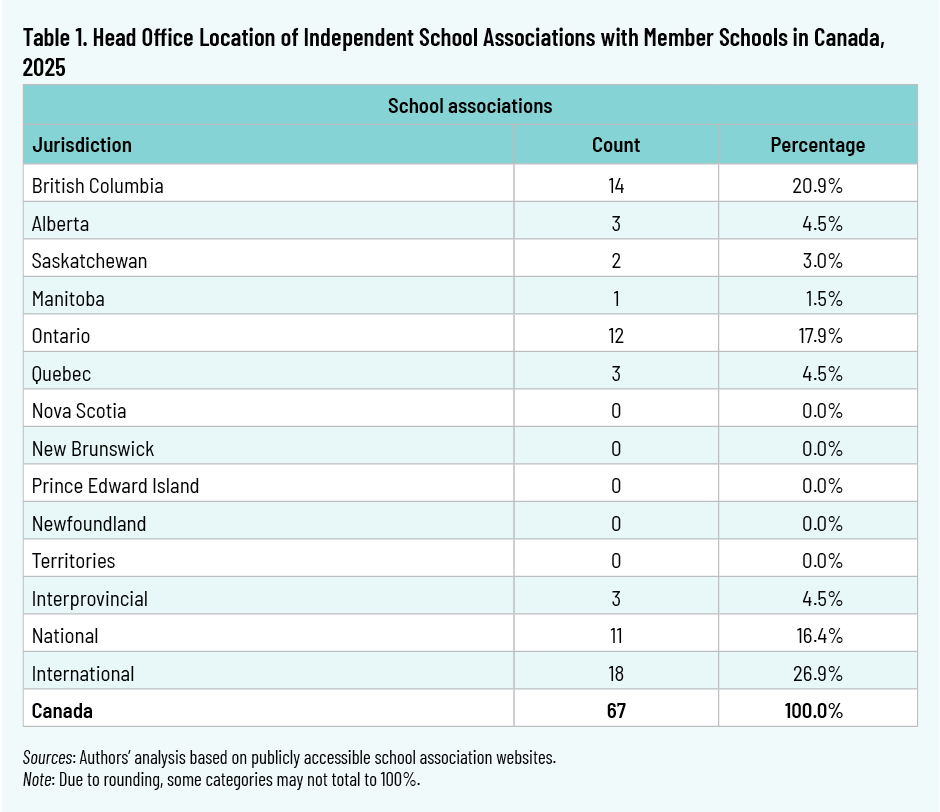
Table 1 indicates the geographic spread of the associations across Canada. National and international organizations make up a large proportion (16.4 percent and 26.9 percent respectively), serving member schools across the country. Most of the associations in Canada can be considered provincial, reflecting the reality that education falls under provincial jurisdiction. Among all provinces and territories, British Columbia and Ontario have the highest number of provincial school associations (fourteen and twelve respectively, or 20.9 and 17.9 percent). The other provinces and territories have significantly lower numbers. There are likely a variety of reasons for this, the main one being that historically, the formation of provincial school associations has been connected to a recognition among independent schools of a growing need for a collective voice to engage with the government. In British Columbia, that recognition resulted in the formation of the Federation of Independent School Associations (FISA) of BC. FISA is an association of associations and was formed when already-existing smaller provincial associations recognized the need to work across ideological and denominational lines for the good of the independent school sector. FISA was formed in 1966 as an alliance between Roman Catholic schools (which in British Columbia are not included in district systems as in other provinces), other Christian and other religious schools, and pedagogically oriented schools, and continues to act as a unifying force today. 9 9 Cunningham, Justice Achieved, 72–87. The Federation of Independent School Associations in BC (FISA) is an umbrella association that represents five school associations in British Columbia, including Catholic schools, non-religious schools, Protestant schools, and top-tier schools. In Alberta, the Association of Independent Schools and Colleges of Alberta (AISCA) serves a similar function to FISA but is not an association of associations. Rather, AISCA has historically welcomed both pedagogically oriented and religiously oriented schools of all kinds, and its capacities have grown as recognition and funding have been extended to independent schools in the province. 10 10 Farney and Banack, Faith, Rights, and Choice, 178–84. This explains why, although British Columbia and Alberta may seem to have two similar associations, Alberta has less than a quarter (21.4 percent) of the number of associations that British Columbia has. Finally, the high number of associations in Ontario reflects two factors. First, the lack of recognition, regulation, and funding by the government of Ontario creates a need for associations to provide schools with quality assurance, resources, and opportunity for collaboration. These associations have formed mainly according to pedagogical and religious orientations. Second, despite the lack of funding, Ontario has a robust, diverse, and growing independent school sector, with more than 1,670 schools currently listed. 11 11 Ontario Ministry of Education, Private School Contact Information. In fact, the need for a collective voice to engage with the government is increasingly recognized and has resulted in the formation of a parallel organization to FISA, named CAISO—the Coalition of Associations of Independent Schools of Ontario. 12 12 At the time of writing, this organization is still in its infancy. Since it does not yet have a publicly accessible website, it is not included in our study.
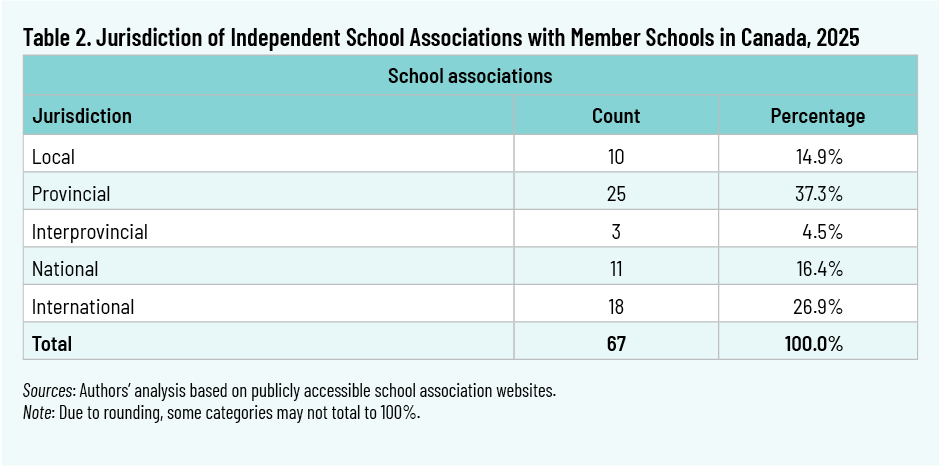
Categorizing associations according to the jurisdiction they serve, rather than by geography, reveals further distinctions (table 2). Though most associations in Canada can be considered provincial, we observed that ten serve very local communities, such as municipalities, county districts, or Roman Catholic dioceses, and three serve interprovincial constituencies, such as the Atlantic provinces or Western Canada.
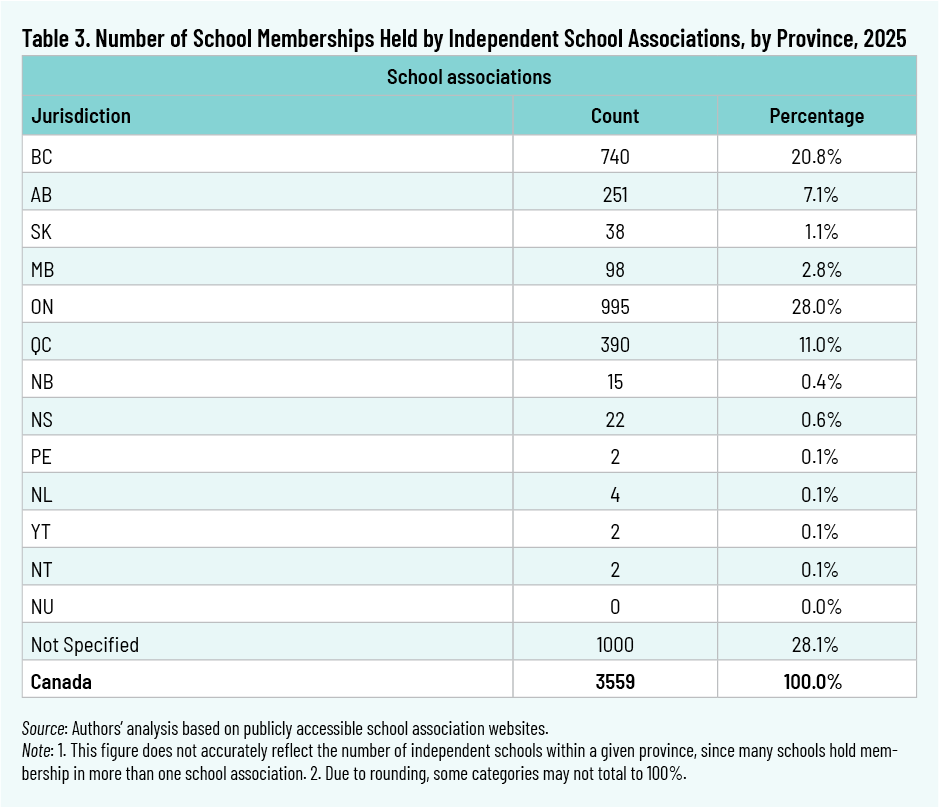
We also mapped the number of independent school memberships across the country, to gain a sense of the geographic scope of affiliated independent schools (table 3). Associations can serve a wider geographic area than their head office locations suggest, since interprovincial, national, and international associations may include member schools in provinces without a dedicated provincial association. Since schools may hold membership or affiliation in more than one association, these numbers are not directly correlated to the actual number of independent schools across the country.
Since some association websites indicate only the total number of member schools in Canada, or across provinces, but do not provide school addresses, leaving 1,000 memberships unspecified. While Ontario has the highest number of association memberships, at 995, previous Cardus research found that in 2022, only 41 percent of the almost 1,600 independent schools were members of an association. 13 13 Hunt, DeJong VanHof, and Los, “Naturally Diverse,” 50. Three years later, there are just over 1,670 independent schools in Ontario, according to the province’s publicly available list of private schools, at Ontario Ministry of Education, Private School Contact Information. These memberships, therefore, are likely distributed among less than half the independent schools in the province. The low association membership in Ontario can be contrasted with that of Alberta, in which 251 memberships are distributed across 237 schools, and where 72.8 percent of independent schools are members of AISCA. 14 14 Hunt and DeJong VanHof, “Exploring Alberta’s Independent School Landscape,” 34. The difference between these provinces is explained in part by the difference in regulatory environment: In Alberta, the ability to start a new school is constrained. New schools must be accredited and must comply with Alberta regulations, hiring Alberta-certified teachers and teaching Alberta curriculum, and following accreditation, must demonstrate full operations for at least one year before they are approved to receive government funding. 15 15 Alberta's Minister of Education can waive the one-year funding wait time on a discretionary basis. Membership in an association is critical for navigation and support in compliance with regulatory requirements. In Ontario, by contrast, schools must simply notify government of their intent to operate. For elementary schools, there are no other requirements; secondary schools are subject to inspections only if they are providing credit courses toward the Ontario Secondary School Diploma. Membership in an association is less critical, and as a result, schools operate within a context that is far more isolated than in any other province.
Demographics and Size
The vast majority of associations orient their services toward independent schools at the institutional level, rather than to individual teachers within those schools. Membership or affiliation is per school, and services provided are available to school boards, leaders, and educators depending on the need. There are four associations whose focus is to serve teachers and whose membership is composed of educators rather than schools. These four are included in the present analysis as associations that fit the definition and criteria identified above, although they typically have a narrower focus. The Christian teacher associations, for example, serve in a similar capacity as district (public) teacher unions, negotiating salary ranges and ensuring that educators are represented fairly and accurately in employer disputes.
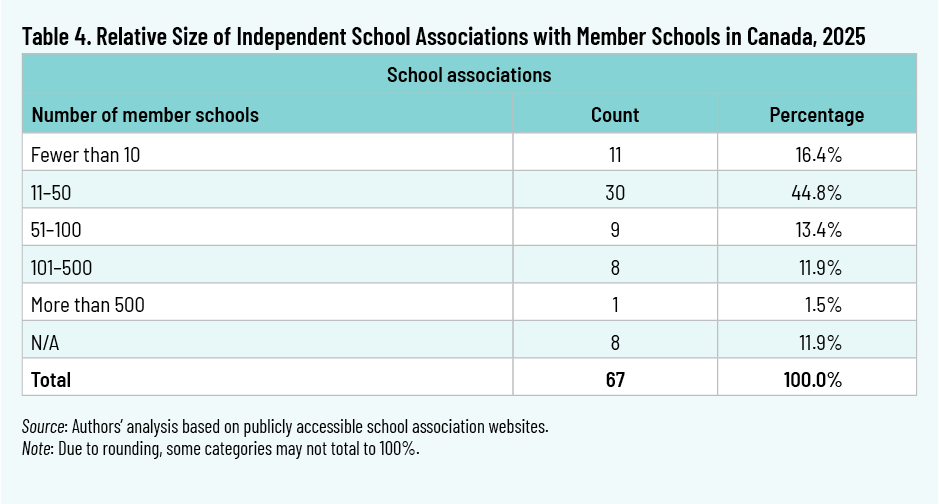
Table 4 shows the relative size of the associations. Lists of member schools were available on all association websites, save eight. A plurality (44.8 percent) serve between eleven and fifty schools. Fully 74.6 percent serve one hundred members or less. 16 16 The one with more than five hundred schools is a Montessori association with over seven hundred members. Since Montessori pedagogy frequently concentrates on early education, it is possible that many of these members are daycare providers rather than schools. Eight associations did not report a list of member schools, leaving insufficient information available to determine their size.
Religious and Pedagogical Orientation
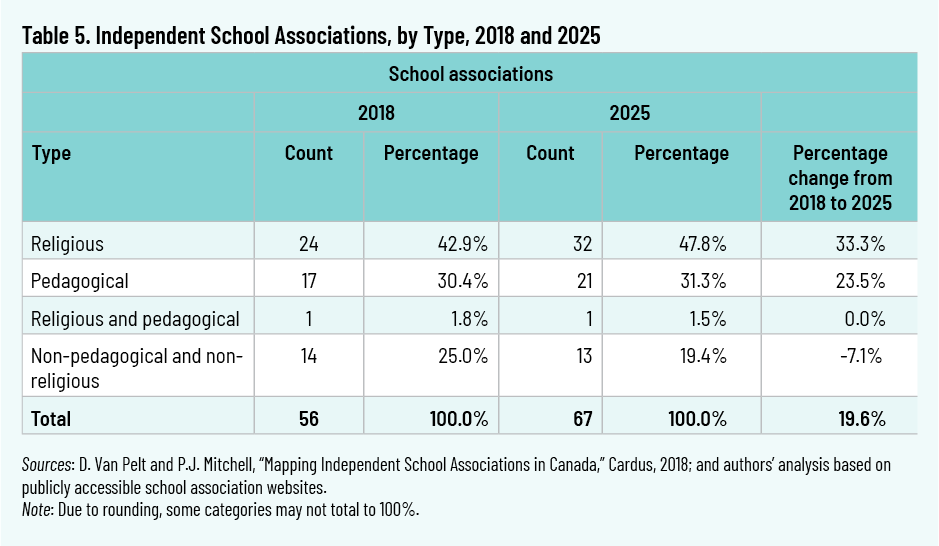
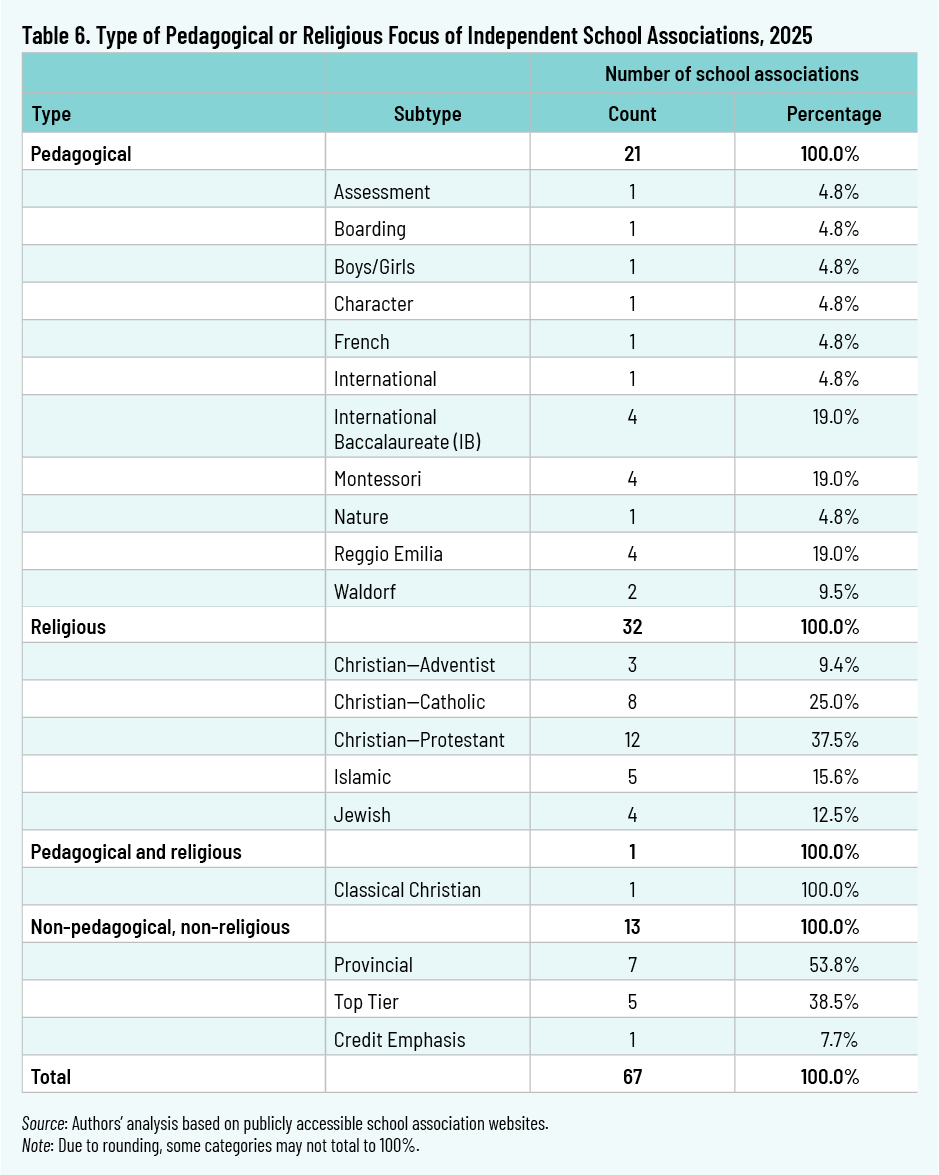
Many associations have a religious or pedagogical orientation that is core to their identity and purpose. In 2018, Van Pelt and Mitchell demonstrated the high proportion that served a pedagogical or religious orientation or both, finding that 73.2 percent of them are either pedagogical or religious in orientation. As Table 5 illustrates, this continues to be the case in 2025, where that number has increased to 79.1. In fact, there has been a 33.3 percent increase in the number of religiously oriented associations, a 23.5 percent increase in the number of pedagogically oriented ones, and a 7.1 percent decrease in ones that are neither pedagogical nor religious. Table 6 breaks down these types, revealing a wide variety in approaches to schooling across the country. 17 17 See Hunt, DeJong VanHof, and Los, “Naturally Diverse,” for an explanation and definitions of subtypes. While most are self-explanatory, “top tier” refers to school associations that provide membership to elite schools, “assessment” refers to those that offer specific standardized testing programs, and “character” refers to those that focus on supporting schools in building student character.
Activities and Services
Following Van Pelt and Mitchell, we identified four main areas of activity for independent school associations: public relations, administrative operations, professional development, and student services. Each of these is further divided into subcategories. Since website analysis confirmed that the subcategories identified by Van Pelt and Mitchell remain relevant, our analysis used these same subcategories and added two, one under public relations and one under student services. We added support for government funding access and distribution to the public relations category, as a unique activity that is demonstrated by just a few associations. In considering the role of associations within the accountability structures for independent schools, this activity provides additional nuance to the data, where previously it may have been subsumed within government relations or advocacy efforts. Similarly, within student services, the provision of student bursary funds or direct tuition as a unique activity became apparent during initial rounds of website analysis.
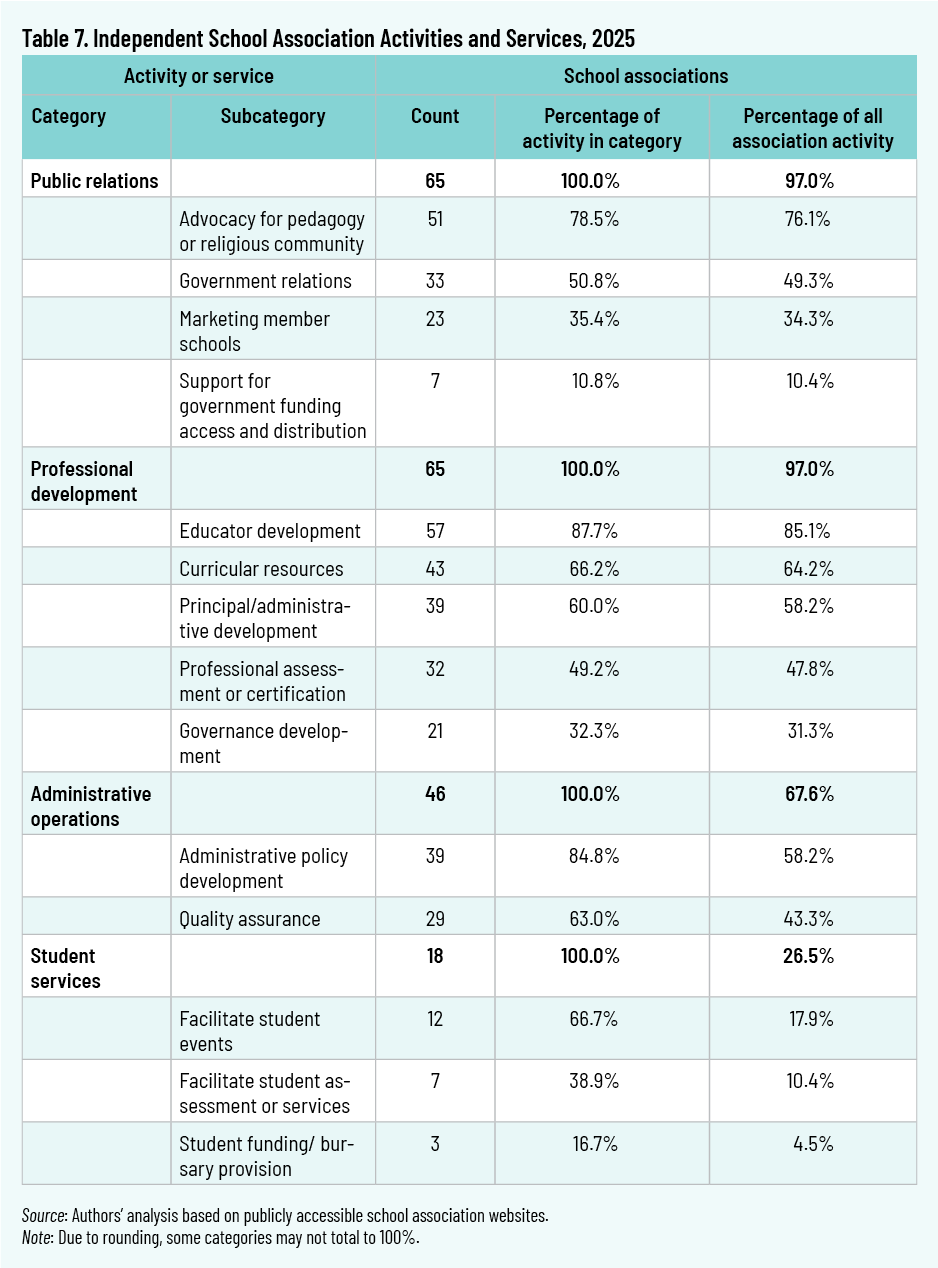
Table 7 provides an overview of all the associations’ activities. Overall, the vast majority (97.0percent) engage in public relations and professional development activities, and 67.6 percent engage in administrative operations. Just 26.5 percent provide direct student services, the least common activity. This is likely a reflection of organizational structure, as associations are far more likely to engage primarily with schools than directly with students and families.
Public Relations
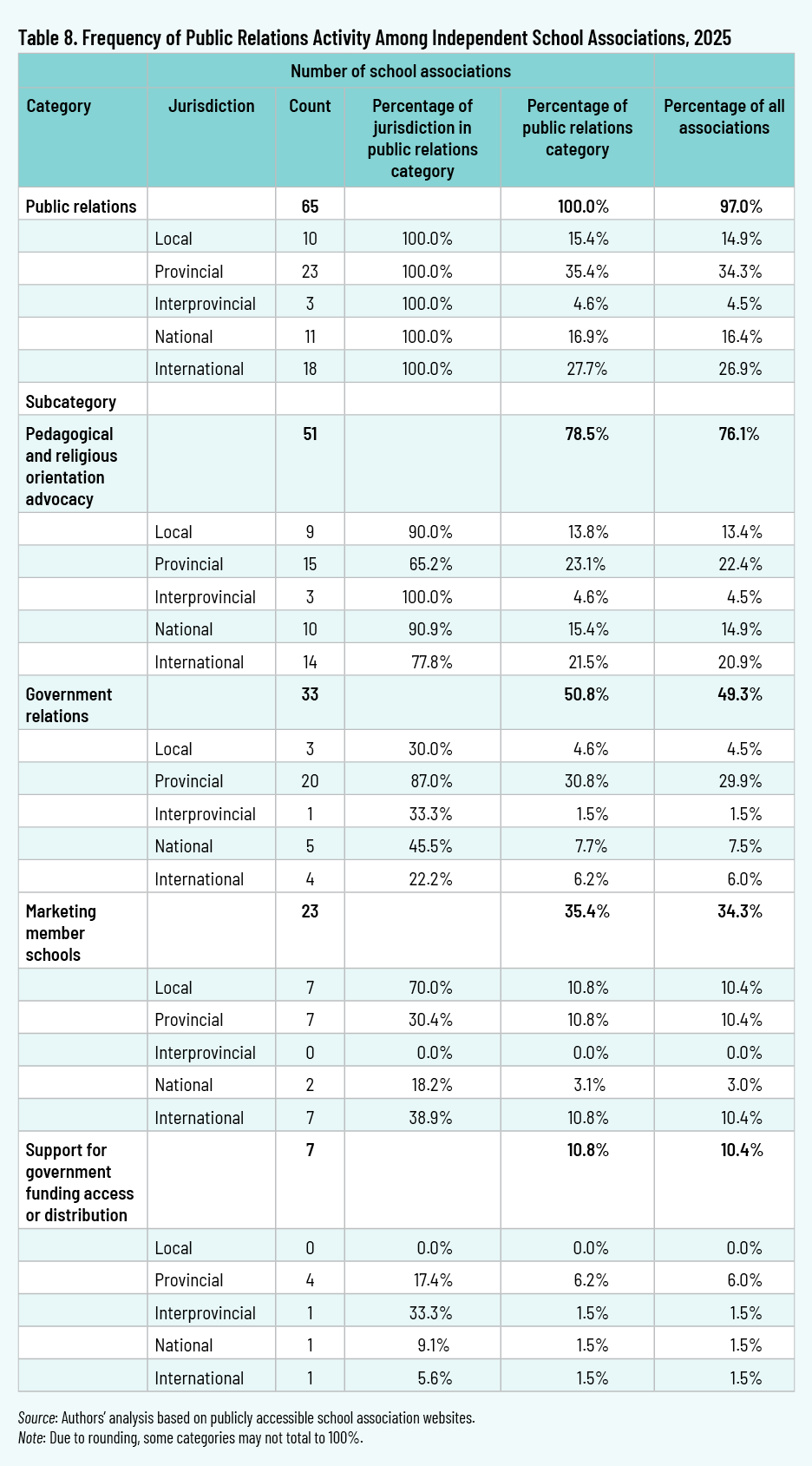
We identified four subcategories under public relations: pedagogical and religious orientation advocacy, government relations, marketing member schools, and funding distribution or support for access to funding. Table 8 shows the frequency of these activities, broken down by jurisdiction. The most common public relations activity is pedagogical and religious orientation advocacy, with 76.1 percent of associations engaging in this activity.
Pedagogical and Religious Orientation Advocacy
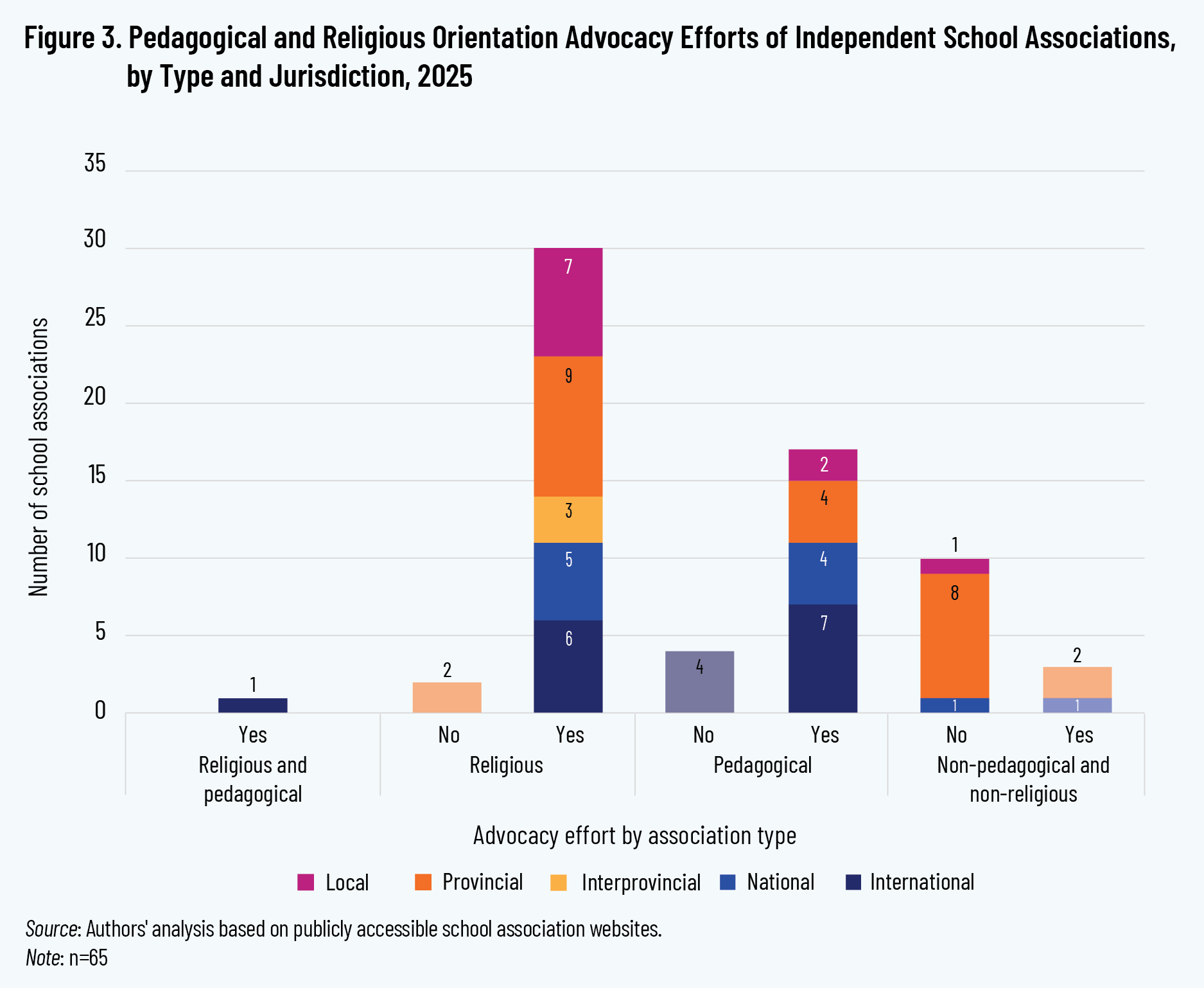
Advocacy is the most common type of public relations activity, with 78.5 percent of associations that indicated they engage in public relations reporting that they engage in advocacy efforts. Van Pelt and Mitchell do not define advocacy in their 2018 paper. Here, we conceptualize advocacy as work or activity to promote the public visibility and awareness of various pedagogical or religious approaches to education. In all jurisdictions, associations spend a significant amount of energy simply building public awareness of who they are, how they are different from mainstream education, and why they matter. Unsurprisingly then, this activity is most common among associations that identify as religious or pedagogical in orientation, at all jurisdictional levels (figure 3). Among religious associations, the only two that do not engage in advocacy efforts are teacher associations. Among pedagogical associations, four international organizations do not engage in advocacy efforts. In these cases, it is likely that high international reputation does not generate a felt need to promote or advocate for their pedagogical approach.
It is noteworthy, however, that non-religious, non-pedagogical associations that do not engage in this advocacy are primarily provincial—there are eight of these, alongside one national and one local association. Two of them are top-tier provincial associations, which frequently have an established historical presence and high-quality reputation, and may not therefore experience the same need to increase public awareness. The remaining six provincial associations in this category represent a broad coalition of schools, which serve a coalition-building purpose and may therefore not advocate for one form of independent education over another. Here we begin to see that provincial associations that are non-religious and non-pedagogical may engage in some different activities and services than their religiously or pedagogically oriented counterparts.
Government Relations
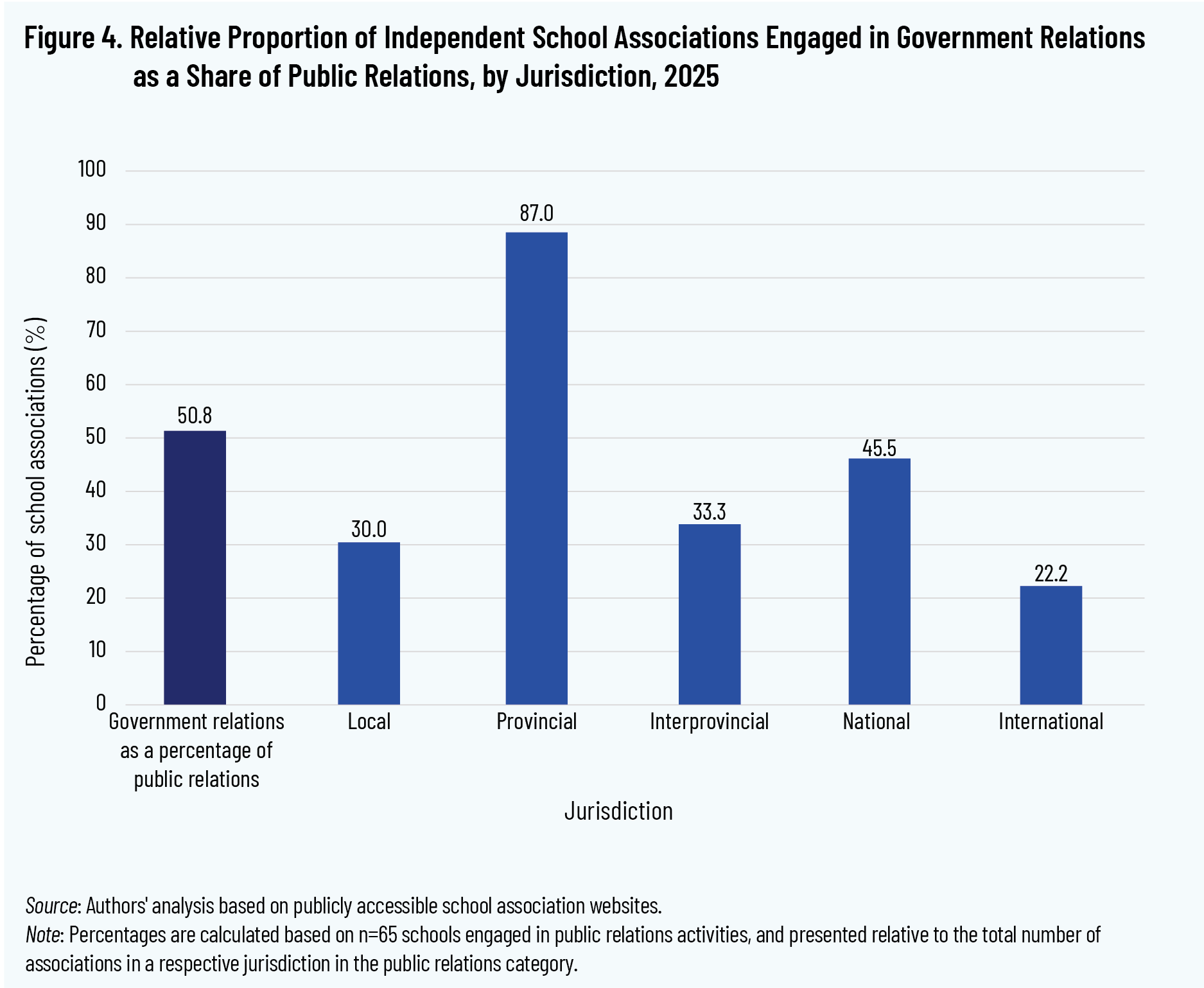
Of school associations that engage in public relations, just over half (50.8 percent) report engaging in communication with government at any level on behalf of member schools. When we break this down by jurisdiction, it is overwhelmingly provincial associations that engage in this advocacy, with 87 percent of those that engage in public relations indicating that they are involved in maintaining or developing government relations, compared to associations operating at other jurisidictional levels, which have lower engagement (between 22.2 percent and 45.5 percent) (figure 4). That this activity frequently takes place at the provincial jurisdictional level reflects the constitutional arrangement in Canada, in which education falls within the purview of provinces.
Marketing Member Schools
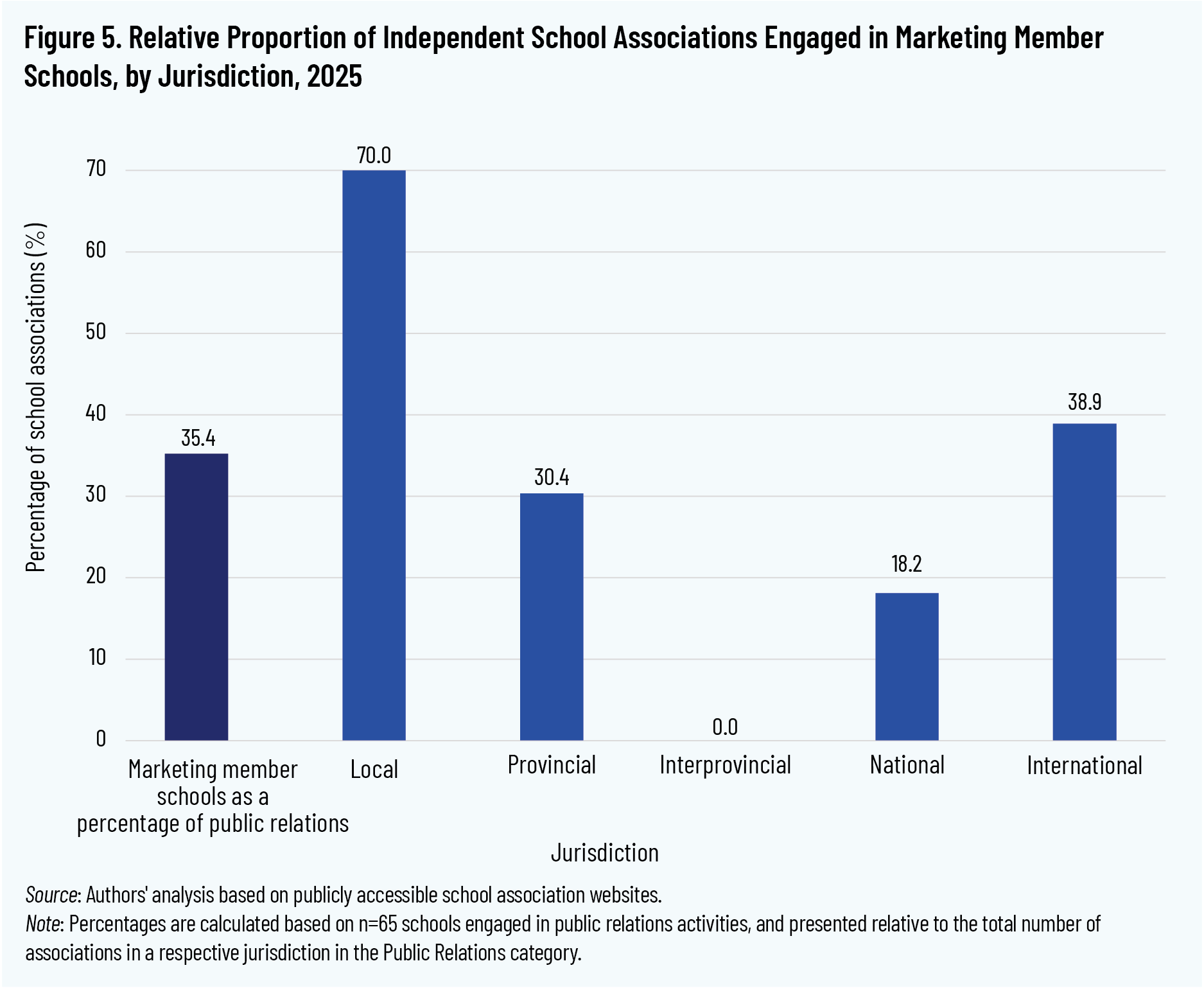
Van Pelt and Mitchell define this subcategory as engaging in activity to “promote or advertise member schools, facilitate promotional events, or provide materials to aid member schools’ self-promotion.” 18 18 Van Pelt and Mitchell, “Mapping Independent School Associations in Canada,” 11. As those authors note, it is commonplace for associations to provide listings of their member or affiliate schools. However, to be considered actively engaged in marketing member schools, Van Pelt and Mitchell required evidence of additional promotional activity, such as featuring stories of schools on their website or in newsletters or social media postings. Associations engage in these activities at similar rates as previously reported; Van Pelt and Mitchell reported that just under a third of all associations (32.1 percent) engaged in marketing member schools in 2018, and in the current data 34.4 percent of all associations do so. When calculated as a share of public relations activity, 35.4 percent engaged in marketing member schools as a form of public relations. Figure 5 demonstrates that local associations, which are frequently municipal in geographic reach, are more likely to engage in this marketing activity than provincial, national, or international ones.
Support for Government Funding Access or Distribution
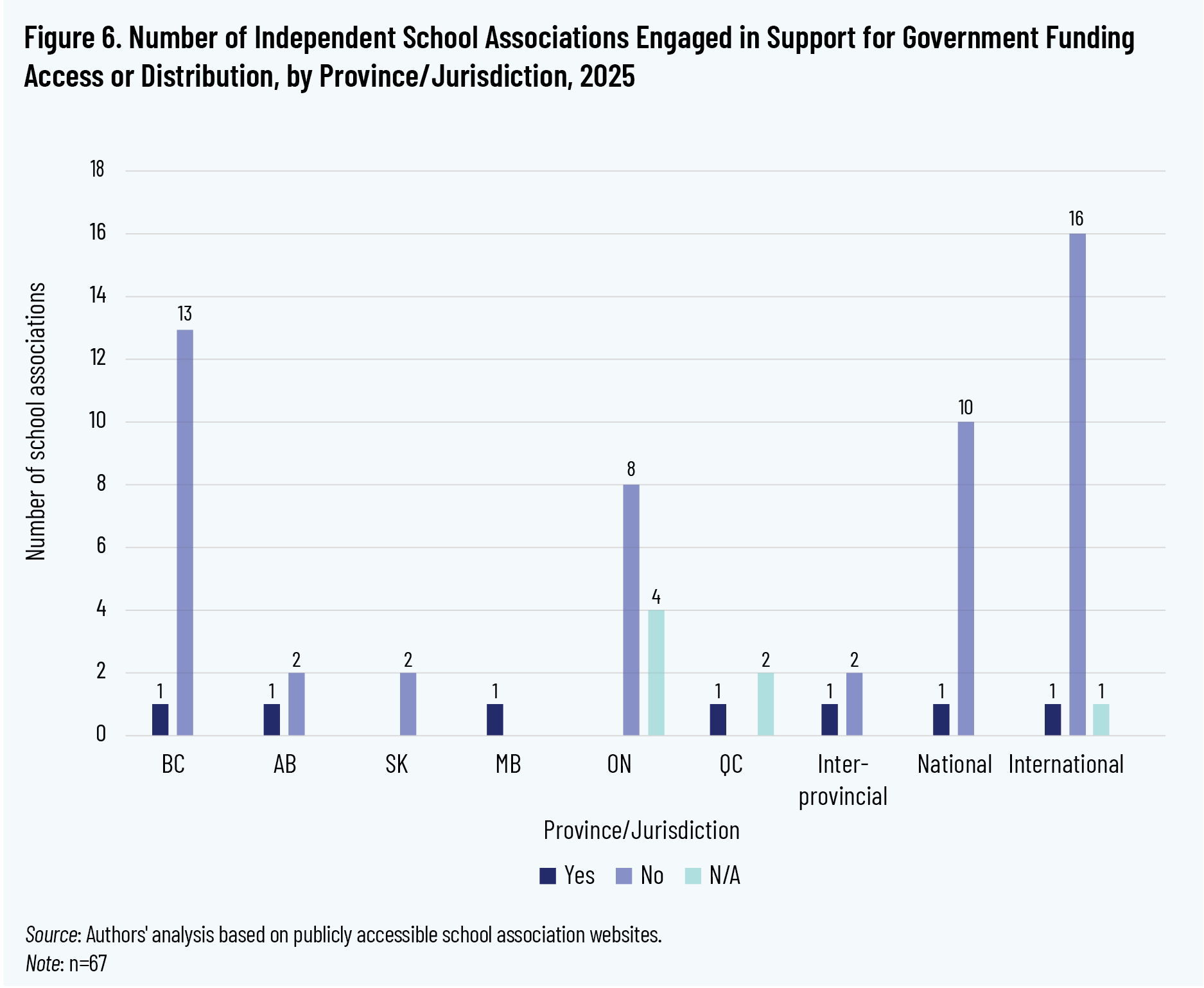
This subcategory was added to attempt to capture a more formalized relationship with government that may exist in some cases. We define support for access to funding and funding distribution as the provision of support, services, or training to independent schools for the purposes of accessing government or other grant opportunities, or for the purpose of the distribution of government funds to independent schools. Some association websites indicate that they provide support for access to government grants or for navigating government funding offerings (e.g., for home education subsidies), or that they provide training for fund development. Associations that engage in support for funding distribution or access directly assist schools with grant applications or navigating government policy. This activity is infrequent, making up just 10.8 percent of all public relations activity among associations. When support for funding distribution or access is broken out across provinces and regions (figure 6), only seven associations were found to engage in this activity; the majority of associations do not provide this service. Notably, it is present in just one association for each of four provinces that provide government funding for independent schools: British Columbia, Alberta, Manitoba, and Quebec. This is true despite the fact that British Columbia has many more provincial associations than the other three provinces. Further analysis reveals that all four of these associations are also non-religious, non-pedagogical in orientation and comprise all types of independent schools.
The provincial associations that engage in this activity share a common feature. Despite different histories in each province, there is one that has become the representative association for almost all independent schools in that province. In some provinces, independent schools that opt out of government funding or that are not accredited to receive it may not be members of these associations, but the vast majority of funded or accredited independent schools maintain membership in and are represented by these associations. This is another indication that these provincial associations fill a unique role in Canada’s education landscape.
At the interprovincial, national, and international levels, there is also one association per level that engages in this activity. A closer look reveals an interprovincial association with strong services in training for growing funding opportunities, and at the national level we find a teacher association that serves educators in both district and independent schools, intervening on behalf of members for access to government funding. At the international level, we find a French school association that provides government funding to French citizens who study at independent schools that offer France’s curriculum.
Professional Development
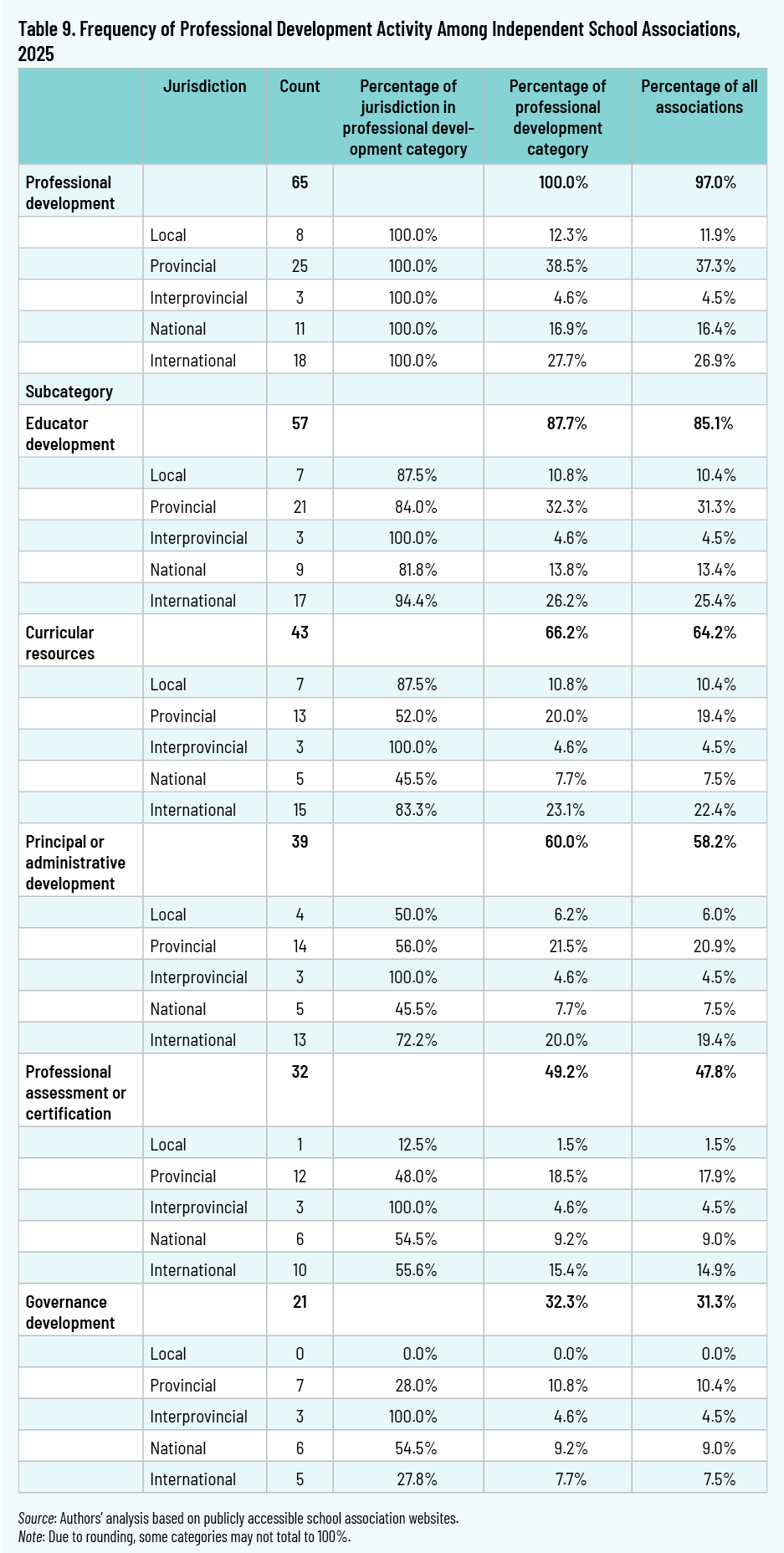
Professional development is a frequent activity for independent school associations, with sixty-five of sixty-seven (97.0 percent) providing it in some form. Professional development has five subcategories, detailed in table 9. Three of the five subcategories focus on individuals: educator development, principal or administrative development, and governance development (directed to trustees or board members). In particular, the development of educators, principals, and administrative leadership is a strong focus for many associations. Of those involved in professional development activity, fifty-seven (87.7 percent) provide educator development resources, and 39 (60.0 percent) provide principal and administrative development resources. The remaining two subcategories are the provision or curation of curricular resources and professional assessment or certification.
Educator Development
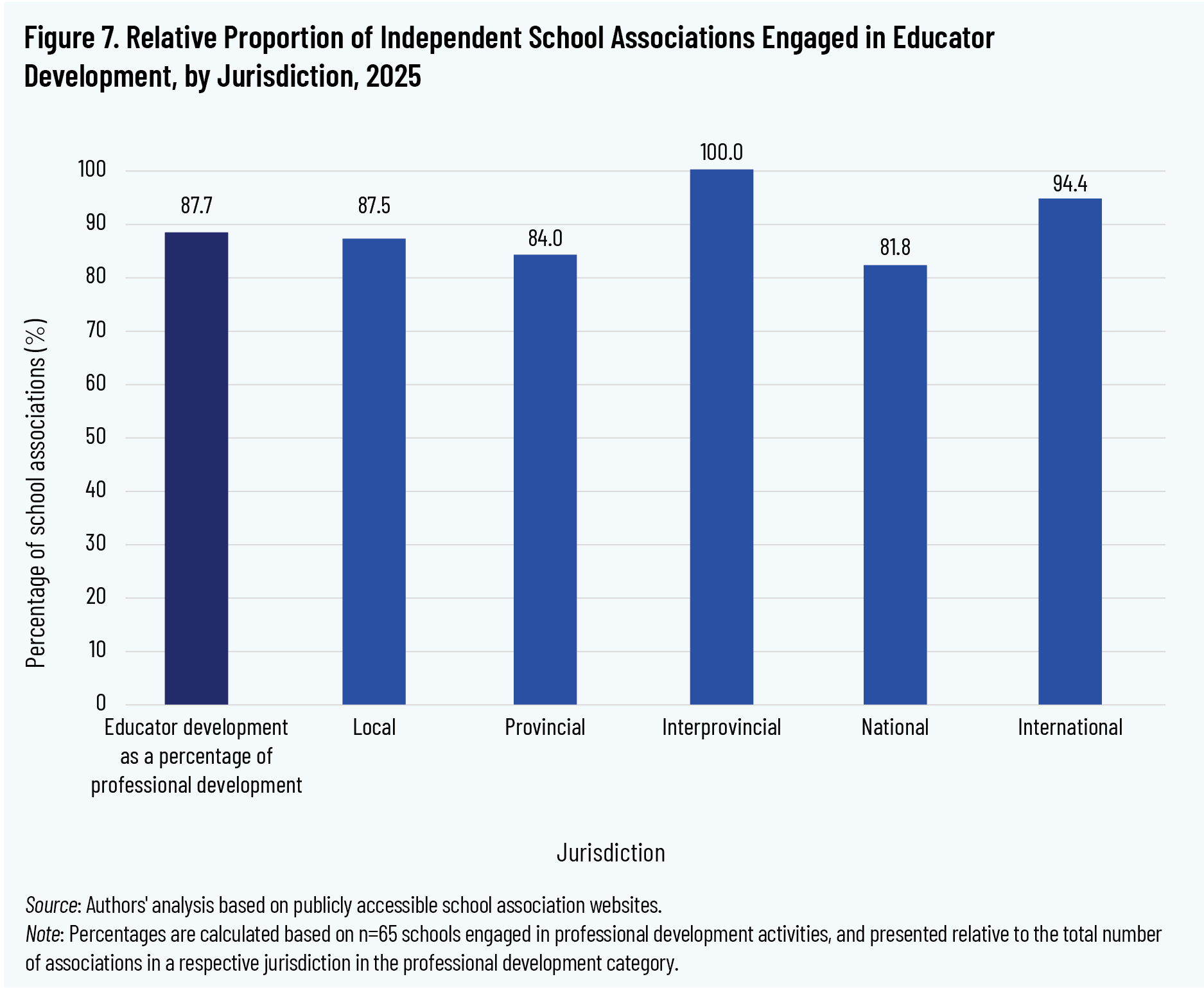
The most frequent professional development activity of associations is educator professional development, which is the provision of “materials, presentations, or consultations for the purpose of professional development for teachers and educators, to enhance student learning.” 19 19 Van Pelt and Mitchell, “Mapping Independent School Associations in Canada,” 9. This might take place through conferences, workshops, or access to training. Fifty-seven associations (87.7 percent) that engaged in professional development, engage in educator development. Figure 7 shows that more than 80.0 percent of associations at all jurisdictional levels offer this service.
Curricular Resources
Our study finds that forty-three of sixty-five (66.2 percent) associations that engage in professional development provide curricular resources, defined as “resources that enhance curriculum including materials, whether online or print, workshops and presentations.” 20 20 Van Pelt and Mitchell, “Mapping Independent School Associations in Canada,” 9. Figure 8 indicates the prevalence of this activity in religiously oriented associations at every jurisdictional level, and pedagogical associations at the local, national, and international level. For associations that are religiously or pedagogically oriented, the development and provision of curricular resources that align with educational goals is common. Results demonstrate that associations at the provincial level that are neither religious nor pedagogically oriented also commonly provide curricular resources to their members. This may reflect the tendency for provincial associations to share resources germane to required provincial curriculum and necessary for independent schools regardless of religious or pedagogical orientation—once again distinguishing these provincial associations from their counterparts at other jurisdictional levels.

Principal and Administrative Development
Of all associations that engage in professional development, 60.0 percent engage in principal or administrative development. This is defined as the provision of “materials, presentations, or consultation for the purpose of professional development for principals and administration.” 21 21 Van Pelt and Mitchell, “Mapping Independent School Associations in Canada,” 9. Figure 9 shows that this offering is quite common for provincial and international associations; 56.0 percent of provincial ones that are engaged in professional development offer this, as do 72.2 percent of international ones. Approximately half of local and national associations that are engaged in professional development do as well. Additionally, all interprovincial organizations offer this.

Professional Assessment or Certification
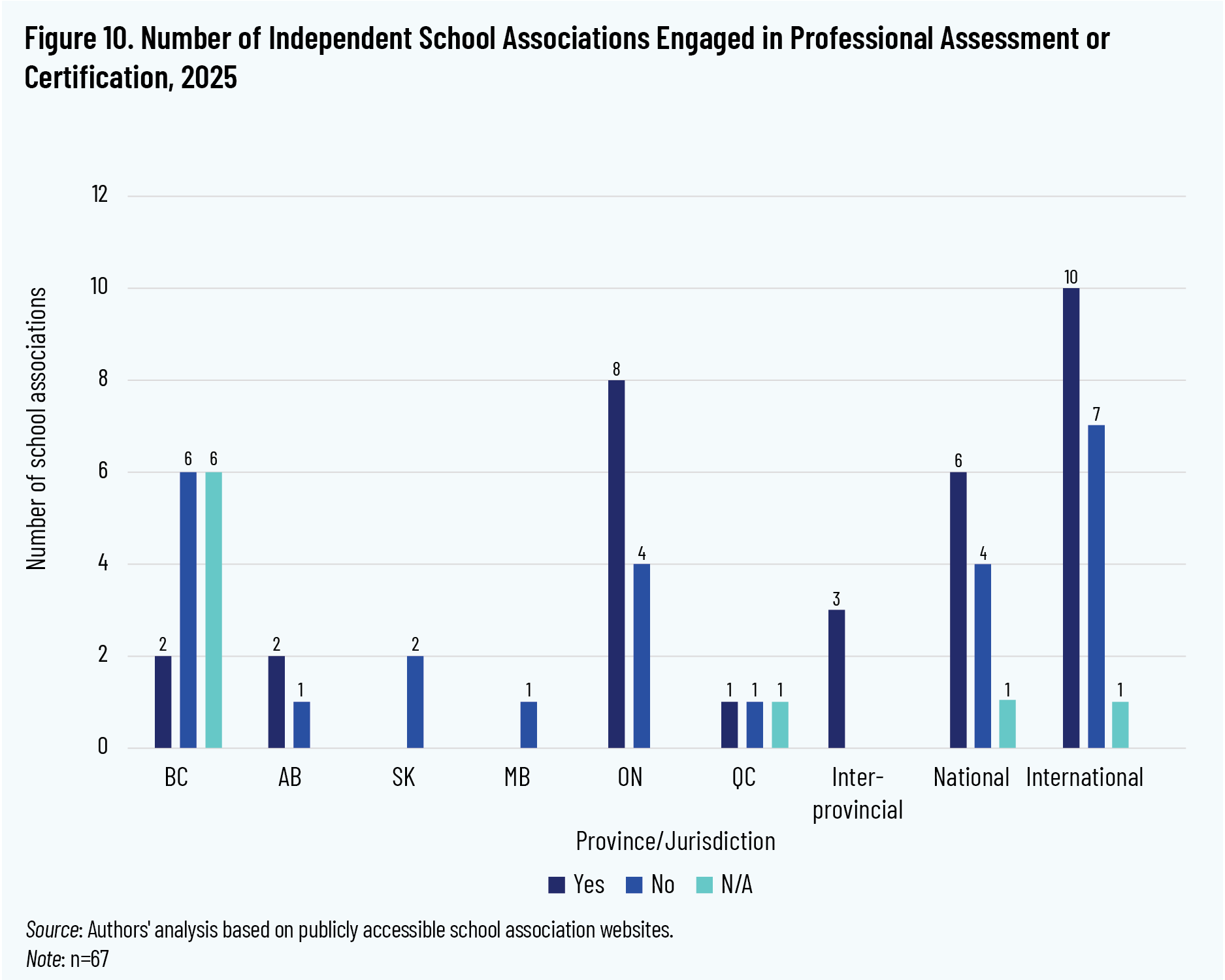
Almost half of the associations involved in professional development (49.2 percent) provide materials, support, or engage in professional assessment or certification of educators. Generally, legislation for teacher certification falls under the jurisdiction of the provincial government and is upheld by provincial certifying boards, but it is important to note that some associations provide certification pathways for specific pedagogical approaches to curriculum, or certificates for educational instruction in fidelity to specific teaching standards or approaches. In our analysis, Ontario has the highest number of associations offering certification pathways, with eight doing so (figure 10). This may reflect the fact that Ontario does not require teachers in independent schools to be provincially certified, and a wide variety of independent schools are on offer in that province. Despite the lack of regulation, it appears that many of the independent schools hire certified educators, and others seek alternative forms of certification.
Sixteen associations at the national and international level offer professional assessment or certification. Examples include Montessori Canada, which certifies educators in Montessori teaching methods, and the Association of IB World Schools, which offers International Baccalaureate educator certificates.
Governance Development
Van Pelt and Mitchell define governance development as “providing materials, presentations or consultations for the purpose of professional development for trustees or board members.” 22 22 Van Pelt and Mitchell, “Mapping Independent School Associations in Canada,” 8. Of all associations that engage in professional development, twenty-one (32.3 percent) offer this, which remains similar to Van Pelt and Mitchell’s findings in 2018 that almost a third of associations offered this. Figure 11 indicates that this work is not undertaken by local associations but is more common in provincial, interprovincial, national, or international ones. This is likely because most local associations are derivatives of larger ones, which offer this training more broadly.

Administrative Operations
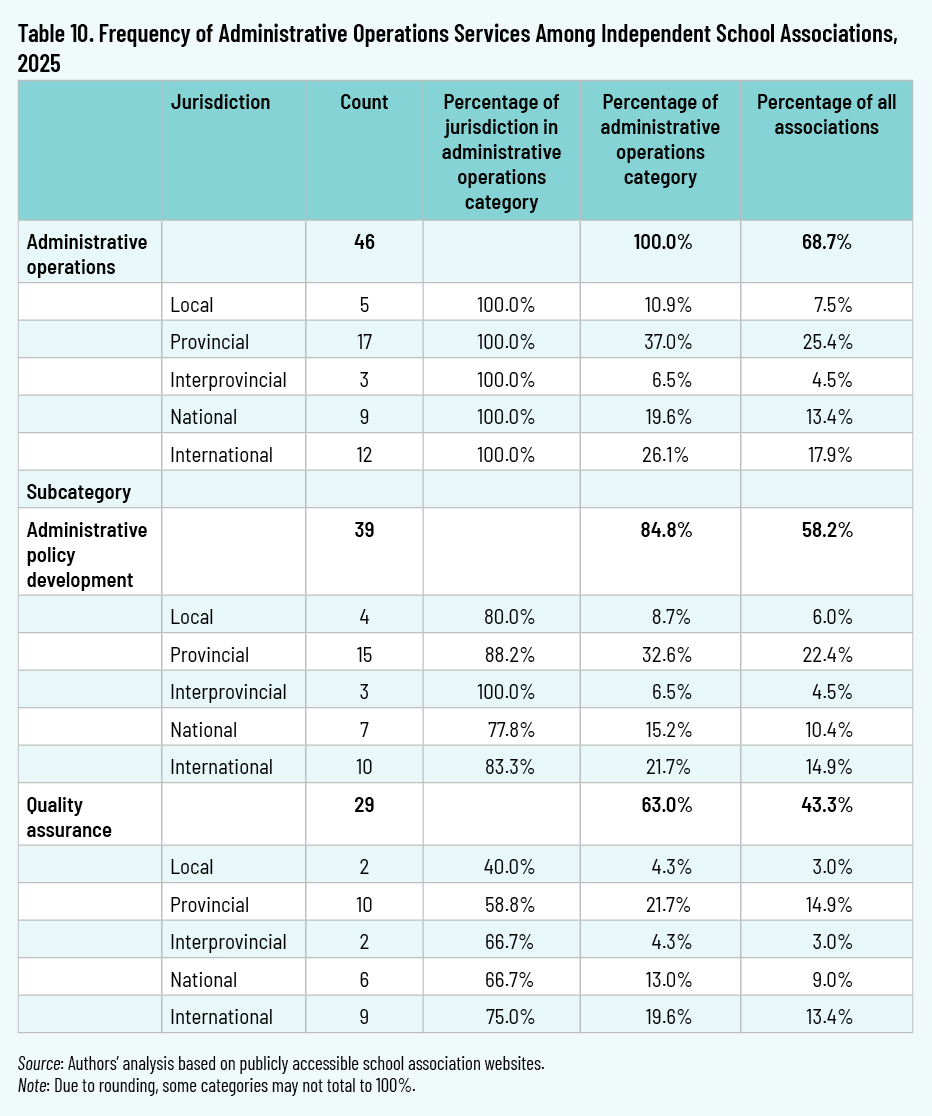
In 2018, Van Pelt and Mitchell identified administrative operations as the third most common activity for independent school associations, with 62.5 percent engaging in this activity. In our study, we find similar frequency of engagement in this activity, with just over two-thirds of associations (68.7 percent) indicating that they do this (table 10). The two subcategories under administrative operations are administrative policy development and quality assurance support.
Administrative Policy Development
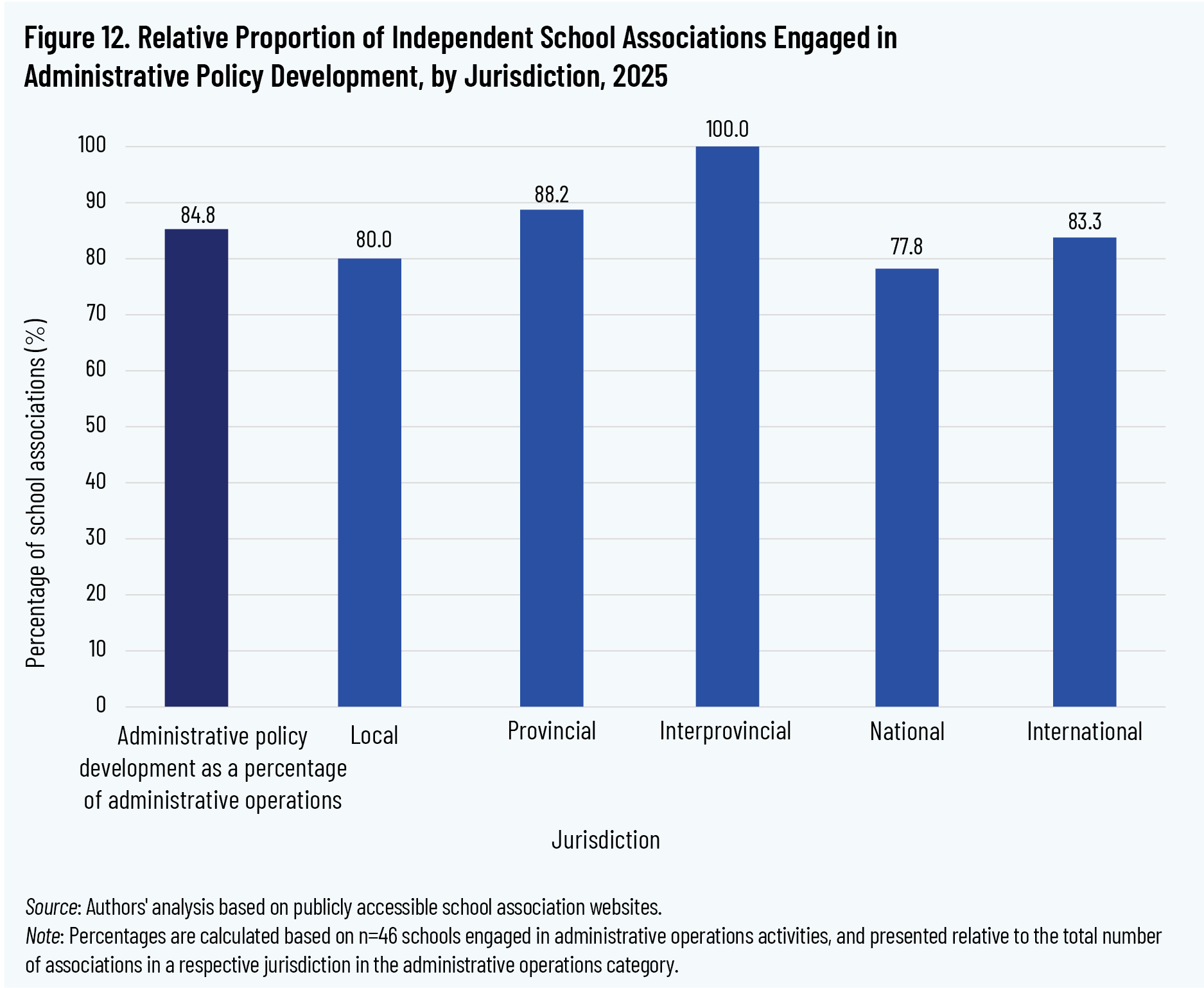
Of the forty-six associations engaged in administrative operations, we found that thirty-nine (84.8 percent) engage in administrative policy development, which includes “offering resources, templates, consultations, or symposiums that assist members with school policy development and implementation.” 23 23 Van Pelt and Mitchell, “Mapping Independent School Associations in Canada,” 13. These policies may relate to compliance with regulatory requirements, the implementation of best practices and standards for education, governance, or fiscal management and sustainability. For associations that engage in administrative operations, policy development is especially important regardless of jurisdiction (figure 12). Of the thirty-nine associations offering this service, fifteen are provincial, ten are international, seven are national, and the remaining seven are local or interprovincial.
Quality Assurance
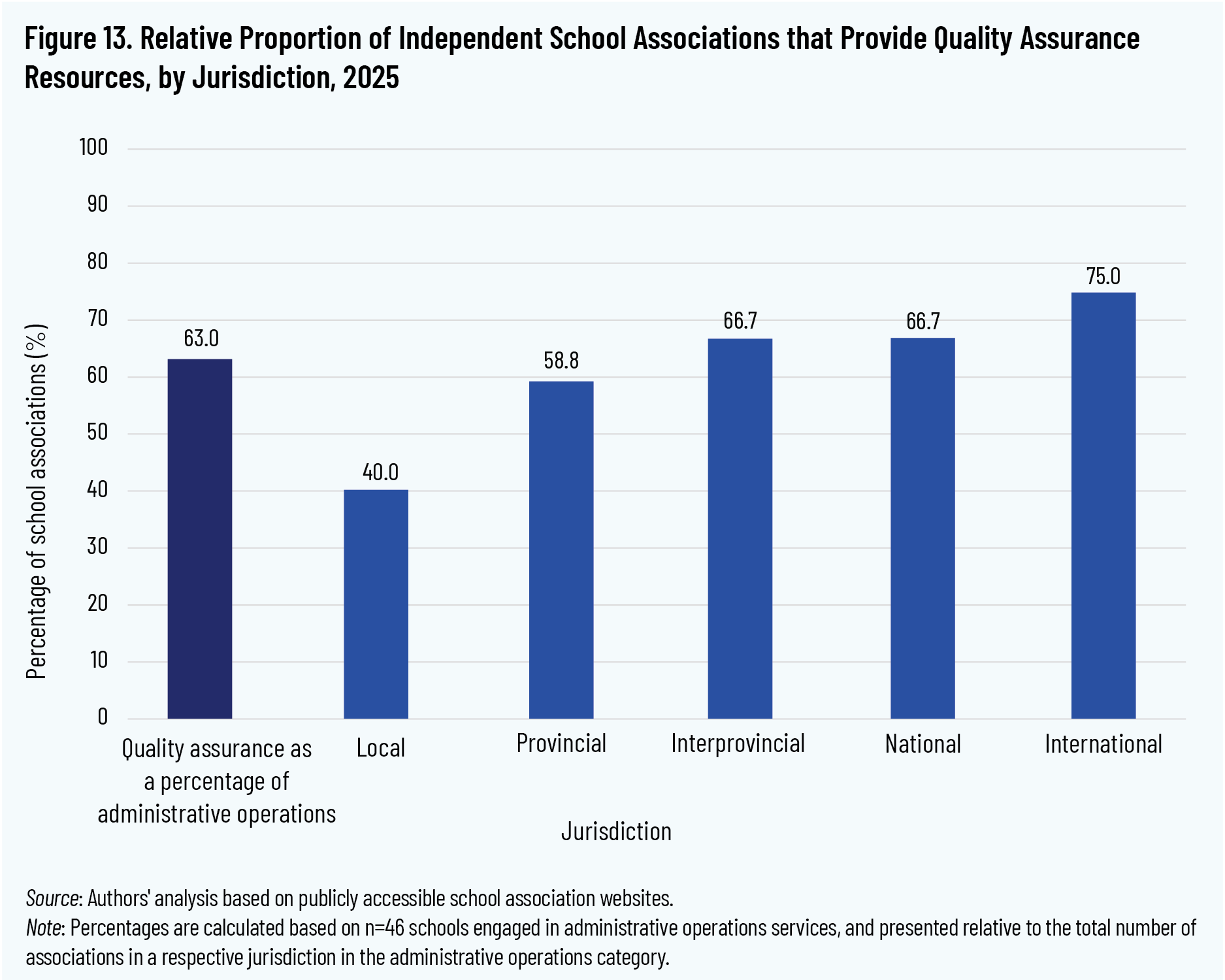
Van Pelt and Mitchell define quality assurance as “inspections, evaluations, or consultations with member schools, or the provision of resources to assist member schools with quality assurance.” 24 24 Van Pelt and Mitchell, “Mapping Independent School Associations in Canada,” 13. As those authors note, the provision of these services, such as inspections and consultations, is expensive and, if offered, frequently comes at additional cost to the school. Of forty-six associations engaged in administrative operations, we find that twenty-nine (63.0 percent) offer some form of quality assurance provision. Provincial, interprovincial, national, and international associations are more likely to offer quality-assurance resources or support (figure 13). At a national or international level, associations are more likely to set or adhere to global standards and practices for pedagogically or religiously oriented education. These may also serve as national or international accrediting bodies, such as the Association of International Baccalaureate (IB) World Schools or the Canadian Accredited Independent Schools. These accreditation processes uphold rigorous standards and require schools to invest significant time and expense.
Student Services
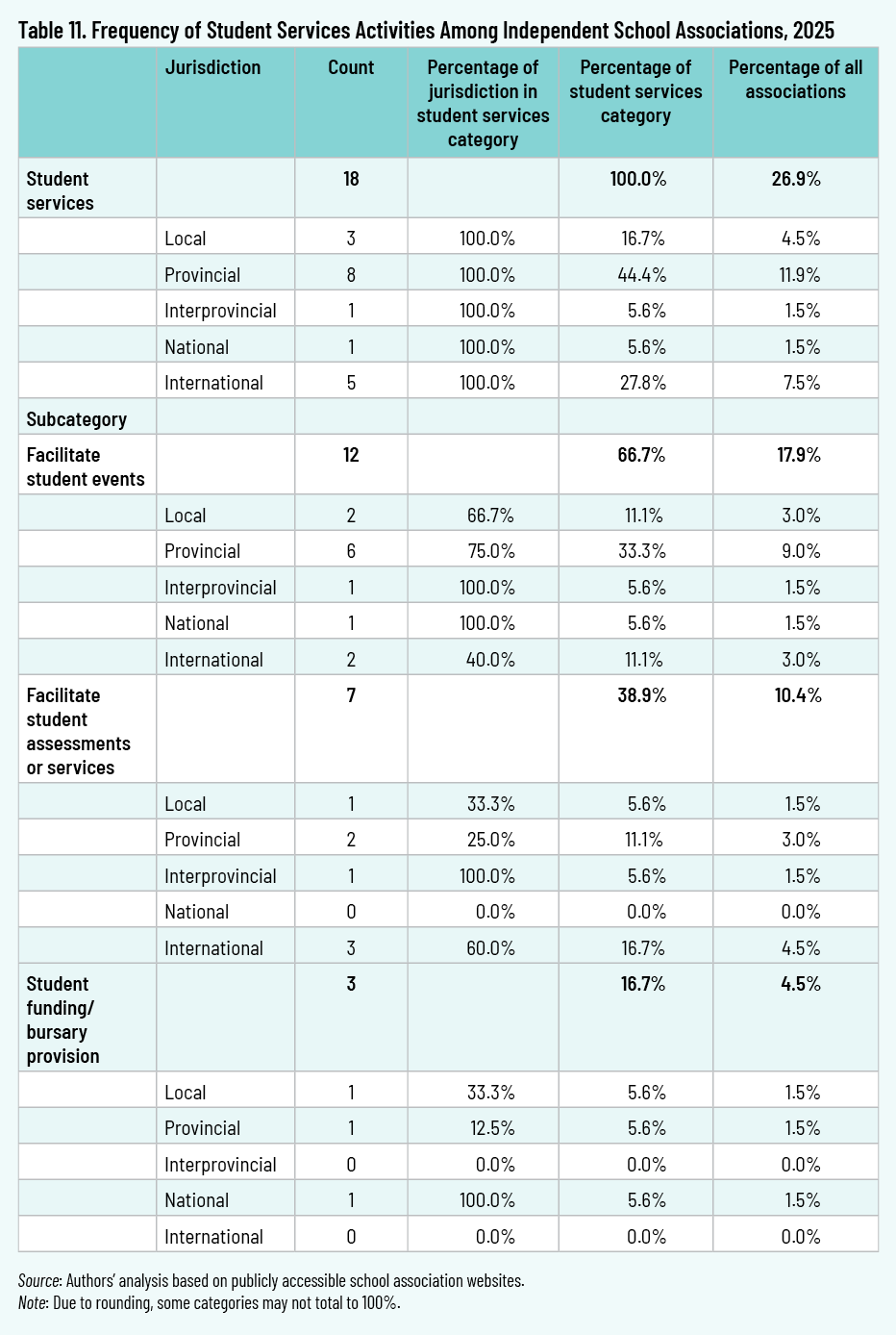
Student services is the activity that associations engage in least. Just eighteen associations (26.9 percent) engage in this activity, which includes the facilitation of student events, supporting student assessment, and providing or supporting the provision of student funding and bursary applications. The first two categories were identified by Van Pelt and Mitchell in their 2018 study. We added the third category, student funding and bursary applications, to reflect that some association websites refer to fundraising efforts, funding opportunities, or bursary application support. Table 11 shows the frequency of student services activity.
Facilitation of Student Events
The most common kind of student service is the facilitation of conferences, activities, and other events for students, with twelve of eighteen associations (66.7 percent) providing these opportunities. Figure 14 shows the distribution of this activity across jurisdiction. Two of the three (66.7 percent) local associations, and six of the eight (75.0 percent) provincial associations that participate in student services indicated they facilitate student events, and both associations that engage in student services at the interprovincial and national levels did so as well.

Student Assessment
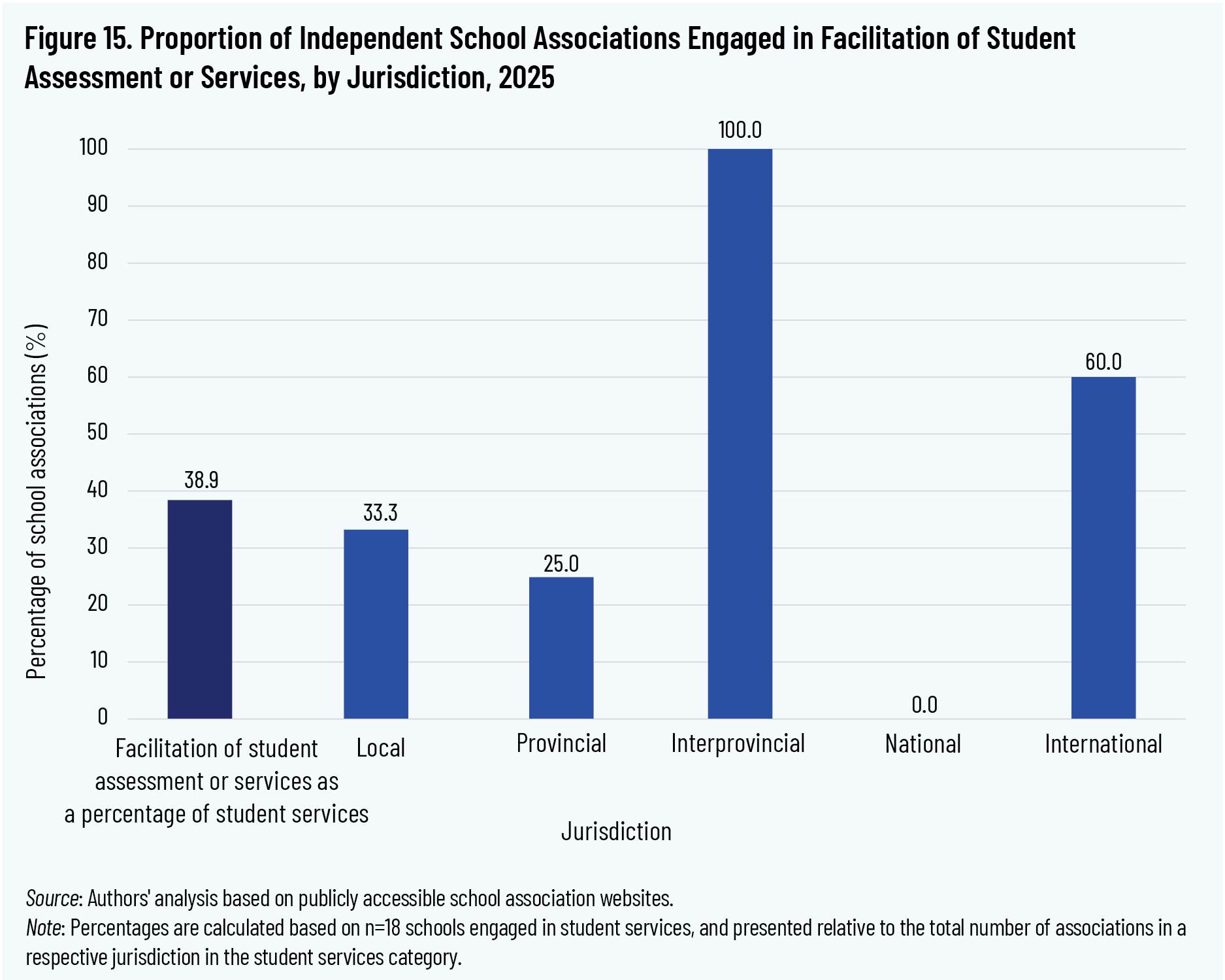
Just seven of the eighteen (38.9 percent) associations that are engaged in student services facilitate student assessments or provide materials or access to materials at a discounted rate (figure 15). Many provinces have standardized testing regimes, but it can be difficult for independent schools to participate since there is usually a significant cost associated with opting in. Of the seven associations, one of one (100.0 percent) interprovincial association and three of five (60.0 percent) international ones offered this service.
Student Funding and Bursary Applications
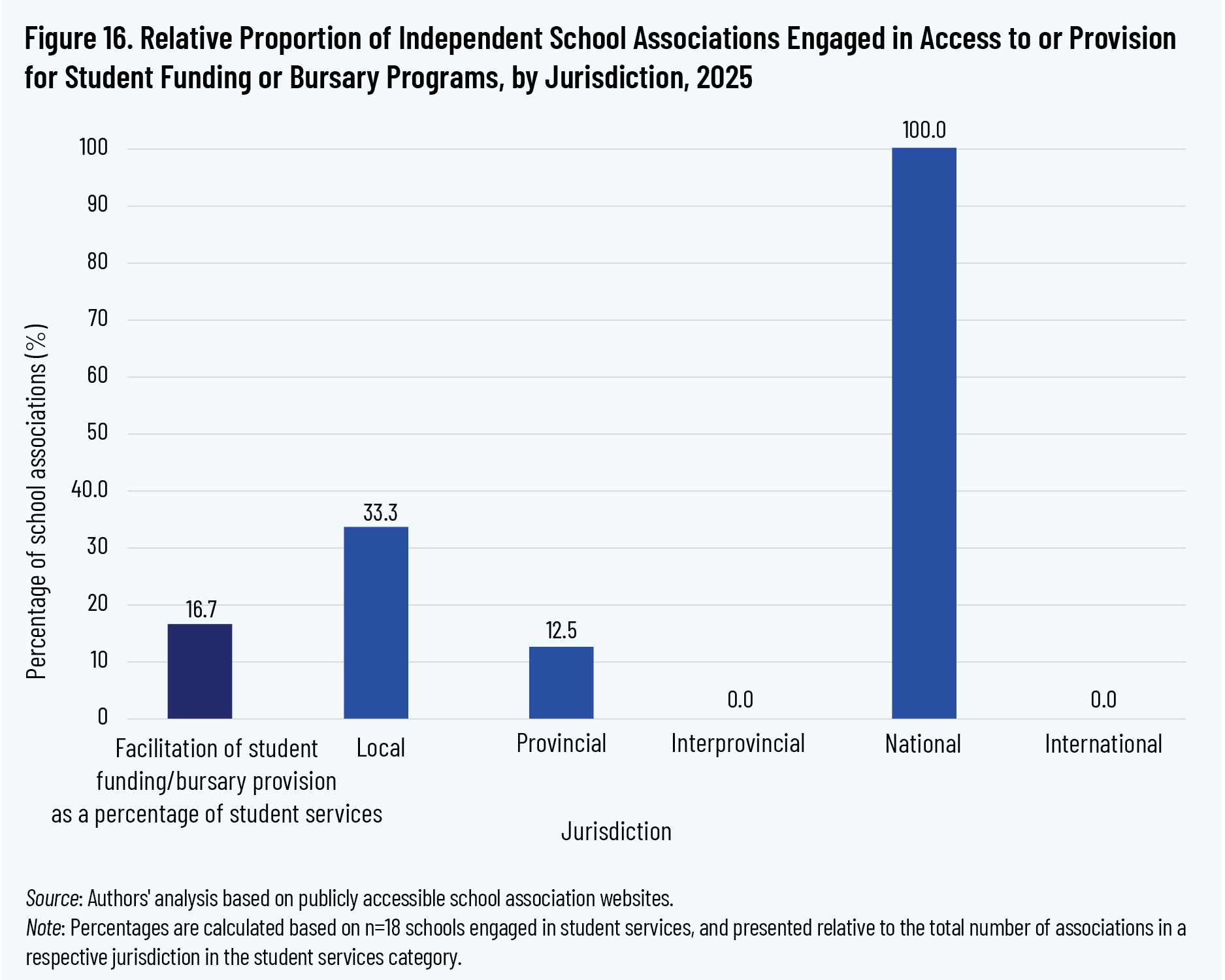
Just three of the eighteen (16.7 percent) associations engage in securing student funding or assisting students and families with applications for funding. These are found at the local, provincial, and national level (figure 16). One of one (100.0 percent) national association reported engaging in student services activity, as did one of eight (12.5 percent) provincial associations and one of three (33.3 percent) local associations.
Independent School Associations as Mediating Institutions
To understand the quality and character of government relations and advocacy that associations engage in, we requested interviews with provincial association leaders or key employees. We restricted the interviews to provincial associations since these are the ones most likely to engage in government relations. We asked four main questions:
- To what extent has your association engaged in communication with the government to advocate on behalf of schools regarding proposed or enacted government regulatory policy? How frequently do you advocate on behalf of schools to the government?
- Conversely, to what extent has your association engaged in communication with schools to create buy-in for government regulatory policy? Have you ever advocated on behalf of the government to schools?
- To what extent has your association helped to shape, change, or influence regulatory policy enacted by the government that affects independent schools? How have you achieved this?
- To what extent would you characterize the role of a school association as engaged in trust-building between independent schools and the government?
We interviewed association leaders or employees in four provinces. Three of these provinces provide partial funding for independent schools, and one (Ontario) provides no funding. Three key themes emerge from interviews with leaders from the former group.
First, all three interviewees from the funding provinces expressed a sense of partnership with the government, suggesting that their role extends beyond advocacy to collaboration and service provision:
Interview A: “We’re partners with the government, with the Ministry of Education, mostly, but we’re partners with other ministries . . . we’re part of the system. So, yes, we do advocate, but they come to us as well to have information, so it’s both ways.”
Interview B: “Right now, our vision statement would be to promote and empower independent schools in the province of [name], and so that ‘promote and empower’ part, the ‘promote’ is still the advocacy. The ‘empower’ is all the services that we do, and we recognize that we were changing our vision and our mission and our mandate. And there are still times we discuss. Should we be two organizations—should we cleave off the advocacy and just have an advocacy organization that’s not beholden to anyone, that can make every public statement at once, that can be really aggressive in the public sphere? Because there’s no doubt that we are somewhat muted because we are a partner to government. We are doing grant work on their behalf. We’ve landed on the fact that we’re still comfortable with the formula, which I guess is really the piece we need to revisit. We give up a little bit of that public initiative.”
Second, provincial associations in provinces that provide funding to independent schools have a direct impact on the shape and nature of policy and regulation:
Interview A: “So we’re a real voice, and we can address our concerns. And they [the provincial government] also come to us to have our opinions on different aspects of [a decision]. And they asked us for the impact on our network. There’s a very big difference between the political image that’s given in the media, and . . . the discussions that we have [with government].”
Interview B: “I think we do advocate on behalf of government because we—right now, for example, a new legislation came in . . . and we will create a slate of template policies that schools can either choose to use or not use. And it’s quite likely in this case we’ll probably only create one set of policies, but we will create guidance. . . . And we’ll do some of that nuance work with a lawyer and figure out what advice we can give schools, and we’ll just present it as alternatives. We’ll say, you know, in [our] view, our understanding of the legislation would be that if you don’t want to do A, you probably have options B, C, and D. And we’ll have some language around that, and then we’ll leave it with schools to decide if they want to do any of it. And they’re still independently operated. They can go do what they want.”
Interview C: “We’ve been able to weigh in on matters that we’re asked about, and the government has, I think, had a respectful understanding that there are some matters where we know what we’re talking about more than the government might. And there are some matters where the government isn’t sure quite what to do with us, and we’ve been able to say, ‘Well, how about this?’ And there’s some, there are matters where the government has said, ‘Yeah, that makes sense. Let’s do it. Let’s see if we can do it that way.’”
Third, trust-building and collaboration are deeply important for associations working to maintain positive relationships both with their member schools and with government.
Interview A: “Well, I think being authentic. We’re not engaging in fights; we’re actually just using those tables and those opportunities to . . . talk about the issues that are brought up in our network. So, schools do feel comfortable talking with us, because they know we’re going to protect them. . . . We’re a tight network, and so we’re going to be working all together to find a solution. . . . I think being very authentic, having the courage to name, and to listen to [each other], is what makes . . . us a good partner in this system right now.”
Interview B: “We have a business principle that we have a positive posture. So I would be restricted from taking [a negative posture] by my board, and I’m supportive of that. So we, our approach is to say, we’re part of a collective system. We would say we’re part of the public system in that we educate the public, and we do so on a partially publicly funded platform. And so our posture is very much one of saying, we’re a partner, and we collaborate with other partners. That’s what we’ve chosen to do. It’s not the only way we could do it, right? We could definitely have gone in different routes, and I think every association—and that’s something you’ll probably find as you go across the country—is that there’s going to be different perspectives on that.”
Interview C: “As you look across Canada, the advice that I would certainly give is: Develop relationships with your elected officials, because elected officials like nothing more than to go and tour a place where they know they’re not being asked for anything. It’s just about, ‘Hey, here we are.’ And once those relationships start to form, and that understanding starts to develop, then if ever there’s a situation where you do need to call on your elected representatives, it’s not the first phone call that you’re making. They know who you are. They know what you’re about. They’ve toured your building, they’ve seen what you’re about, and that they know who you are. So [school association name] does some of that advocacy. We also go into the minister’s office once or twice a year, and it’s been maybe more than that this last year. And we encourage individual schools to develop their own relationships too.”
Particularly for associations that do not have a religious or pedagogical orientation, this work of maintaining unity among member schools through trust-building is a key component:
Interview B: “It’s not like all my schools are cohesively on the right side of the political spectrum. So it’s, they represent the province. . . . The full political kind of realm that my neighbours would have are also in my schools. And so that’s a part for us to navigate as we do the work. . . . I don’t try to say you can’t advocate outside of [school association name], because they absolutely can. And they do. I just try to be transparent about what we heard from our members and what our position is. And then I present that position to government. And so I think that’s a key part of your advocacy is that the members are not always going to be supported. So, for example, home education. . . . At the end of the day, I just had to draw a line around a certain box of advocacy positions and say, ‘These are our positions, and outside of these positions you are welcome to go, advocate. But when [others] call me, I’m going to say that’s not [our] position.’”
By contrast, our interview with a key association employee in Ontario demonstrated that advocacy remains core to the work of associations in this province. Because Ontario does not fund its independent schools, the relationship between the schools and the government is tenuous and opaque. It is characterized mainly by grassroots efforts to simply be heard:
Interview D: “There’s a public perception of independent schools, which in Ontario needs to change. So that is the space that we’re attempting to provide advocacy services within, over, the last three years in Ontario. There’s been three major independent school associations that have really tried to work more closely together . . . on a number of different items. You know, ten or twelve or more different items. Some of them we’ve seen traction on [with the government]. Most of them we have not. . . . I don’t think the work was in vain, because I think a lot of it comes down to relationships and just learning about how systems work, and that kind of thing.”
Even when the opportunity to offer feedback to government presents itself, little comes of it:
Interview D: “This is a good example of how things tend to function in Ontario. [All] of a sudden, we got an email from the [Ministry of Education] saying that high school inspection fees were back on. They had been off for two or three years, because they had flipped to online. And so now it’s the middle of September, and schools have not budgeted for it. . . . So then we tried to coordinate a response. The [Ministry] sent a survey out. . . . I think we did a decent job coordinating our responses across different independent school sectors. So all of that goes into a black hole, and then we don’t hear anything about it.”
This interviewee highlighted the need to strengthen the collective voice of independent schools in this province through the formation of a new association. As previously mentioned, it will bring a variety of associations under one umbrella, similar to the associational model in British Columbia. 25 25 For an in-depth explanation of the central role of British Columbia’s Federation of Independent School Associations in the history of securing provincial funding for independent schools, see Cunningham, Justice Achieved.
Interview D: “The reality is that in Ontario there are actually not that many independent school associations that really are set up to serve groups of schools in Ontario. Many of them are national bodies, or they exist outside of, they serve Ontario schools. But that’s not their only domain. So they have a bit of a split focus. Almost all of them are involved in other things. So advocacy tends to be done kind of off the side of somebody’s desk. So the move to unite everybody under one banner is a big deal. And it involves fees, membership fees, the hiring of actual staff, and a much more coordinated advocacy effort.”
The lack of communication and tenuous relationship with government in Ontario stands in contrast to the situation in provinces where the provision of funding requires greater accountability from independent schools. In these provinces, provincial associations play a truly mediating role, facilitating the compliance of member schools with provincial regulation and even, in some cases, acting as direct conduits of government grant funding. Overall, it is clear that in provinces that provide some funding for independent schools, associations play a central role in the success, quality, legitimacy, and accountability of independent schools.
In their book on the history of religious schools in Canada, Farney and Banack note that in each province in which funding was eventually provided for independent schools, strategic alliances between schools of different faiths or pedagogical orientation had to develop. This, they demonstrate, was part of the transition from a regulatory regime that had developed due to religious differences to one that emphasized arguments about rights and choice, which became compelling in the later twentieth century. 26 26 Banack and Farney, Faith, Rights, and Choice, 27-30, 195.
Our findings suggest that associations played an integral role in this transition. In most provinces that provide funding to independent schools, key provincial associations are non-religious and non-pedagogical in orientation and work collaboratively across religious and pedagogical differences for a common goal. They have developed over time to become representative of the independent school sector in their province and serve as conduits between the schools and the provincial ministry of education. In these provinces, provincial associations have frequently played a key role in achieving public funding for independent schooling.
Discussion
Alexis de Tocqueville’s view of the role of associations in American civic life are applicable to this research. He viewed the creation of voluntary associations as critical to the health and well-being of a democracy. He observed that non-political associations—the associations of civil society, formed simply because of the desire and commitment of a group of people to engage in a shared enterprise—are capable of supplying society with rich benefits:
Americans of all ages, conditions, and all dispositions constantly unite together. Not only do they have commercial and industrial associations to which all belong but also a thousand other kinds, religious, moral, serious, futile, very general and very specialized, large and small. Americans group together to hold fêtes, found seminaries, build inns, construct churches, distribute books, dispatch missionaries to the antipodes. They establish hospitals, prisons, schools by the same method. Finally, if they wish to highlight a truth or develop an opinion by the encouragement of a great example, they form an association. Where you see in France the government and in England a noble lord at the head of a great new initiative, in the United States you can count on finding an association. 27 27 Tocqueville, Democracy in America, 596.
Tocqueville wrote these words prior to the founding of modern Canada, and he viewed the formation of associations as a necessary and healthy counterpart to the free individualism he saw expressed in American-style democracy. The Canadian story is different from the American one: On the whole, our history less revolutionary and our culture more collective. Yet Tocqueville’s words apply: Many of Canada’s oldest institutions that continue to provide rich benefit today, such as universities and hospitals, were begun as civil society initiatives. What is more, his insistence that the knowledge of how to form associations is a necessary part of a healthy democracy seems prescient in today’s context, in which we find an eroding charitable sector and a thin civil society: 28 28 Robert D. Putnam’s seminal work Bowling Alone describes the decline of civil society organizations and its impact on American civil engagement. While scholars report, on average, higher levels of societal trust in Canada than in the US, a similar decline in volunteerism, community involvement, and institutional trust affects Canadians. See Angus Reid Institute, “Strong Links?,” Kaplan, “Responding to Canada’s Rising Social Woes,” and Statistics Canada, Volunteering and Charitable Giving in Canada, 2018–2023.
It is simple to see the time approaching when man will be decreasingly able to produce alone the commonest necessities of life. The tasks of government will therefore constantly increase and its very exertions must daily extend its scope. The more it replaces associations, the more individuals will need government to help as they lose the idea of an association. This is the endless vicious cycle of cause and effect. . . . The moral wellbeing and intelligence of a democratic nation would be in no less danger than its business and industry if ever the government wholly took over the place of associations. 29 29 Tocqueville, Democracy in America, 598.
Independent school associations are a small portion of civil society institutions. This research shows that, despite increasing in number from fifty-six in 2018 to sixty-seven in 2025, most school associations remain small, with the majority having fewer than fifty member schools. Since many rely on the financial contributions or membership dues of member schools, they are not generally wealthy, do not have extensive influence and reach, and are more likely to maintain small operations on a shoestring budget.
The ability to form associations, and to maintain them, increasingly seems a formidable challenge. The increase in social isolation experienced by many Canadians is likely a contributing factor, as is rising economic uncertainty and the instability that many charitable organizations face. 30 30 Vachon and Allat, “Social Isolation,” 11; Carleton University, “Between a Rock and a Hard Place.” Yet Tocqueville reminds us that it is a challenge worthy of our time and efforts. In this light, the central role that associations play in the vitality and quality of independent schooling should be viewed as a core contribution not just to the interests of the communities they serve but to Canadian democracy itself.
Consider the role of associations in ensuring fidelity to a particular mode of schooling. Montessori school associations accredit Montessori educators, for example, and religious school associations may ensure fidelity to education within a religious worldview. Holding schools accountable for what they say they stand for is a democratic service itself in its commitment toward better education. Moreover, that many associations provide services to improve or ensure good governance, transparency, and leadership, to shape policy, and to develop educators serves to build public trust in independent schooling and offer assurance that a wide variety of educational models are equipped to serve the broad diversity we see in society today. The importance of associations to the independent education sector in Canada should not be underestimated. In addition to their overall contribution to democracy and civil society, they play a clear role in enhancing the visibility, quality, and accountability of independent education.
We offer here three recommendations based on the findings of this research:
- Independent schools should join a school association, and schools should form associations if no existing ones adequately meet their needs. To that end, public policy that enables the formation of civil society associations should be encouraged.
- Government ministries should view independent school associations as vital to the health of the sector and as critical to communication with and support for independent schools. Such associations can serve as a resource for government and as a partner in shaping policy that meets the needs of diverse schooling communities.
- Governments should view independent school associations as partners in school accountability. Policy that gives preference to schools that are part of school associations, for example, can serve to encourage the formation of these associations and acknowledge the roles they play in enhancing the quality of education on offer. For example, reducing the frequency of high school inspections for schools that are members of a recognized association in Ontario would incentivize membership in an association, and, over time, encourage increased quality in the sector overall.
References
Angus Reid Institute. “Strong Links? Community-Minded Canadians More Satisfied with Life, More Trusting of Institutions and Others.” January 3, 2026. https://angusreid.org/community-involvement-canada-us/.
Berner, A.R. Pluralism and American Public Education: No One Way to School. Palgrave Macmillan, 2017.
Carleton University. “Between a Rock and a Hard Place: Charities’ Biggest Concerns and Priorities in 2025.” February 27, 2025. https://carleton.ca/cicp-pcpob/2025/between-a-rock-and-a-hard-place/.
Cunningham, V. Justice Achieved: The Political Struggle of Independent Schools in British Columbia. Federation of Independent School Associations in British Columbia, 2002.
DeJong VanHof, J. “The Three Pillars of Educational Pluralism: Availability, Access, and Accountability.” Cardus, 2025. https://www.cardus.ca/research/education/reports/the-three-pillars-of-educational-pluralism/.
Farney, J., and C. Banack. Faith, Rights, and Choice: The Politics of Religious Schools in Canada. University of Toronto Press, 2023.
Hunt, D., and J. DeJong VanHof. “Exploring Alberta’s Independent School Landscape: Diversity, Growth, and Trends.” Cardus, 2024. https://www.cardus.ca/research/education/research-report/exploring-albertas-independent-school-landscape.
Hunt, D., J. DeJong VanHof, and J. Los. “Naturally Diverse: The Landscape of Independent Schools in Ontario.” Cardus, 2022. https://www.cardus.ca/research/education/research-report/naturally-diverse/.
Kaplan, S. “Government As Enabler—Responding to Canada’s Rising Social Woes.” Macdonald-Laurier Institute, March 19, 2024. https://macdonaldlaurier.ca/government-as-enabler-seth-kaplan/.
Ontario Ministry of Education. Private School Contact Information. https://data.ontario.ca/dataset/private-school-contact-information/resource/6545c5ec-a5ce-411c-8ad5-d66363da8891.
Putnam, R.D. Bowling Alone: The Collapse and Revival of American Community. Simon and Schuster, 2000.
Statistics Canada. Table 37-10-0109-01, Number of Students in Elementary and Secondary Schools, by School Type and Program Type. https://doi.org/10.25318/3710010901-eng.
Statistics Canada. Volunteering and Charitable Giving in Canada, 2018–2023. The Daily, June 23, 2025. https://www150.statcan.gc.ca/n1/daily-quotidien/250623/dq250623b-eng.htm.
Tocqueville, A. de. Democracy in America. Translated by G. E. Bevan. Penguin, 2003.
Vachon, R., and M. Allat. “Social Isolation, Loneliness, and Christian Communities.” Cardus, 2025. https://cardus.ca/research/health/reports/social-isolation-loneliness-and-christian-communities/.
Van Pelt, D., and P. J. Mitchell. “Mapping Independent School Associations in Canada.” Cardus, 2018. https://www.cardus.ca/research/education/reports/mapping-independent-school-associations-in-canada/.
Appendix: List of School Associations, Provinces, and Websites
| Jurisdiction | Association name | Website |
| BC | Associate Member Group of FISABC (Federation of Independent School Associations–British Columbia) | https://fisabc.ca/who-are-we/member-associations/associate-member-society |
| BC | Association of Christian Schools International (Western Canada) BC |
http://www.acsiwc.org |
| BC | British Columbia Adventist Education | https://bcadventisteducation.ca |
| BC | British Columbia Association of IB World Schools | http://www.bcaibws.ca |
| BC | Catholic Independent Schools–Kamloops Diocese | http://ciskd.ca |
| BC | Catholic Independent Schools–Diocese of Prince George | http://cispg.ca |
| BC | Catholic Independent Schools Nelson Diocese | http://www.cisnd.ca |
| BC | Catholic Independent Schools of British Columbia | https://fisabc.ca/who-are-we/member-associations/catholic-independent-schools-british-columbia |
| BC | Catholic Independent Schools–Vancouver Archdiocese | https://www.cisvaschools.ca |
| BC | Christian Educators of BC | https://www.christianeducators.ca |
| BC | Federation of Independent School Associations BC | http://www.fisabc.ca |
| BC | Independent Schools Association of British Columbia | https://www.isabc.ca |
| BC | Island Catholic Schools | http://www.cisdv.bc.ca |
| BC | Society of Christian Schools in British Columbia | http://www.scsbc.ca |
| BC | Vancouver Reggio Association | http://www.vancouverreggioassociation.ca |
| BC AB SK MB | Association of Christian Schools International (Western Canada) | http://www.acsiwc.org |
| AB | Association of Independent Schools and Colleges in Alberta | http://www.aisca.ab.ca |
| AB | Calgary Reggio Network Association | https://calgaryreggio.org |
| AB | Seventh Day Adventist Alberta Conference | https://albertasdaedu.org |
| SK | Prairie Association of IB World Schools | http://www.paibws.org |
| SK | Saskatchewan Association of Independent Church Schools | http://www.saics.ca |
| MB | Manitoba Federation of Independent Schools | http://www.mfis.ca |
| ON | Conference of Independent Schools Ontario | https://www.cisontario.ca |
| ON | Consortium of Independent Ontario Catholic Schools | https://www.ciocs.ca |
| ON | Edvance Christian Schools | www.edvance.ca |
| ON | IB Schools of Ontario | http://www.ibschoolsofontario.ca |
| ON | Independent & Private School Forum (Ontario) | https://ipsf.ca |
| ON | League of Canadian Reformed School Societies in Ontario | http://www.lcrss.ca |
| ON | Oakville Independent Schools | https://oakvilleindependentschools.com |
| ON | Ontario Federation of Independent Schools | http://www.ofis.ca |
| ON | Ontario Reggio Association | http://ontarioreggioassociation.ca |
| ON | UJA Koschitzky Centre for Jewish Education | https://www.jewishtoronto.com/cje/day-school |
| ON | Ummati | http://ummati.ca |
| ON | Vocate Christian School Employees Association | https://vocate.ca/ |
| ON NB NS PEI NFLD | Association of Christian Schools International (Eastern Canada) | http://www.acsiec.org |
| QC | Association of Jewish Day Schools | https://ajdsmontreal.org |
| QC | Fédération des Établissements D’enseignement Privés | http://www.feep.qc.ca |
| QC | Quebec Association of Independent Schools | http://www.qais.qc.ca |
| Canada | Association Montessori Internationale Canada | http://www.ami-canada.com |
| Canada | Canadian Accredited Independent Schools | http://www.cais.ca |
| Canada | Canadian Association of Montessori Teachers | https://www.camt100.ca |
| Canada | Canadian Catholic School Trustees’ Association | https://ccsta.ca |
| Canada | Child and Nature Alliance Canada | https://childnature.ca/about-forest-and-nature-school |
| Canada | Christian Schools Canada | http://www.christianschoolscanada.com |
| Canada | Islamic Schools Association of Canada | https://www.theisac.ca |
| Canada | Montessori Canada | https://www.montessori-canada.ca |
| Canada | National Association of Independent Schools | https://www.nais.org |
| Canada | Seventh-Day Adventist Church in Canada, Office of Education | https://education.adventist.ca |
| Canada | Torah Umesorah | http://www.torahumesorah.org |
| International | Agency for French Teaching Abroad | http://www.aefe.fr |
| International | Association of Boarding Schools | https://www.tabs.org |
| International | Association of Classical Christian Schools | https://classicalchristian.org/ |
| International | Association of IB World Schools | https://www.ibo.org/benefits/associations-of-ib-schools |
| International | Association of Waldorf Schools of North America | https://www.waldorfeducation.org |
| International | Cambridge International Education | http://www.cambridgeinternational.org |
| International | Christian Schools International | https://csionline.org |
| International | Council of International Schools | https://www.cois.org |
| International | Council of Islamic Schools in North America | https://cisnausa.org/ |
| International | Global Association of Islamic Schools | https://gais.network |
| International | International Coalition of Girls’ Schools | https://girlsschools.org |
| International | International Montessori Council | https://www.montessori.org/imc |
| International | Islamic Schools League of America | https://theisla.org/ |
| International | North American Reggio Emilia Alliance | https://www.reggioalliance.org |
| International | OneSchool Global | https://www.oneschoolglobal.com |
| International | Prizmah Center for Jewish Day Schools | https://prizmah.org |
| International | Round Square | https://www.roundsquare.org |
| International | Waldorf Early Childhood Association of North America | https://waldorfearlychildhood.org |