

Key Points
- Since 2011, the Cardus Education Survey (CES) has examined a range of outcomes for a nationally representative sample of adults aged 24 to 39 who attended traditional public schools, Protestant schools, Catholic schools, nonreligious independent schools, or were homeschooled. To isolate the school-sector effect, the CES controls for key demographic variables.
- Across almost a decade of data, Protestant school graduates consistently report the highest levels of prayer, Bible reading, and religious service attendance, as compared with their peers from Catholic, nonreligious independent, and public schools—patterns that have remained remarkably stable.
- Between 2014 and 2023, all sectors saw declines in religious service attendance, possibly reflecting COVID-19 disruptions and broader cultural and technological shifts. Catholic school graduates, however, show modest increases in private devotional practices such as prayer and Scripture reading.
- For both religious school sectors (Protestant and Catholic), graduates who said their schools prepared them “very well” for a vibrant spiritual life were far more likely to report regular religious practice, strong belief in God and in life after death, and high personal valuation of faith and family, with Protestant school graduates higher on all of the above.
- The CES findings suggest that the relative strength of a school’s emphasis on religious formation—how fully its mission is enacted in programs and curricula—may play an important role in shaping graduates’ faith-related outcomes and values. While further research is needed on this relationship, CES findings suggest that faith-based education has a lasting, formative role in graduates’ lives
Introduction
The Cardus Education Survey (CES), conducted in the United States in 2011, 2014, 2018, and again in 2023, examines a range of outcomes for a nationally representative sample of adults aged 24 to 39 who attended traditional public schools, Protestant schools, Catholic schools, nonreligious independent schools, or were homeschooled. It examines respondents’ academic, spiritual, cultural, civic, and relational outcomes, and their life patterns, views, and choices. The 2023 iteration also included questions about mental health and personal values. The CES controls for a range of respondents’ demographic characteristics in order to estimate the specific effect of school type on graduate outcomes.
This report explores how patterns of spiritual formation have developed and persisted across close to a decade of CES data. By comparing results from the 2014 and 2023 US surveys, the report traces the long-term trajectories of religious practice among graduates from different school sectors, as well as the influence of school type on that practice. This report also includes a new analysis from the 2023 data which goes beyond sector comparisons to within-sector differences, to explore the relationship between the strength of schools’ emphasis on spiritual formation and graduate outcomes.
Literature Review
In social science research, “religiosity” is understood as a multidimensional construct that encompasses belief, practice, experience, knowledge, and moral or behavioral expression. 1 1 Glock and Stark, Religion and Society in Tension. Religiosity can either be intrinsic or extrinsic, meaning that faith is internalized or instrumentally pursued, respectively. 2 2 Allport and Ross, “Personal Religious Orientation and Prejudice.” Religious practices such as prayer, Scripture reading, and service attendance are among the most frequently studied indicators of religiosity in empirical research. Private prayer and Bible reading are elements of non-organizational religiosity, or personal and devotional aspects of faith that occur outside formal institutions.
In contrast, religious service attendance reflects organizational religiosity, or the communal dimension of faith involving participation in congregational worship, rituals, and fellowship. This attendance is often the single strongest religious predictor of health and well-being outcomes in epidemiological studies, likely because it combines spiritual meaning with social integration and mutual support. 3 3 VanderWeele, “Religious Service Attendance and Health”; Li et al., “Religious Service Attendance and Mortality Among Women.” Together, these practices—prayer, Bible reading, and communal worship—span the private and public expressions of faith that make religiosity a multidimensional construct encompassing belief and behavior. 4 4 Koenig and Büssing, “The Duke University Religion Index (DUREL).”
A sizeable, interdisciplinary body of literature connects religiosity with positive physical and mental health outcomes, demonstrating associations between religious involvement and greater self-regulation, gratitude, and psychological well-being, as well as lower levels of anxiety, depression, substance misuse, and mortality. 5 5 Koenig et al., Handbook of Religion and Health. In the landmark Nurses’ Health Study, women attending religious services more than once per week had a 33 percent lower risk of all-cause mortality compared to non-attenders, even after extensive covariate controls. 6 6 Li et al., “Religious Service Attendance and Mortality Among Women.” Follow-up analyses found substantially lower numbers of “deaths of despair”—suicide, drug overdose, and alcohol-related mortality—among regular attenders. 7 7 Chen et al., “Religious Service Attendance and Deaths of Despair Among Health Care Professionals.” A review in the American Journal of Epidemiology concludes that religious service attendance functions as a robust predictor of longevity through social, psychological, and behavioral pathways. 8 8 VanderWeele, “Religious Service Attendance and Health.” Longitudinal and experimental studies point to similar protective associations for youth: Religious involvement during adolescence predicts lower risk of substance use, delinquency, and suicidal ideation, as well as higher life satisfaction and purpose. 9 9 Smith and Denton, Soul Searching; Koenig et al., Handbook of Religion and Health.
The mechanisms underlying these associations are multifaceted. Religious communities provide social integration and support, promote healthful behaviors (e.g., reduced smoking, moderated alcohol use), cultivate psychological resources such as meaning, hope, and forgiveness, and offer coping frameworks that buffer stress. 10 10 Koenig et al., Handbook of Religion and Health. Notably, communal participation—more than private belief alone—consistently yields the strongest associations with health and well-being, underscoring the relational dimension of faith. 11 11 VanderWeele, “Religious Service Attendance and Health.” While causality remains a subject of ongoing research, the convergence of sociological, psychological, and epidemiological evidence suggests that religiosity contributes to human flourishing through interconnected social, behavioral, and spiritual mechanisms.
Although research has consistently demonstrated that family religious engagement is the strongest predictor of teen religiosity, some studies have found that attending schools with higher proportions of religious peers and adult spiritual mentors is also positively correlated with higher levels of teen religiosity. 12 12 Barrett et al., “Adolescent Religiosity and School Context.” Alongside students’ own religiosity, attending religious schools correlates with higher academic achievement, stronger character development, and fewer behavioral problems, with religious schools’ emphasis on moral formation and parent engagement likely related to these effects. 13 13 Jeynes, “A Meta-Analysis of the Effects of Attending Religious Schools and Religiosity on Minority Students’ Achievement;” Jeynes, “A Meta-Analysis on the Effects and Contributions of Public, Public Charter, and Religious Schools on Student Outcomes.”
The findings from this broader literature underscore the importance of examining religiosity not only as an individual disposition but also as a phenomenon shaped by institutional and communal contexts. The CES extends this line of inquiry by investigating how formative experiences within different schooling sectors are associated with long-term patterns of religious practice in adulthood. By examining multidimensional constructs of religiosity identified in prior research—such as reading the Bible, prayer, and religious service attendance—within the context of educational formation, the CES contributes uniquely to understanding the role of schooling in shaping graduates’ faith trajectories over time.
Methodology
This report compares results from the 2014 and 2023 CES surveys and presents an analysis from the 2023 data about the relationship between graduate outcomes and those graduates’ perceptions of their schools’ emphasis on spiritual formation. The sample sizes for the 2014 and 2023 CES administrations were 1,500 and 2,350 US-based respondents, respectively. Both administrations employed a nationally recognized polling firm in the US which used probability-based sampling techniques to obtain a representative sample of adults aged 24 through 39 who completed high school. Adults who predominantly attended Protestant schools, Catholic schools, nonreligious independent schools, or were homeschooled for high school were oversampled because they make up a minority of the US population. Survey weights are incorporated into all the analyses to account for this oversampling so that the results remain nationally representative of 24- to 39-year-olds who at least completed high school. 14 14 For a thorough explanation of CES methodology and sampling for the 2014 and 2023 administrations, see Pennings et al., “Cardus Education Survey 2014” and Swaner et al., “School-Sector Influence on Graduate Outcomes and Flourishing,” respectively.
Respondents indicated the sector they attended each year of their primary and secondary schooling. For each year, respondents were able to indicate whether they attended a traditional public school, a charter school, a Catholic school, a Protestant school, another type of religious independent school, a nonreligious independent school, or another type of school. Respondents were also able to indicate whether they were homeschooled for any of their primary and secondary schooling years. Data are reported by school sector: Respondents who spent the majority of their high school years in traditional public school are compared to respondents who spent the majority in Catholic schools, Protestant schools, and nonreligious independent schools.
This report draws upon two sets of analyses. First, three questions from both the 2014 and 2023 data sets are analyzed relative to graduates’ frequency of practices (Bible reading, prayer, and religious service attendance). Next, the report examines whether frequency of religious practices is connected with graduates’ responses to the Likert-type item, “How well would you say that your high school prepared you for having a vibrant spiritual or religious life?” Protestant and Catholic school graduates who indicated that their schools prepared them well are then compared with those who indicated the opposite, effectively segmenting the sample into two groups. Religious practices for these two groups are then analyzed to observe if any patterns or differences in religious practices emerge between the two groups. While not a perfect measure, this analysis provides an initial exploration of graduate outcomes relative to the strength of schools’ religious focus (versus just the sector type).
Each figure in this report shows sector effects, which are obtained by using linear regression techniques to account for the following demographic differences that potentially affect outcomes: respondent’s age, sex, race, whether they live in a metropolitan area, region of the US in which they currently live, and whether they grew up in poverty, grew up with both biological parents, were raised in a nonreligious household, and had a college-educated mother. These regression models serve to isolate the influence that schools have on respondents’ religious formation from the influence that the home and other formative life experiences have, so that any observed differences among respondents across the school sectors and schools’ strength of religious mission are more likely related to the schools’ contribution to those outcomes. This set of results assumes that influences outside of school sector have been adequately accounted for in the demographic variables included in the models. While this cannot be guaranteed, the CES follows industry standards in accounting for these variables as much as is methodologically possible.
Key Findings
Frequency of Religious Practices
Both the 2014 and the 2023 CES asked graduates to report how often they engage in reading the Bible or a sacred text, how often they pray, and how often they attend religious services (other than weddings or funerals). For all three religious practices and across both administrations of the CES, a greater percentage of graduates of Protestant Christian schools reported engaging in the practice at least once a week, as compared with graduates of all other school sectors (Catholic, independent, and public schools). This held constant even after controlling for the range of respondents’ demographic characteristics, which suggests that the observed differences between sector graduates are likely due to school type. There is some variability among the other sectors in terms of frequency of behaviors, with no clear picture or pattern emerging for any sector other than Protestant Christian schools.
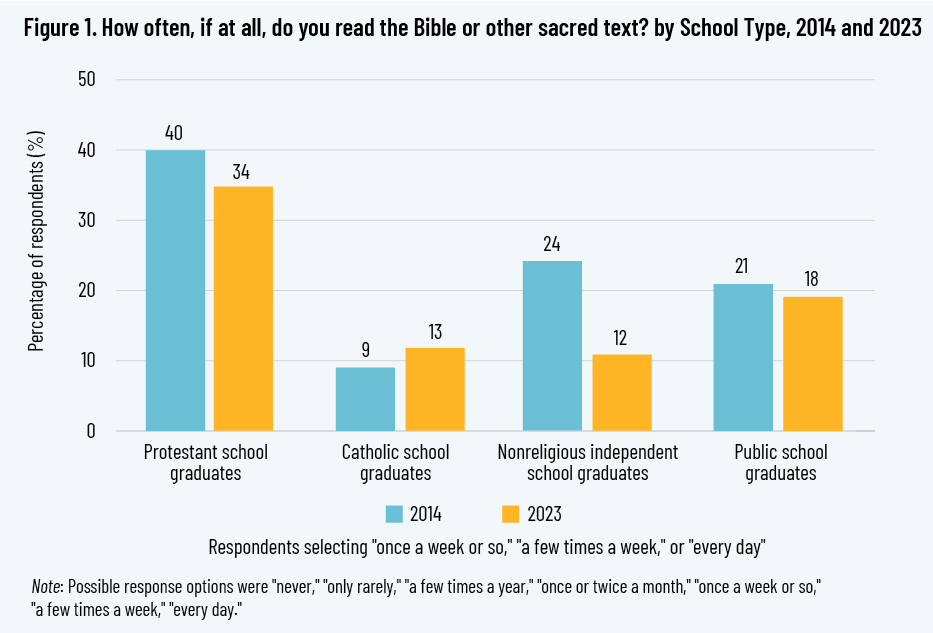
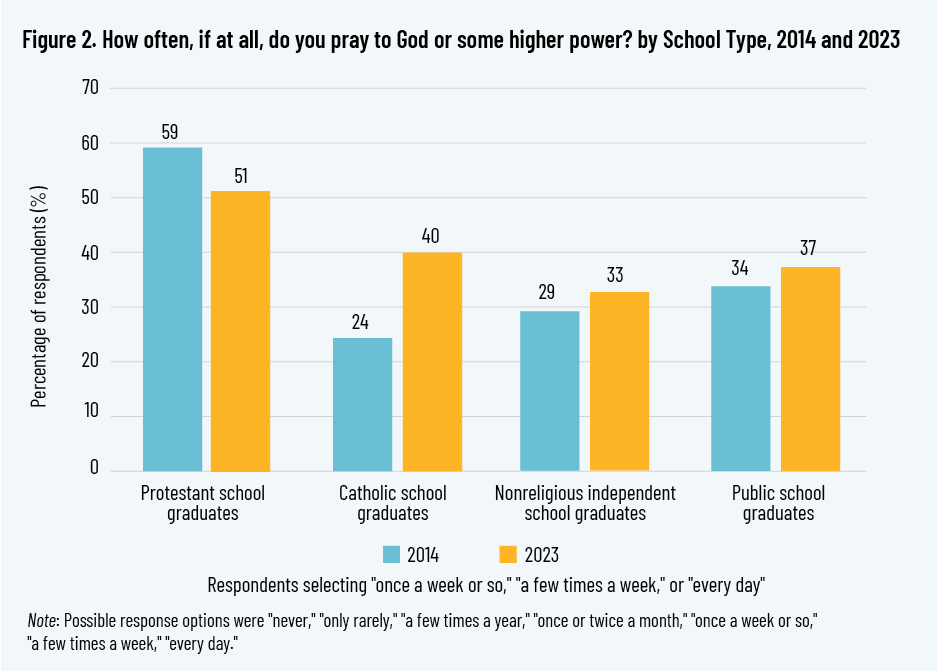
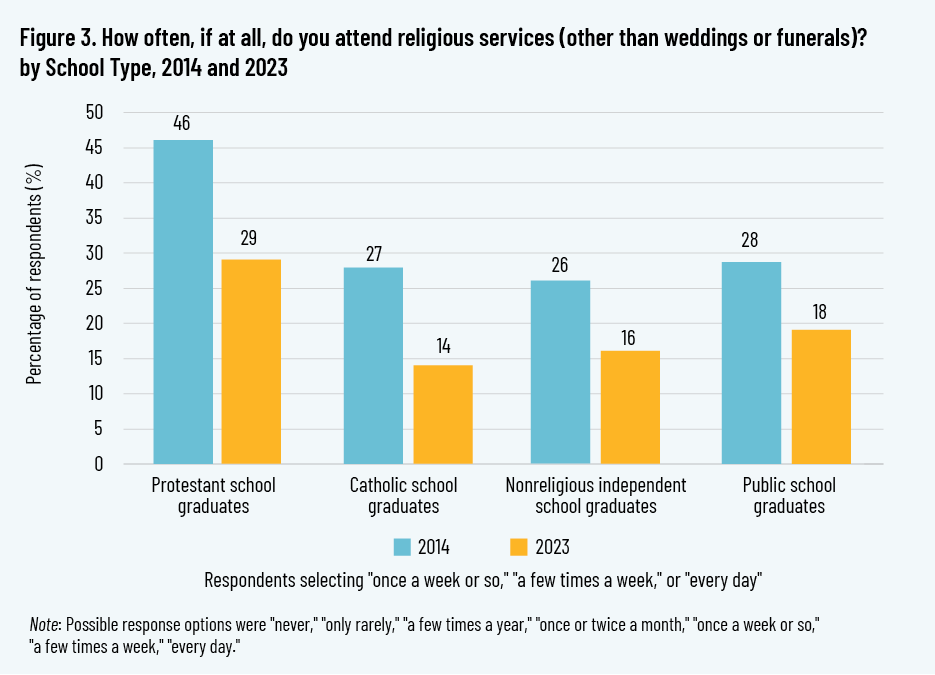
This suggests that Protestant Christian school graduates maintain a relatively higher likelihood of engaging in core religious practices, as compared with their peers from other school sectors. However, across the past decade, patterns of religious engagement have notably declined across school sectors. While still engaging in these practices more frequently than their counterparts from other school sectors, Protestant school graduates showed consistent declines in all three practices, especially religious service attendance. Graduates of the three other school sectors (Catholic, independent, and public) also exhibited a decline in religious service attendance from 2014 to 2023. Catholic school graduates appear to have increased rates of Bible reading and prayer during these years, while public school graduates’ rates of prayer increased and Bible reading decreased.
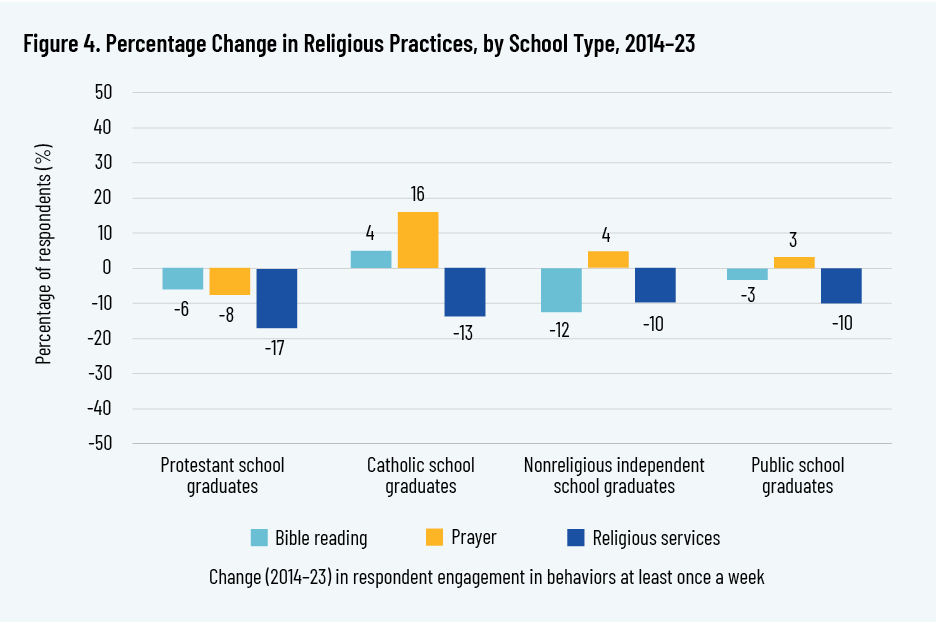
While the CES does not allow for causal inferences as to why these changes between 2014 and 2023 occurred, these findings are considered in the discussion section with regard to COVID-19 and technological trends that might have influenced graduates’ experiences and religious practices. Even so, declines in religious identification and engagement have been observed in the US since the early 2000s, well before the COVID-19 pandemic. 15 15 Uecker et al., “Losing My Religion”; Smith et al., “Decline of Christianity in the U.S. Has Slowed, May Have Leveled Off.”
Strength of Religious Preparation
In addition to frequency of religious practices across sectors, a second analysis examines these practices in light of graduates’ responses on the 2023 survey to the Likert-type item, “How well would you say that your high school prepared you for having a vibrant spiritual or religious life?” 16 16 This analysis was conducted for 2023 only, as the same question and answer choices did not appear on the 2014 survey (thus precluding a comparison of 2014 and 2023 findings). This analysis attempts to map the differences in graduate practices relative to the strength of their schools’ religious preparation, within a given sector. In other words, Protestant Christian and Catholic schools all have a religious dimension to their mission but may vary in the degree to which that mission is emphasized or translates successfully into a curricular and programmatic focus, as far as graduates’ perceptions are concerned.
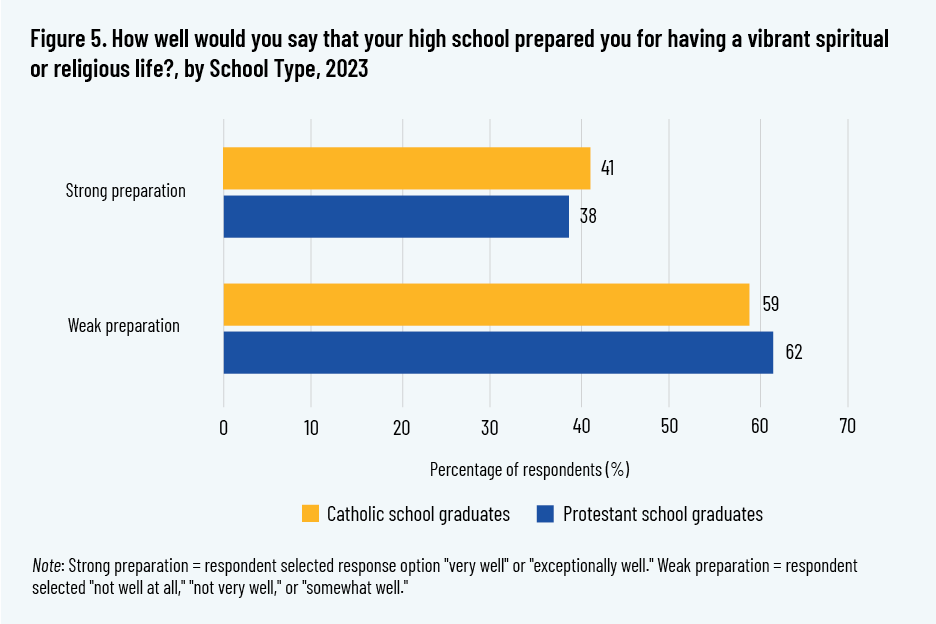
Respondents had five options from which they could select: “Very well” and “exceptionally well” were grouped together (“Strong Preparation”) and then compared with those who selected “not well at all,” “not very well,” or “somewhat well” (“Weak Preparation”). Less than half of respondents thought their school prepared them for having a vibrant spiritual or religious life, though that number was slightly higher among Catholic school graduates (41 percent) as compared to graduates from Protestant schools (38 percent).
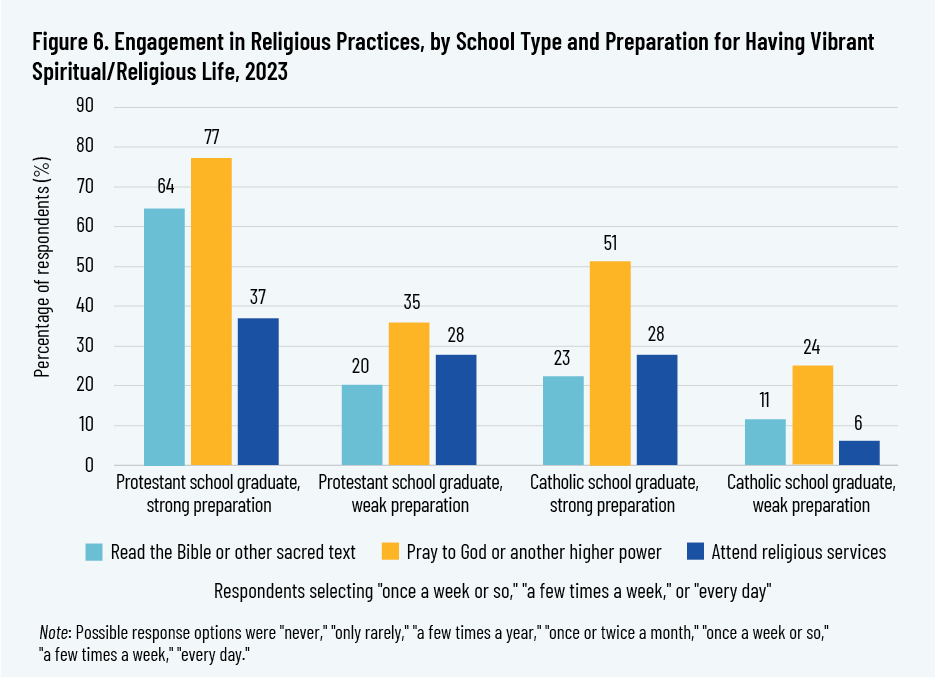
With these two groups defined (by graduates who reported their schools offered a “Strong Preparation” or a “Weak Preparation” for a vibrant spiritual or religious life), three religious practices were examined: the frequency each group reported for reading the Bible or a sacred text, praying, and attending religious services (other than weddings or funerals). For all three of these practices, respondents in the “Strong Preparation” groups were much more likely to engage in these practices at least once a week, though the difference was more pronounced for Protestant school than Catholic school graduates (with Protestant school graduates in the “Strong Preparation” group reporting the highest levels of engagement).
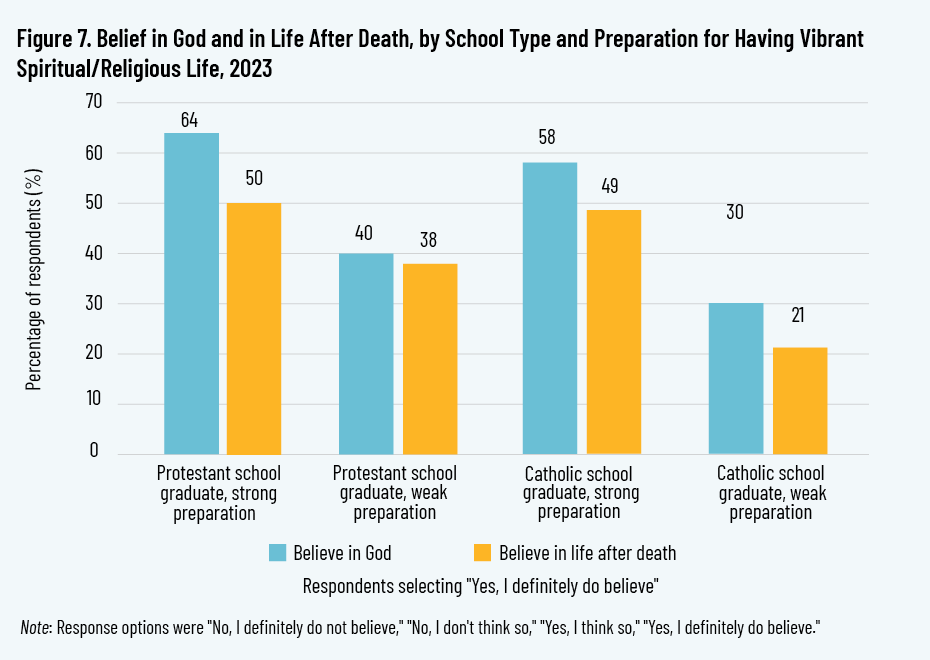
In addition to religious practices, the 2023 CES asked about respondents’ belief in God and life after death. Respondents in the “Strong Preparation” groups were much more likely to say “Yes, I definitely do believe” for both. Protestant school graduates in the “Strong Preparation” group more frequently reported “Yes, I definitely do believe” (64 percent believing in God, and 50 percent believing in life after death) than did Catholic school graduates in the “Strong Preparation” group (at 58 and 49 percent, respectively).
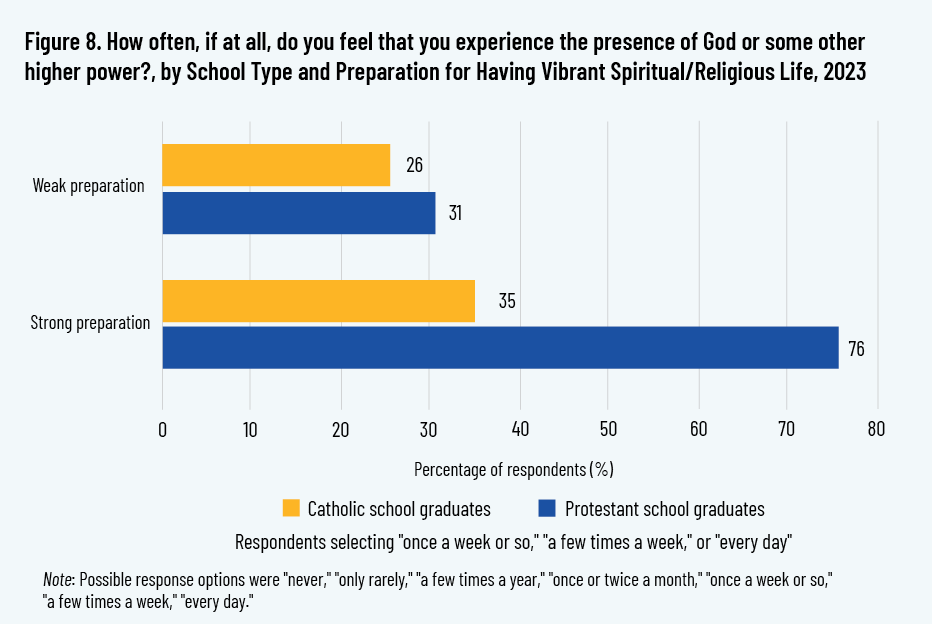
The CES also asked respondents how often they felt God’s presence. Graduates in the “Strong Preparation” groups for both Protestant and Catholic schools were notably more likely to report feeling God’s presence on at least a weekly basis, as compared with their counterparts from the “Weak Preparation” groups. Again, Protestant school graduates in the “Strong Preparation” group more frequently reported feeling God’s presence (76 percent) than did Catholic school graduates in the “Strong Preparation” group (35 percent).
Finally, the two groups were compared in terms of how important they felt the values of religion, marriage, and having children were to them personally. For each, they were able to select from the response options “very unimportant,” “moderately unimportant,” “slightly unimportant,” “slightly important,” “moderately important,” and “very important.” Graduates in the “Strong Preparation” groups for both Protestant and Catholic schools were significantly more likely to rank each of these values as “very important” to them personally, as compared with their counterparts from the “Weak Preparation” groups. Once again, the difference for Protestant school graduates was greater than for Catholic school graduates, in the positive direction.
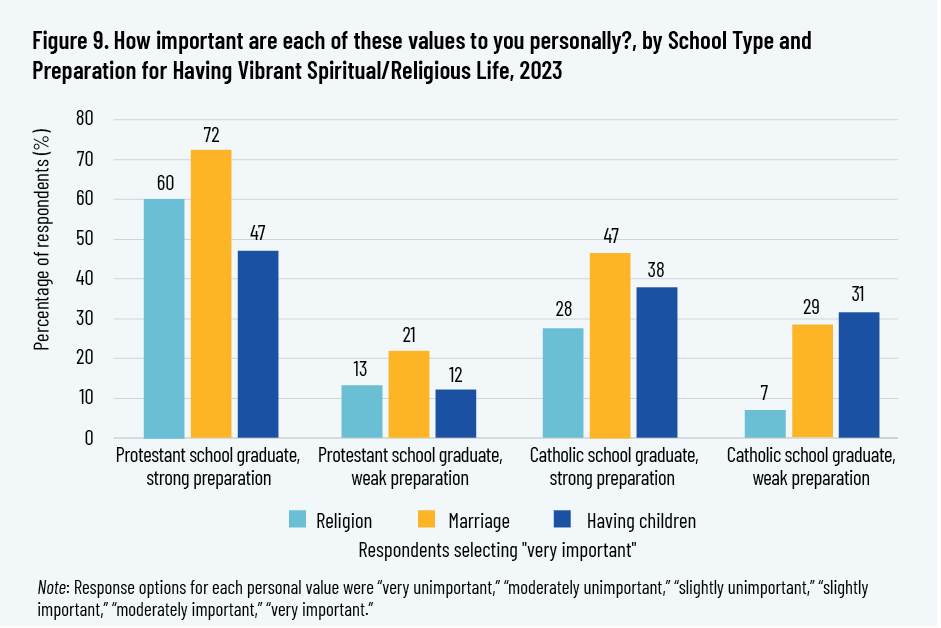
It should be reiterated that all analyses for these two groups (“Strong Preparation” and “Weak Preparation”) in each religious school sector controlled for respondents’ demographic background characteristics, including respondents’ religious identity while growing up. This means that any differences observed could be attributable, at least in part, to difference in schools’ strength of spiritual or religious preparation rather than those background characteristics. However, this does not eliminate the possibility of endogenous effects being at play in these results. That is to say, respondents may feel well prepared by their schools because of their high frequency of religious practice, rather than respondents having a high frequency of religious practice because their schools truly prepared them well. Although this report opts for the latter interpretation, alternate interpretations and applications of these findings are plausible and offer opportunities for further research.
Discussion
Across nearly a decade of Cardus Education Survey data, the Protestant school sector continues to demonstrate a consistent advantage in graduates’ long-term patterns of religious belief and practice. This finding has remained remarkably stable since 2011, even after controlling for a broad range of demographic characteristics, with Protestant school graduates remaining the most likely to engage regularly in prayer, Bible reading, and religious service attendance. The consistency of these results over time points to a distinctive capacity of Protestant schools to shape graduates’ spiritual lives well into adulthood, suggesting that these schools’ formative environments continue to foster durable habits of faith.
At the same time, the longitudinal comparisons between 2014 and 2023 reveal notable declines in certain forms of religious engagement, particularly in religious service attendance. These declines mirror national and global trends in organized religious participation, 17 17 Pew Research Center, “About Three-in-Ten U.S. Adults Are Now Religiously Unaffiliated”; Wiertz and Lim, “The Rise of the Nones Across the United States, 1973 to 2018.” accelerated by the social disruptions of the COVID-19 pandemic. 18 18 Pew Research Center, “Faith After the Pandemic”; Jones, “Church Attendance Has Declined in Most U.S. Religious Groups.” When it comes to religious service attendance (the practice for which the steepest declines were observed), prolonged restrictions on gatherings likely disrupted religious attendance patterns, with some religious adherents not resuming regular participation even after restrictions lifted. The parallel rise of digital and mediated religious engagement (e.g., livestreamed services, podcasts) may also have reshaped how individuals practice their faith. Interestingly, while Protestant school graduates remain comparatively more engaged than peers from other sectors, they too experienced declines in attendance, suggesting that larger cultural and technological shifts such as secularization, distrust of institutions, social isolation, and individualism are influencing even the most religiously active populations. 19 19 Twenge et al., “Declines in American Adults’ Religious Participation and Beliefs”; Uecker et al., “Losing My Religion.” These factors deserve attention from Protestant and other religious schools, if religious formation is a central part of their educational mission. Meanwhile, Catholic school graduates’ modest increases in prayer and Bible reading may reflect renewed lay devotional movements or access to new forms of digital spiritual content during the same period.
The within-sector analysis of schools’ strength of religious preparation may provide insight into how schools’ programs may contribute to long-term graduate outcomes. Respondents who reported that their schools prepared them well for a vibrant spiritual or religious life also exhibited higher rates of belief, practice, and religious and familial values alignment (with the highest rates observed among Protestant school graduates). This suggests that the degree to which a school’s religious mission is intentionally integrated into programs and curricula may matter significantly for enduring faith outcomes. In other words, it is likely not merely a school’s religious affiliation but the strength of its formative culture that shapes graduates’ lifelong spiritual engagement. These findings are tempered by the possibility of endogenous effects, where graduates who remain active in faith communities may retrospectively attribute stronger formation to their schools. Nonetheless, the patterns observed here suggest meaningful within-sector variation that deserves further empirical study on the relationship between mission strength and graduate outcomes.
Taken together, these findings affirm that faith-based education continues to exert a lasting formative influence on graduates’ lives, even amid broader cultural secularization and shifts in religious practice. Yet they also point to the importance of intentionality: Schools that most deeply and coherently live out their mission are likely best equipped to nurture graduates whose faith endures and flourishes into adulthood.
References
Allport, G.W., and J.M. Ross. “Personal Religious Orientation and Prejudice.” Journal of Personality and Social Psychology 5, no. 4 (1967): 432–43. https://doi.org/10.1037/h0021212.
Barrett, J.B., J. Pearson, C. Muller, and K.A. Frank. “Adolescent Religiosity and School Contexts.” Social Science Quarterly 88, no. 4 (2007): 1024–37. 10.1111/j.1540-6237.2007.00516.x.
Chen, Y., H.K. Koh, I. Kawachi, M. Botticelli, and T.J. VanderWeele. “Religious Service Attendance and Deaths Related to Drugs, Alcohol, and Suicide Among US Health Care Professionals.” JAMA Psychiatry 77, no. 7 (2020): 737–44. https://doi.org/10.1001/jamapsychiatry.2020.0175.
Glock, C.Y., and R. Stark. Religion and Society in Tension. Rand McNally, 1965.
Jeynes, W.H. “A Meta-Analysis of the Effects of Attending Religious Schools and Religiosity on Minority Students’ Achievement.” Education and Urban Society 35, no. 1 (2002): 27–49.
Jeynes, W.H. “A Meta-Analysis on the Effects and Contributions of Public, Public Charter, and Religious Schools on Student Outcomes.” Peabody Journal of Education 87, no. 3 (2012): 305–35.
Jones, J.M. “Church Attendance Has Declined in Most U.S. Religious Groups.” Gallup News, March 25, 2024. https://news.gallup.com/poll/642548/church-attendance-declined-religious-groups.aspx.
Koenig, H.G., and A. Büssing. “The Duke University Religion Index (DUREL): A Five-Item Measure for Use in Epidemiological Studies.” Religions 1, no. 1 (2010): 78–85.
Koenig, H.G., D.E. King, and V.B. Carson. Handbook of Religion and Health. 2nd ed. Oxford University Press, 2012.
Li, S., M.J. Stampfer, D.R. Williams, et al. “Religious Service Attendance and Mortality Among Women.” JAMA Internal Medicine 176, no. 6 (2016): 777–85.
Pennings, R., D. Sikkink, and A. Berner. “Cardus Education Survey 2014: Private Schools for the Public Good.” Cardus, 2014. https://www.cardus.ca/research/education/research-report/cardus-education-survey-2014-private-schools-for-the-public-good/.
Pew Research Center. “About Three-in-Ten U.S. Adults Are Now Religiously Unaffiliated.” December 14, 2021. https://www.pewresearch.org/religion/2021/12/14/about-three-in-ten-u-s-adults-are-now-religiously-unaffiliated/.
Pew Research Center. “Faith After the Pandemic: How COVID-19 Changed American Worship.” NORC at the University of Chicago, 2022. https://www.norc.org/research/projects/faith-after-the-pandemic-how-covid-19-changed-american-worship.html.
Smith, C., and M.L. Denton. Soul Searching: The Religious and Spiritual Lives of American Teenagers. Oxford University Press, 2005.
Smith, G., A. Cooperman, B. Alper, et al. “Decline of Christianity in the U.S. Has Slowed, May Have Leveled Off.” Pew Research Center, 2025. https://www.pewresearch.org/religion/2025/02/26/decline-of-christianity-in-the-us-has-slowed-may-have-leveled-off/.
Swaner, L.E., A. Cheng, and J. Eckert. “School-Sector Influence on Graduate Outcomes and Flourishing: Findings from the 2023 Cardus Education Survey.” Cardus, 2024. https://www.cardus.ca/research/education/reports/school-sector-influence-on-graduate-outcomes-and-flourishing/.
Twenge, J.M., R.A. Sherman, J.J. Exline, and J.B. Grubbs. “Declines in American Adults’ Religious Participation and Beliefs, 1972–2014.” Sage Open 6, no. 1 (2016). https://doi.org/10.1177/2158244016638133.
Uecker, J.E., M.D. Regnerus, and M.L. Vaaler. “Losing My Religion: The Social Sources of Religious Decline in Early Adulthood.” Social Forces 85, no. 4 (2007): 1667–92.
VanderWeele, Tyler J. “Religious Service Attendance and Health: A Review and Assessment of Causal Pathways.” American Journal of Epidemiology 191, no. 4 (2022): 621–30.
Wiertz, D., and C. Lim. “The Rise of the Nones Across the United States, 1973 to 2018: State-Level Trends of Religious Affiliation and Participation in the General Social Survey.” Sociological Science 8 (2021): 429–54.